Water Soluble Fertilizer for Fertigation: Formulation Guide
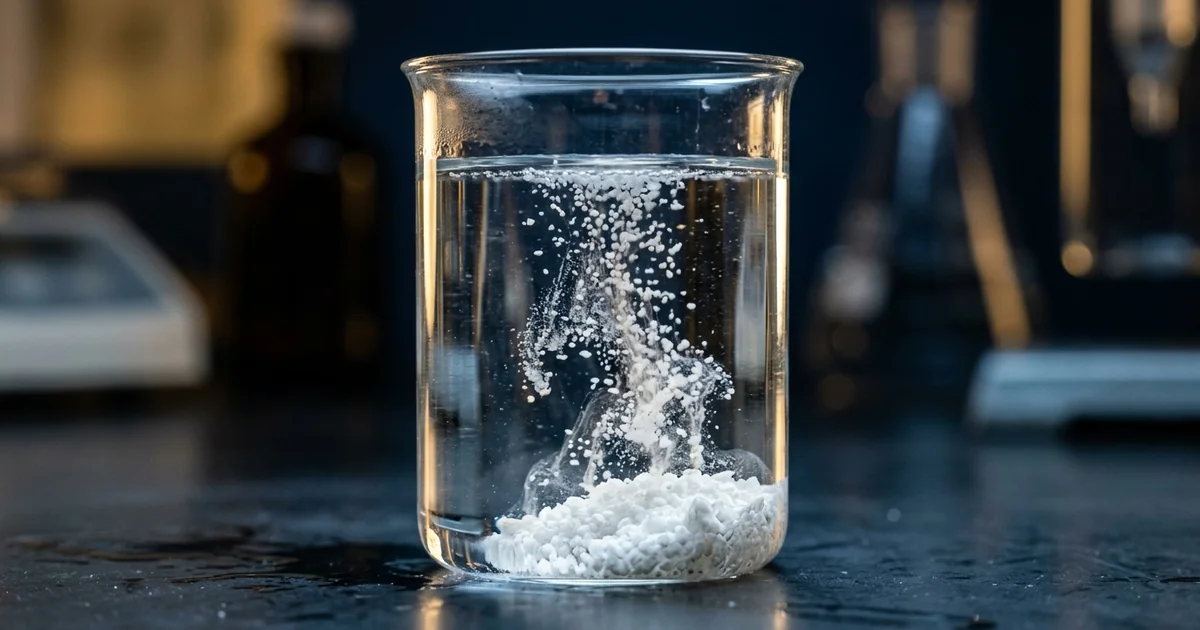
A grower injects a stock solution into a drip line and, within weeks, white deposits and slow emitters follow. The bag said water soluble fertilizer, but a solution that looks clear in the tank can still precipitate in the line. Emitter clogging is one of the greatest problems in drip irrigation, according to the IFA and International Potash Institute fertigation handbook, and the cause often sits in solution chemistry. This guide explains what 100 percent water soluble means in specification terms and how a formulator tests for it. Temperature, tank chemistry and irrigation water decide whether the product stays dissolved, and each gets its own section. Sources are that handbook, university extension publications, a South African research information sheet and India's Fertiliser (Control) Order, with formulation support from Global Formulation.
What a 100 Percent Water Soluble Fertilizer Means in Practice
The phrase 100 percent water soluble fertilizer sounds absolute, but in a specification it is a defined limit. India's Fertiliser (Control) Order, 1985 lists a separate group of 100 percent water soluble complex fertilisers in Schedule I. Most entries in that group carry a cap on matter insoluble in water, and several carry a cap on moisture. The numbers show what a formulator must deliver and what a buyer can verify.
| Schedule I Product | Matter Insoluble in Water, Maximum (% by weight) | Other Limits Worth Noting |
|---|---|---|
| Potassium nitrate (13-0-45) | 0.05 | All nitrogen as nitrate; sodium and total chloride capped |
| Calcium nitrate | 1.5 (listed as water insolubles) | Ammoniacal nitrogen capped |
| Mono ammonium phosphate (12:61:0) | 0.5 | Moisture and sodium (as NaCl) capped |
| NPK 19:19:19 | 0.5 | Nitrogen limited by form: nitrate, ammoniacal and urea; moisture capped |
| NPK 20:20:20 | 0.5 | Nitrogen limited by form; very low sodium (as NaCl) cap |
| NPK 13:40:13 | 0.5 | Nitrate nitrogen capped, ammoniacal nitrogen has a floor |
| Mono potassium phosphate (0-52-34) | No insoluble limit listed | Moisture and sodium (as NaCl) capped |
Four points follow from the schedule:
- Soluble is a specification, not an adjective — the NPK grades allow ten times the insoluble matter that potassium nitrate allows.
- Nitrogen form is controlled — nitrate, ammoniacal and urea nitrogen are limited separately, so a formulator sources forms and not just a total.
- Sodium and chloride are capped — salt carried in with the raw materials is part of the quality definition.
- The regulatory route differs — clause 13 excludes liquid fertilisers and 100 percent water soluble fertilisers containing N, P and K from the State mixture standards.
Our guide to NPK fertilizer formulation, grades and manufacturing covers grade arithmetic, granulation and the wider Indian rules, so this article stays with the dissolved product. A specification that tolerates some residue leaves the formulator to decide what matters to a drip emitter, and that depends on what happens in the tank.
Water Soluble Fertilizer Solubility: Temperature and Dissolution
Drip irrigation fertilizer solubility is a hard requirement, not a preference. The IFA handbook calls high and complete solubility a prerequisite for fertilizers used in fertigation. Solubility generally rises with temperature, but the rise differs by salt, so a stock solution made on a warm afternoon can precipitate on a cold night. The figures below show how large that difference is.
| Salt | At 10 °C | At 20 °C | At 40 °C |
|---|---|---|---|
| Potassium nitrate | 21 | 31 | 46 |
| Potassium chloride | 31 | 34 | 37 |
| Potassium sulfate | 9 | 11 | 13 |
| Ammonium nitrate | 158 | 195 | 242 |
| Urea | 84 | 105 | 133 |
Values are approximate grams of product per 100 g of water, from Table 1.3 of the handbook. Potassium nitrate loses a third of its capacity between 20 °C and 10 °C, while potassium chloride loses less than a tenth. The handbook adds that potassium nitrate can precipitate in the tank at low night temperatures, so containers left in the open overnight need care.
- Endothermic dissolution — potassium nitrate, calcium nitrate, urea, ammonium nitrate and potassium chloride cool the tank as they dissolve. Added in the cold early morning, part of the solution can freeze and change the concentration.
- Ample water — the handbook says nurse-tank problems are avoided by adding ample water to the stock solution. The South African Sugarcane Research Institute advises filling the tank halfway and adding fertilizer under stirring to prevent insoluble lumps.
- Colder water, smaller capacity — the institute notes that injector capacity must rise as water temperature falls, because less fertilizer dissolves per litre.
Dissolution sets how much can be put into a tank, and the next question is what stays dissolved once several products share it.
Fertigation Formulation Compatibility and the Two-Tank Rule
Two soluble fertilizers can form an insoluble product when they meet. Calcium is the usual culprit, because it forms poorly soluble salts with phosphate and sulfate. The IFA handbook advises against mixing calcium-containing solutions with solutions containing phosphates or sulfates unless the pH is sufficiently acidic. The University of Florida gives a concrete case: calcium nitrate and diammonium phosphate form insoluble calcium phosphate that clogs lines and emitters.
| Pair in the Same Tank | Rating in the IFA Compatibility Chart |
|---|---|
| Calcium nitrate with ammonium phosphate | Incompatible |
| Calcium nitrate with potassium sulfate | Incompatible |
| Calcium nitrate with magnesium sulfate | Incompatible |
| Calcium nitrate with ammonium sulfate | Incompatible |
| Calcium nitrate with iron, zinc, copper or manganese sulfates | Incompatible |
| Ammonium phosphate with magnesium sulfate | Incompatible |
| Calcium nitrate with micronutrient chelates | Reduced compatibility |
| Nitric acid with micronutrient chelates | Incompatible |
The South African Sugarcane Research Institute turns the chart into a working rule. Products that contain sulfates are incompatible with products that contain calcium, and products that contain phosphates are incompatible with products that contain calcium or magnesium. Such products are injected separately from separate tanks, which gives the familiar two-tank layout:
- Tank A — no phosphates or sulfates. Typical contents are potassium nitrate, calcium nitrate, urea, ammonium nitrate and micronutrients.
- Tank B — no calcium. Typical contents are mono ammonium phosphate, mono potassium phosphate, potassium sulfate, magnesium sulfate and phosphoric acid, with potassium nitrate, urea and ammonium nitrate common to both.
No chart replaces a test. The handbook suggests mixing 50 mL of the fertilizer solution with 1 L of the irrigation water and watching for precipitate over one to two hours. The University of Florida describes the same jar test at field dilution for about two hours, and says milkiness means clogging will follow. Our article on tank-mix compatibility testing for agrochemicals covers the same logic for crop protection products. Compatibility inside the tank is one half of the problem, and the water that carries the solution is the other.
Irrigation Water Chemistry and Emitter Clogging
A fertilizer is only half of a fertigation system, because the irrigation water is the second reactant. Hard water carrying calcium, magnesium and bicarbonate raises the clogging hazard, especially when phosphate fertilizers are injected. The University of Florida traces clogging to either the water supply or the injected fertilizer. A product designed without the water analysis in view can fail on first use.
| Water Factor | Hazard | Threshold Reported in the Literature |
|---|---|---|
| pH and bicarbonate | Calcium carbonate scale | More likely above pH 7.5 with bicarbonate above 5 mmol/L (IFA) |
| Water pH for fertigation | Phosphate and carbonate precipitation | Ideal range 5.6 to 6.2; precipitation risk above 7.5 (SASRI) |
| Phosphate with calcium or iron | Calcium and iron phosphate precipitates | Form quickly above pH 5.5 for calcium and above pH 4 for iron (IFA) |
| Ferrous iron | Iron slime, helped by iron bacteria | Above about 0.5 g Fe per m³ the water should not be used unless treated (IFA) |
| Suspended solids | Physical plugging | Clogging likely above 50 ppm, severe above 100 ppm (UF/IFAS) |
| Bacteria | Biofilm slime | Likely above 2,600 CFU per gallon, severe above 13,200 (UF/IFAS) |
Two product-side effects add to the water-side hazards. Polyphosphate fertilizers form gel suspensions with calcium and magnesium at certain concentrations, and the handbook lists the minimum polyphosphate level that prevents gelling at each calcium level. The institute also notes that alkaline solutions, such as urea injected into water high in calcium and bicarbonate, cause lime to precipitate.
The University of Florida publication on fertigation clogging lists the remedies in order: filter the water, acidify it, chlorinate where bacteria are the cause, and confirm compatibility before injecting. Acidifying water carries its own rules, which depend on the phosphate source, as the next section shows.
Phosphate Sources, Acidifiers and Line Cleaning
Phosphorus is the nutrient most sensitive to water quality in fertigation. The IFA handbook says phosphate fertilizers precipitate with calcium and magnesium in the line when the pH is above 7, and with iron at low pH. Each phosphate source also changes the acidity of the stock solution, so source choice is a formulation decision. Six forms recur in the handbook and the extension literature, and Table 5.1 of the handbook compares the acidity of five of them.
- Phosphoric acid — cleans fertigation lines of inorganic precipitates and opens clogged drippers while it supplies phosphorus. The University of Florida warns that it can precipitate with calcium in the water, so it is not injected into water high in calcium.
- Urea phosphate — a dry crystalline acid and a concentrated acidifier. The handbook says its acidity helps keep tank solutions clear and prevents clogging.
- Mono potassium phosphate — leaves very low salt residues and is non-corrosive, and the handbook reports insolubles below 0.1 percent.
- Acidulated mono potassium phosphate — a blend with phosphoric acid introduced to raise acidity and prevent phosphorus precipitation when hard water is the source.
- Mono ammonium phosphate — a common field source in fertigation grade, which in hydroponic systems helps hold an acidic solution pH where ammonium is not toxic to the plants.
- Ammonium polyphosphate — gels with calcium and magnesium unless its concentration is high enough to sequester the calcium.
| Phosphorus Source | pH of a 1% Solution | Handbook Comment on Metal Parts |
|---|---|---|
| Phosphoric acid | 0 | Avoid metal parts |
| Urea phosphate | 1.8 | Avoid metal parts |
| Acidulated mono potassium phosphate | 2.2 | Avoid metal parts |
| Mono potassium phosphate | 4.5 | Safe to metal parts |
| Mono ammonium phosphate | 4.3 to 4.5 | Safe to metal parts |
When a line has already scaled, acid is the remedy. The University of Florida notes that cleaning needs to break up and flush out deposits, not dissolve every trace, and that citric acid soaking cleans calcium- or iron-fouled emitters. The handbook adds that once iron phosphate has formed, flushing with nitric acid is the only way to restore delivery. Acid is always added to water and never the reverse, and the system is flushed for half an hour afterwards.
Phosphate chemistry decides acidity, and acidity decides how much salt and corrosion the product brings with it.
Salt Residues, Chloride and Corrosivity
Every dissolved fertilizer adds salt to the root zone, and the crop decides how much is tolerable. The IFA handbook gives electrical conductivity values beyond which growth falls, from 7 dS/m for sugar beet to 2.5 dS/m for tomato and 1.7 dS/m for some orange rootstocks. Product choice therefore matters most in saline water or with sensitive crops. The same salts also attack the equipment that delivers them.
- Mono potassium phosphate — the handbook calls it especially suitable for open-field agriculture with saline water because of its very low salt residues.
- Potassium sulfate — widely used under saline conditions, but only where the water is soft. High calcium in the water gives gypsum in the lines.
- Chloride and sodium — the Indian schedule caps sodium (as NaCl) in every soluble NPK grade and total chloride in potassium nitrate, which makes salt carry-over a specification item.
- Corrosivity — the handbook's Table 1.2 rates both ammonium phosphates as corrosive to carbon steel and potassium nitrate as corrosive to metals. It rates ammonium nitrate as corrosive to galvanised iron and brass. Its phosphorus table calls mono ammonium phosphate safe to metal parts, so test against the actual equipment.
- Equipment materials — the institute names stainless steel, Teflon, uPVC, polyethylene and polystyrene as the most corrosion-resistant, and warns that acidic products attack metal and asbestos cement.
Salt and corrosion limits are part of the product claim, and a formulator who documents them gives the buyer a reason to choose one source over another. Purity is the next lever, because the same nutrient can arrive with very different insoluble loads.
Product Design: Single Salts, Blends and Liquids
A fertigation product is designed backwards from the water it will meet. The designer starts with the crop programme and the likely water, then picks salts whose purity, acidity and compatibility fit. Purity matters because the same nutrient can arrive with very different insoluble loads. The handbook's shipping analyses show how far apart sources can be.
| Source | Reported Insolubles (%) | Solution pH and Comment |
|---|---|---|
| Mono potassium phosphate | Below 0.1 | pH 5.5 ± 0.5; non-corrosive |
| Potassium nitrate | 0.1 | Solution cools as it dissolves |
| Ammonium sulfate | 0.5 | pH 4.5; corrosive to mild steel |
| Potassium chloride | 0.5 | pH 7.0 to 9.0 |
| Potassium sulfate | 0.4 to 4 | pH 8.5 to 9.5; range across sources of supply |
| Mono ammonium phosphate | 11 | pH 4.5; corrosive to carbon steel |
| Diammonium phosphate | 15 | pH 7.6; corrosive to carbon steel |
The figures come from Table 1.2 of the handbook, adapted from a 2000 Primary Industries publication, and describe the materials listed there. The handbook's phosphorus table lists mono ammonium phosphate as fertigation grade, so the grade of every raw material has to be specified. Beyond purity, five design decisions shape the range:
- Nitrogen and anion forms — nitrate, ammoniacal and urea nitrogen behave differently in water, and the sulfate or chloride content has to match the expected water.
- Calcium stays separate — calcium nitrate is its own Schedule I entry and is not pre-blended with phosphates or sulfates.
- Micronutrient protection — trace elements are commonly applied as chelates, and the institute notes they decompose in strongly acid mixtures.
- Moisture control — the schedule caps moisture in several entries, so packaging and storage are part of the product. Our NPK guide covers the humidity behaviour of fertilizer salts.
- Solid or liquid — solid sources are typically cheaper for large-scale field work, but they need ample water, and some salts cool the tank as they dissolve. Ready-to-use liquids avoid that cooling and allow slightly higher nutrient concentrations.
For a small producer, the equipment and licensing questions are covered in our guide to starting a liquid fertilizer manufacturing unit. A designed range still has to be proved on the bench, which is the subject of the next section.
Quality Control: Insolubles, Clarity and Jar Tests
A water soluble fertilizer is accepted or rejected by what it leaves behind. Insoluble matter, clarity after dissolution and behaviour in real water are the checks that predict clogging. Each is cheap to run and can be written into a specification. The sequence below follows the specifications and extension protocols cited in this article.
- Moisture and insoluble matter — measure both against the product specification, using the Indian schedule limits as the reference for water soluble NPK grades.
- Dissolution and clarity — dissolve the product in ample water under stirring, as the institute advises, and look for lumps and turbidity. Record the temperature change for the endothermic salts.
- Cold hold — keep the stock solution at the lowest expected night temperature and look for crystals. The handbook notes that potassium nitrate can precipitate in tanks at low night temperatures.
- Fertigation jar test in local water — add the solution to a jar of the irrigation water at field dilution and watch for cloudiness for one to two hours. If two products are injected, mix them in the jar as well.
- pH and conductivity of the working solution — check them against the acidity limits for chelates and the salinity limits for the crop.
The jar test deserves the most attention because it is the closest bench match to what the emitter sees. A product that passes it with the hardest, highest-pH water of the target market has real evidence behind its compatibility claim. Writing those checks into a technical sheet turns a label claim into a specification a buyer can hold.
Working With an Agrochemical Formulation Consultant
Decisions at the bench decide how a fertigation product behaves in a field tank. A product that clogs in hard water, cakes in the bag or fails the first jar test traces back to early choices about raw materials and blend design. An agrochemical formulation consultant tests those choices against realistic waters before launch. Agrochemical product development services then carry the work through documentation, scale-up and supply.
- Raw material specification — grades, insoluble limits and nitrogen forms matched to the target market and to the Indian schedule where it applies.
- Compatibility mapping — tank A and tank B layouts, acid and chelate limits, and jar tests in the hardest target waters.
- Temperature and storage studies — dissolution cooling, cold-hold behaviour and moisture control in the chosen pack.
- Technical sheets — a clear statement of solubility, pH, conductivity and compatibility that a buyer can verify.
- Scale-up and supply — transfer to a contract formulation agrochemical manufacturer with defined quality checks.
The full range of services sits under agro chemicals, and our overview of agrochemical technology and formulations places fertigation products beside the other families. Before committing to a product, collect the target waters' analysis, the crops and the injection equipment in use. Those three inputs shape every decision in this article.
Frequently Asked Questions
What does 100 percent water soluble fertilizer mean?
It is a specification term, not a claim of zero residue. India's Fertiliser (Control) Order lists a group of 100 percent water soluble fertilisers in Schedule I and sets a maximum for matter insoluble in water in most entries.
That maximum is 0.05 percent by weight for potassium nitrate and 0.5 percent for the soluble NPK grades and mono ammonium phosphate. Calcium nitrate is allowed up to 1.5 percent water insolubles.
Why do water soluble fertilizers clog drip emitters?
Clogging comes from either the water or the fertilizer. Hard water with calcium, magnesium and bicarbonate, iron, suspended solids and bacteria all contribute, as does the precipitation of calcium phosphate and calcium sulfate when incompatible fertilizers meet.
The IFA handbook adds that scaling is more likely above pH 7.5 with bicarbonate above 5 mmol/L. Polyphosphate fertilizers can also form a gel with calcium and magnesium.
Can calcium nitrate be mixed with phosphate or sulfate fertilizers?
Not in the same stock tank unless the solution is sufficiently acidic. The IFA compatibility chart rates calcium nitrate as incompatible with ammonium phosphate, potassium sulfate, magnesium sulfate, ammonium sulfate and the sulfates of iron, zinc, copper and manganese.
The usual remedy is the two-tank layout. Calcium products go in one tank and phosphate and sulfate products in the other, and each is injected separately.
Why does the tank get cold when fertilizer dissolves?
Several common fertilizers dissolve endothermically, meaning they absorb heat from the water. The IFA handbook names potassium nitrate, calcium nitrate, urea, ammonium nitrate and potassium chloride.
In cold early morning conditions this can lower the tank temperature enough that part of the solution freezes, which changes the nutrient concentration. Ready-to-use liquid fertilizers avoid the effect in the field.
How do I test whether a fertilizer is compatible with my irrigation water?
Run a jar test. The IFA handbook suggests mixing 50 mL of the fertilizer solution with 1 L of the irrigation water and watching for precipitate over one to two hours.
The University of Florida describes the same test at field dilution for about two hours, and warns that milkiness means clogging will follow. If two products are injected, they should be mixed in the jar as well.
Why are micronutrient chelates kept away from strong acid?
The South African Sugarcane Research Institute notes that micronutrient chelates decompose in strongly acid solutions of most fertilizer mixtures. The IFA compatibility chart also rates nitric acid with chelates as incompatible.
Acid is often added to keep calcium phosphate in solution, so a formulator has to balance the acidity needed for the phosphate against the stability of the chelated micronutrients.
Which phosphorus sources suit hard water?
The IFA handbook describes acidulated mono potassium phosphate as introduced to raise acidity and prevent phosphorus precipitation when hard water is the source. It also describes urea phosphate as a concentrated acidifier that helps keep tank solutions clear.
Phosphoric acid cleans lines of inorganic precipitates, but the University of Florida warns that it can precipitate with calcium, so it is not injected into water high in calcium.
How can an agrochemical formulation consultant help with fertigation products?
A consultant specifies raw materials and insoluble limits, maps compatibility for the target waters, and designs the tank layout and acid and chelate limits. The same team plans temperature, cold-hold and moisture studies for the chosen pack.
The work extends to a technical sheet that a buyer can verify and to technology transfer to a contract formulation agrochemical manufacturer.
Developing a Fertigation Product or Fixing a Clogging Problem?
Global Formulation supports agrochemical and fertilizer manufacturers with water soluble fertilizer formulation, compatibility mapping, technical sheets, scale-up and technology transfer to a contract manufacturing partner.
Talk to Our Formulation Team