Chlorine Dioxide Water Treatment: Generation and Control
A plant that switches from chlorine to chlorine dioxide to cut trihalomethanes often trades one regulated by-product for another. Chlorine dioxide water treatment produces almost no THMs, yet 50 to 70 percent of the chlorine dioxide consumed ends up as chlorite, which has its own limit. The chlorate that forms alongside has no low-cost removal route once it is in the water. That makes the generator, the oxidant demand of the water and the analytical plan more important than the biocide itself. This guide explains how chlorine dioxide works, how generators make it, and how chlorite and chlorate form and are controlled. It also covers measurement, handling, regulatory routes and formulation priorities, drawing on US EPA and WHO primary documents and the product development experience of Global Formulation.
How Chlorine Dioxide Water Treatment Works
Chlorine dioxide behaves differently from chlorine, and the differences explain both its strengths and its limits. It is a neutral molecule of chlorine in the +IV oxidation state that disinfects by oxidation and does not chlorinate. In water it stays as a dissolved gas instead of hydrolyzing, so it is volatile, sensitive to light and best used close to where it is made. The properties below show what that means for a treatment design.
- One-electron oxidant — the EPA guidance manual on alternative disinfectants and oxidants describes a highly selective oxidant that accepts one electron and is reduced to chlorite.
- No appreciable hydrolysis — unlike chlorine gas, chlorine dioxide remains a dissolved gas. The EPA reregistration decision puts its hydrolysis rate about ten million times below that of chlorine at neutral pH.
- Gas at room temperature — the boiling point is 11 °C, and the molecule leaves dilute solutions with minimal aeration.
- Light sensitivity — sunlight and ultraviolet light destroy it, which is why basins exposed to bright light lose residual.
- pH behaviour — it is relatively stable in neutral solutions between pH 4 and 10. Under alkaline conditions it disproportionates to chlorite and chlorate.
EPA's manual places the alkaline threshold at pH 9 in one passage and pH 11 in another, and the reregistration decision says above pH 10. Because the sources differ, add the oxidant after any high-pH step such as softening rather than before it. These properties set up a direct comparison with chlorine, the oxidant that chlorine dioxide most often replaces.
Chlorine Dioxide vs Chlorine: What Actually Differs
The case for chlorine dioxide rests on three differences from chlorine: it forms no THMs, its performance depends less on pH, and it penetrates biofilm. Each difference comes with a cost that appears elsewhere in the plant. The table sets the two oxidants side by side using the EPA manual, the WHO fact sheet and the US drinking-water regulations. Read it as a trade of by-products, not a clear win for either side.
| Property | Chlorine Dioxide | Chlorine |
|---|---|---|
| Reaction type | Oxidizes by one-electron transfer; does not chlorinate | Oxidizes and chlorinates organic matter |
| Behaviour in water | Stays as a dissolved gas; no appreciable hydrolysis | The gas hydrolyzes to hypochlorous and hydrochloric acids |
| Effect of pH on disinfection | Much smaller for viruses and cysts between pH 6 and 8.5; often improves as pH rises | Falls as pH rises |
| Organic by-products | No THMs; a small amount of total organic halide | THMs and haloacetic acids from natural organic matter |
| Chlorite and chlorate | Main inorganic by-products of reduction, with chlorite the larger share | Chlorate also forms in hypochlorite solutions stored long or warm |
| US maximum residual disinfectant level | 0.8 mg/L as ClO2 | 4.0 mg/L as Cl2 |
| Biofilm and amoebae | Reported to penetrate biofilm and reach Legionella inside amoebae | Biofilm and amoebae shield organisms |
| Supply | Generated on site; never shipped as a gas | Delivered as gas or hypochlorite solution |
On a mass-dose basis the manual finds chlorine dioxide equal or superior to chlorine against bacteria, and more effective than chlorine against Bacillus spores. It rates chlorine dioxide equal or better for Giardia, while Cryptosporidium is 8 to 16 times more resistant than Giardia. Cooling the water from 20 °C to 10 °C reduced effectiveness against Cryptosporidium by 40 percent, and suspended matter shields organisms further. The biofilm row comes from EPA's summary of Legionella control literature, which also lists taste, odour and corrosion as water quality issues.
How these oxidants sit among cleaning and disinfecting products is covered in our guide to chlorine and oxygen bleach chemistry. The advantage is real, but it holds only if the generator delivers clean chlorine dioxide, and that is a question of chemistry.
Chlorine Dioxide Generator Chemistry and Types
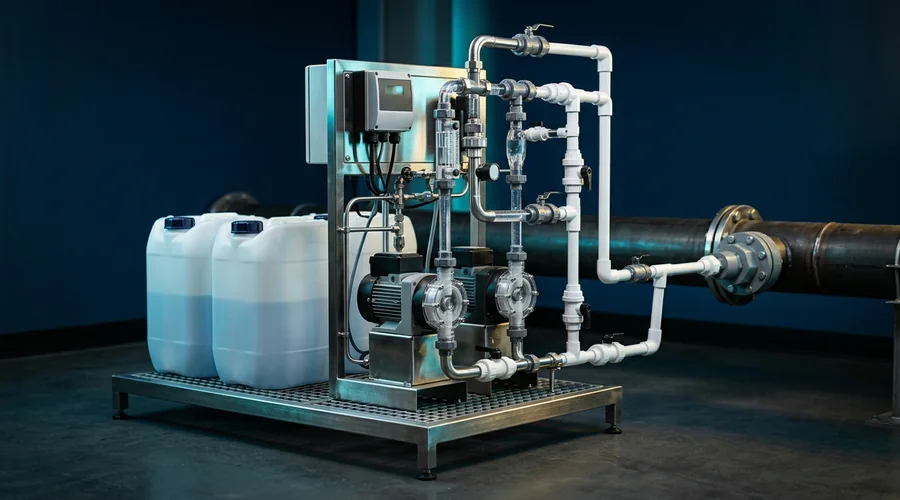
Chlorine dioxide cannot be compressed or stored commercially as a gas because it is explosive under pressure, so every user makes it on site. Most commercial generators use sodium chlorite as the precursor, which is oxidized or acidified under controlled pH and temperature. Three reactions in the EPA manual explain why generators differ even when they use the same chemicals. The table sets them out with the chlorate route that pulp and paper mills have traditionally used.
| Route | Overall Reaction | What It Means in Practice |
|---|---|---|
| Chlorine gas | 2NaClO2 + Cl2 → 2ClO2 + 2NaCl | Fast, with a near-neutral effluent under ideal conditions |
| Hypochlorous acid | 2NaClO2 + HOCl → 2ClO2 + NaCl + NaOH | The sodium hydroxide formed raises pH unless excess chlorine or acid neutralizes it |
| Hydrochloric acid | 5NaClO2 + 4HCl → 4ClO2 + 5NaCl + 2H2O | Four of every five chlorite units become chlorine dioxide, a ceiling of 80 percent |
| Chlorate, peroxide and sulfuric acid | 2NaClO3 + H2O2 + H2SO4 → 2ClO2 + O2 + Na2SO4 + 2H2O | Traditional pulp and paper route, tested at two US municipal plants by 1999 |
The manual groups commercial generators by how they apply those reactions. The yields below are its 1999 figures, so check current supplier data before specifying equipment.
| Generator Type | Chemistry | Reported Yield and Notes |
|---|---|---|
| Acid-chlorite (direct acid) | Chlorite plus hydrochloric acid | Low pH, chlorate possible, slow; yield ceiling about 80 percent |
| Aqueous chlorine-chlorite | Chlorine dissolved in water, then mixed with chlorite | Yield 80 to 92 percent; acidic, corrosive effluent |
| Recycled aqueous chlorine (French loop) | Chlorine held at saturation in a circulating loop | Yield 92 to 98 percent with about 10 percent excess chlorine reported; needs a maturation tank |
| Gaseous chlorine-chlorite | Chlorine gas and about 25 percent chlorite solution in a vacuum ejector column | Yield 95 to 99 percent, under 2 percent excess chlorine, near-neutral effluent |
| Solid chlorite matrix | Humidified chlorine gas through solid chlorite | About 8 percent gaseous chlorine dioxide stream; yield above 99 percent |
| Electrochemical | Chlorite solution through an electrolytic cell | Described as new technology in 1999 |
When chlorine gas is unavailable, the same manual describes combining sodium hypochlorite with hydrochloric acid to form hypochlorous acid before adding chlorite. For food use, 21 CFR 173.300 names three generation methods. They are chlorite with chlorine gas or hypochlorite plus hydrochloric acid, chlorate with hydrogen peroxide and sulfuric acid, and electrolysis of chlorite. The yield column matters because every unit the generator fails to convert reaches the water as chlorite, chlorate or free chlorine.
Yield, Purity and Chlorate Formation in the Generator
A generator that makes 90 percent chlorine dioxide sends the other 10 percent into the treated water as chlorite, chlorate or free chlorine. EPA's manual therefore describes a typical specified yield above 95 percent and puts excess chlorine below 2 percent by weight in the generator effluent. It defines purity from measured concentrations instead of a manufacturer's yield claim, which avoids flow-measurement errors of up to 5 percent. Those two numbers describe a good generator and show what to test at commissioning.
Free available chlorine in the effluent can read as a false chlorine dioxide residual for CT purposes, and it forms chlorinated by-products when it is high. The conditions below raise chlorate in the generator itself.
- Excess chlorine — an excessively high ratio of chlorine gas to chlorite, or an excess of hypochlorous acid, oxidizes chlorite to chlorate instead of chlorine dioxide.
- Free chlorine at low pH — high free chlorine concentrations in acidic aqueous solution.
- Over-dilution — dilute chlorite held at low pH, or weak precursor feed, favours chlorate. This is why generators use about 25 percent chlorite and gaseous or near-saturated chlorine.
- Very low pH — reaction mixtures below pH 3 push the intermediate toward chlorate.
- High pH — base-catalysed disproportionation of chlorine dioxide above pH 11. Caustic stabiliser in the chlorite feed can also raise the mixture pH too far, which slows chlorine dioxide formation and favours chlorate.
Chlorite solutions stronger than about 25 percent, for example 37 percent, are more prone to crystallization or stratification at ambient temperatures as high as 25 °C. Stratified tanks feed too much chlorite first and too little later, which shifts yield. Generators that run intermittent batches at high concentration and cycle often avoid storing the generated solution beyond 24 hours. Even a well-tuned generator cannot stop the chlorite that forms when chlorine dioxide reacts with the water itself, and that chlorite sets the real limit.
Chlorite and Chlorate: The Limit That Sets the Dose
In drinking water, chlorite is the main end product of chlorine dioxide, not an impurity. EPA's manual reports that 50 to 70 percent of the chlorine dioxide consumed converts to chlorite, with the rest forming chlorate and chloride. US rules cap the chlorine dioxide residual at 0.8 mg/L as ClO2 under 40 CFR 141.65 and chlorite at 1.0 mg/L under 40 CFR 141.64. The WHO fact sheet sets provisional guideline values of 0.7 mg/L for both chlorite and chlorate.
Five factors move the chlorite and chlorate balance, according to the manual.
- Dose to demand ratio — the more chlorine dioxide the water consumes, the more chlorite forms.
- Generator blend — the ratio of chlorite to chlorine in the generator decides how much unreacted chlorite or chlorate leaves with the product.
- Sunlight — exposure of treated water raises chlorate, particularly in uncovered basins.
- Secondary chlorine — free chlorine added later for distribution residual oxidizes remaining chlorite to chlorate.
- Feedstock chlorate — chlorate already present in the sodium chlorite carries straight through.
The manual lists the removal options for chlorite in the table below. In an EPA survey of plants using chlorine dioxide, median concentrations were 0.24 mg/L chlorite and 0.20 mg/L chlorate. WHO sets no guideline value for chlorine dioxide itself, because any residual at the tap is reduced to chlorite and chloride on ingestion. Its taste and odour threshold is 0.2 to 0.4 mg/L.
| Removal Option | How It Works | Limits |
|---|---|---|
| Ferrous iron salts | Reduce chlorite to chloride; complete within 3 to 5 seconds at pH 5 to 7 | Excess iron stains below pH 6.5; watch the secondary limit for iron |
| Powdered activated carbon | Adsorption and reduction | Needs relatively high doses at pH 5.5 to 6.5; not cost effective unless used for other purposes |
| Granular activated carbon | Adsorption first, then chemical reduction on the carbon surface | Early breakthrough; chlorate forms if free chlorine reaches the bed |
| Reduced sulfur compounds | Reduce chlorite | Form chlorate or need high doses; the manual calls them not desirable |
Chlorate is the harder problem. WHO notes there is no low-cost option for reducing chlorate once it forms, so control relies on preventing its formation in the generator and its addition from aged hypochlorite. EPA's manual lists chlorate in the sodium chlorite feedstock as a further source. Generator design and feedstock quality therefore carry great weight, and the applications below depend on a demand study first.
ClO2 Disinfection in Municipal and Industrial Water
The same oxidant serves very different jobs, from municipal pre-oxidation to cooling water and process water in pulp mills. The EPA reregistration decision lists its industrial uses, and the guidance manual describes its main water treatment roles. Volatility and light sensitivity shape how it is applied in each. The list covers the uses that matter to suppliers of industrial water chemicals.
- Primary disinfection — CT credit in drinking water. The manual says chlorine dioxide works well in plug-flow pipelines and that CT credit should not be expected through a filter, where no residual remains.
- Taste and odour control — algae, decaying vegetation and phenolic compounds. In conventional plants the manual recommends adding it near the end of or after the sedimentation basin.
- Iron and manganese oxidation — soluble forms precipitate for removal by sedimentation and filtration, and the oxidant is reduced to chlorite. High iron and manganese loads therefore reach the chlorite limit first.
- Industrial processes — the reregistration decision names ammonia plants, pulp mills, oil fields, scrubbing systems, odour control and the electronics industry.
- Cooling and process water — supported use sites include once-through and recirculating industrial cooling water systems and pulp and paper mill water systems.
- Food processing water — 21 CFR 173.300 allows it in poultry processing water. It also allows it in wash water for fruits and vegetables that are not raw agricultural commodities, with a residual cap and a potable rinse or cooking afterwards.
- Pulp bleaching — EPA identifies this non-pesticidal use as the largest use of chlorine dioxide.
Cooling towers aerate the water by design, and the manual notes that turbulent aeration removes chlorine dioxide from dilute solution. EPA's environmental assessment used once-through cooling water as the worst-case discharge and assessed it with sodium chlorite endpoints, because chlorine dioxide converts mostly to chlorite ions in the environment. To reduce acute risk to aquatic organisms, the decision lowered the maximum label rate for that use. Recirculating systems are covered in our guide to cooling tower water treatment. Chlorine dioxide is also among the oxidants that damage RO and NF membranes when misused, as our RO pretreatment guide explains.
Measuring Chlorine Dioxide, Chlorite and Chlorate
Chlorine dioxide is measured with methods that must separate it from chlorine, chlorite and other oxidants, because each interferes with the others. A free chlorine reading can pass as chlorine dioxide, which is why EPA's manual warns about false residuals. The table lists the methods in the 1999 manual with their main interferences. Check the current text of 40 CFR 141.131 for the approved list before relying on it.
| Method | Basis | Interferences and Limits |
|---|---|---|
| DPD colorimetric test kits (SM 4500-ClO2 G) | Coloured oxidation product; instrument detection recommended | Manganese and other oxidants including chlorine; above 0.1 mg/L |
| DPD-glycine (SM 4500-ClO2 D) | Glycine masks free chlorine before the colour reaction | Chlorite slowly, other oxidants; above 0.1 mg/L |
| Amperometric titration, five-step (SM 4500-ClO2 E) | Iodide oxidation with pH control and gas purging | Needs a skilled analyst; suited to generated solution; low levels unreliable |
| Amperometric titration, two-step | Iodide oxidation with pH control | Copper, manganese, nitrite; accounts for free chlorine, chloramine and chlorite species, not chlorate |
| Ion chromatography (EPA 300.0 or 300.1) | Conductivity detection | Measures chlorite and chlorate to about 0.05 mg/L; chlorine dioxide and chlorine species are not detected |
The US rule described in the manual requires systems using chlorine dioxide to sample chlorine dioxide and chlorite daily at the entrance to the distribution system. It adds monthly sample sets inside the distribution system for chlorite. Ion chromatography must be used for routine chlorate monitoring. WHO reports detection limits as low as 0.45 µg/L for chlorite and 0.78 µg/L for chlorate by ion chromatography. A method choice made at design stage prevents disputes later, so the plan belongs in the project file before the generator is ordered.
Storage, Materials and Safe Handling
The hazard is not the dilute solution in the pipe but the gas above it and the chlorite feed beside it. EPA's manual considers chlorine dioxide explosive above 10 percent by volume in air, with an ignition temperature of about 130 °C. Sodium chlorite solutions can release high levels of chlorine dioxide if they are acidified by accident. Design therefore starts with keeping the gas phase, acids and chlorite apart.
- Gas-phase control — keep headspace concentrations below 8 to 10 percent by volume by operating under vacuum or storing under positive pressure, and vent bulk tanks to atmosphere. Solutions below about 10 g/L do not generate an explosion hazard under most ambient conditions.
- Chlorite storage — closed, non-translucent containers away from sunlight and heat. The manual recommends fiberglass-reinforced vinyl ester or HDPE tanks and CPVC piping, and advises against carbon steel and stainless steel piping.
- Incompatibles — acids, organic materials, powdered activated carbon and flammable solvents. Accidental mixing with reducing agents or oxidizable material is a significant hazard.
- Dried chlorite — sodium chlorite must not evaporate to a powder, because the dry product can ignite on contact with combustible materials. Using too much water on a chlorite fire can cause a steam explosion.
- Cold and heat — solutions of 25 percent or more can stratify below 4 °C, and long storage of drums in hot climates causes decomposition.
- Dilution water — near neutral pH and not excessively hard, to avoid calcium deposits in the reactor.
For workers, the NIOSH Pocket Guide lists a time-weighted average of 0.1 ppm and a short-term limit of 0.3 ppm. OSHA's time-weighted average is also 0.1 ppm, and the IDLH value is 5 ppm. Those figures belong in the area monitoring and alarm design. The next section turns from the plant to the regulations that govern what you can sell.
Regulatory Routes for Chlorine Dioxide Products
Chlorine dioxide products sit under several regimes at once: drinking-water rules, pesticide or biocide registration, food additive rules and product standards. In the United States, EPA first registered aqueous chlorine dioxide as a disinfectant and sanitizer in 1967 and registered chlorine dioxide gas as a sterilant in 1988. Sodium chlorite, the usual precursor, is covered by the same reregistration decision. The claim a product makes and the water it treats decide which regime applies.
- US pesticide registration — the 2006 decision covers the antimicrobial uses of chlorine dioxide and sodium chlorite, and its manufacturing-use label language lists the supported use sites.
- Drinking water — 40 CFR 141.65 and 141.64 set the chlorine dioxide and chlorite limits discussed above.
- Food contact — 21 CFR 173.300 requires generator effluent to contain at least 90 percent chlorine dioxide by weight of all chlorine species, per Method 4500-ClO2 E. Our guide to FDA 21 CFR compliance for food contact sanitisers places this among the wider rules.
- Product standards — EN 12671:2016 covers chlorine dioxide generated on site for drinking-water treatment, with composition, test methods and handling rules. EPA's manual refers to AWWA Standard B303 for the sodium chlorite feedstock.
- EU and India — in the EU, antimicrobial products fall under biocide law, summarised in our guide to the EU Biocidal Products Regulation. India's registration route for a chlorine dioxide product was not verified for this article, so confirm it with the competent authority before launch.
The wider logic of disinfectant claims and registrations is explained in our article on sanitizers, disinfectants and cleaners. Registration status then shapes what you can formulate and how you can label it.
Precursor and Kit Products: Formulation Priorities
Most formulation work on chlorine dioxide happens upstream of the generator, in the precursor chemicals and the packaging around them. Generators commonly use sodium chlorite solutions of 25 percent active or less, and the quality of that feed decides how much chlorate reaches the treated water. The aim is a feedstock that stores safely, converts cleanly and carries little chlorate. The priorities below follow from the EPA manual and apply to water and process-water treatment only.
- Feedstock quality — specify chlorate as a controlled impurity in the chlorite and test it by ion chromatography.
- Stabiliser balance — sodium hydroxide is a common stabiliser of chlorite feed, and it can push generator pH too high, slow chlorine dioxide formation and favour chlorate.
- Acid choice — hydrochloric acid is generally preferred in direct-acidification systems, which cap conversion at about 80 percent by stoichiometry.
- Strength and stability — strengths above 25 percent raise the risk of crystallization and stratification at ambient temperatures.
- Packaging — closed, opaque, compatible containers in drums, totes or bulk, because sunlight, ultraviolet light and heat reduce product strength.
- Two-component kits — a kit that pairs chlorite with an acid activator is a direct-acid generator in a bottle. It inherits the 80 percent ceiling and the chlorate risk at very low pH.
Each priority is testable, and each test belongs in the quality specification, not in a laboratory notebook. A partner with water treatment formulation experience can set those specifications before pilot batches are made. The final step is putting the sequence in order.
A Decision Sequence for Chlorine Dioxide Projects
A chlorine dioxide project is easier to defend when the water is characterized before the generator is chosen. The sequence below puts the by-product arithmetic and the regulatory limits ahead of equipment. Its first step is the one EPA's manual recommends before chlorine dioxide is selected as a primary disinfectant. Each step produces a record that supports the next.
- Run an oxidant demand study — across seasons, temperatures and application points, as the EPA manual advises before choosing chlorine dioxide.
- Check the by-product arithmetic — apply the 50 to 70 percent chlorite fraction against the chlorite limit that governs your water or discharge.
- Match the generator to the scale — and verify purity from measured chlorine dioxide, chlorite, chlorate and free chlorine.
- Place the injection point for volatility and light — in pipes and plug flow, away from aeration and sunlit basins.
- Plan chlorite control — ferrous iron or carbon where needed, or a lower-demand water source.
- Set the analytical plan — DPD-glycine or amperometric methods for residual, ion chromatography for chlorite and chlorate.
- Confirm registration and safety design — product claims, applicable standards, and separation of acid, chlorine and chlorite.
Together the records form the file that a regulator, an insurer or a customer will ask for. Starting with the demand study keeps every later choice honest.
Working With a Water Treatment Formulation Consultant
Chlorine dioxide projects combine chemistry, equipment, analytics and regulation, so the work spans several disciplines at once. A water treatment formulation consultant joins those strands into one development plan. The aim is a product and process that meet the limits in this guide with data to prove it. Water treatment chemical product development services then carry the plan into pilot work and manufacture.
- Precursor specification — chlorate limits, stabiliser balance and packaging for chlorite feedstock.
- Demand and by-product studies — oxidant demand, chlorite and chlorate balance, and removal options for your water.
- Analytical method selection — residual, chlorite and chlorate methods matched to the regulatory framework.
- Regulatory mapping — registration, standards and label claims for each target market.
- Scale-up and transfer — handover to industrial water chemicals contract manufacturing with defined specifications and hazard controls.
The full range of services sits under water treatment, and our guide to starting a water treatment chemical manufacturing business covers the commercial side. Before approaching a consultant, collect your oxidant demand data, discharge limits and target markets. Those three inputs decide which chlorine dioxide route is realistic.
Frequently Asked Questions
What is chlorine dioxide water treatment?
Chlorine dioxide water treatment uses ClO2, a neutral chlorine compound generated on site, as a disinfectant and oxidant. It inactivates bacteria, viruses and protozoa by oxidation, removes iron, manganese and hydrogen sulfide, and destroys many taste-and-odour compounds without chlorinating organic matter.
The EPA guidance manual notes that it produces no trihalomethanes, although THMs still form if chlorine is added to the treated water later.
How is chlorine dioxide generated for water treatment?
Most commercial generators react sodium chlorite with chlorine gas, hypochlorous acid or hydrochloric acid. Chlorate-based generators use sodium chlorate with hydrogen peroxide and sulfuric acid and are established in pulp and paper.
Chlorine dioxide is explosive under pressure and cannot be compressed or stored commercially as a gas. It is therefore generated on site and never shipped.
Why is chlorite the limiting by-product of chlorine dioxide?
EPA's guidance manual reports that 50 to 70 percent of the chlorine dioxide consumed in drinking water converts to chlorite. US rules limit chlorite to 1.0 mg/L, and WHO has a provisional guideline value of 0.7 mg/L.
A high oxidant demand therefore caps the usable dose unless chlorite is removed afterwards, for example with ferrous iron or activated carbon.
Is chlorine dioxide better than chlorine?
It is better in some respects and worse in others. For viruses and cysts its performance depends much less on pH than chlorine's between pH 6 and 8.5. It forms no THMs, and EPA's literature summary reports that it penetrates biofilms.
It also leaves chlorite and chlorate, needs on-site generation and is destroyed by light and aeration. The choice depends on the water, the by-product limits and the application point.
Can chlorine dioxide be stored or shipped?
Not as a gas, because it is explosive under pressure. Dilute solutions are stable in a closed container without light. EPA's manual notes that frequent generator cycling avoids storing generated solution for more than 24 hours.
What is shipped and stored is the precursor, usually sodium chlorite solution, in closed containers that keep out sunlight and heat.
How do you measure a chlorine dioxide residual?
EPA's manual lists DPD-glycine (Standard Method 4500-ClO2 D) and amperometric titration (4500-ClO2 E) for chlorine dioxide. Glycine masks free chlorine, which would otherwise read as chlorine dioxide.
Chlorite and chlorate are measured by ion chromatography, EPA Method 300.0 or 300.1, and the rule requires ion chromatography for routine chlorate monitoring.
How is chlorite removed from treated water?
EPA's manual lists reduced-sulfur compounds, activated carbon and ferrous iron. It recommends against the sulfur compounds because they form chlorate.
Ferrous iron reduces chlorite to chloride within seconds at pH 5 to 7, and carbon works by adsorption followed by reduction. No known treatment removes chlorate once it has formed.
How can a water treatment formulation consultant help with chlorine dioxide?
A consultant specifies the precursor chemistry, the chlorate limits and the analytical methods that decide how clean the chlorine dioxide is. They also compare generator technology against your oxidant demand and discharge limits.
Water treatment chemical product development services then cover pilot work, documentation and transfer to an industrial water chemicals contract manufacturing partner.
Planning a Chlorine Dioxide Product or Treatment Programme?
Global Formulation supports water treatment chemical makers with precursor specification, by-product studies, analytical method selection and transfer to a contract manufacturing partner.
Talk to Our Formulation Team