Reverse Osmosis Pretreatment: SDI, Dechlorination, Filters
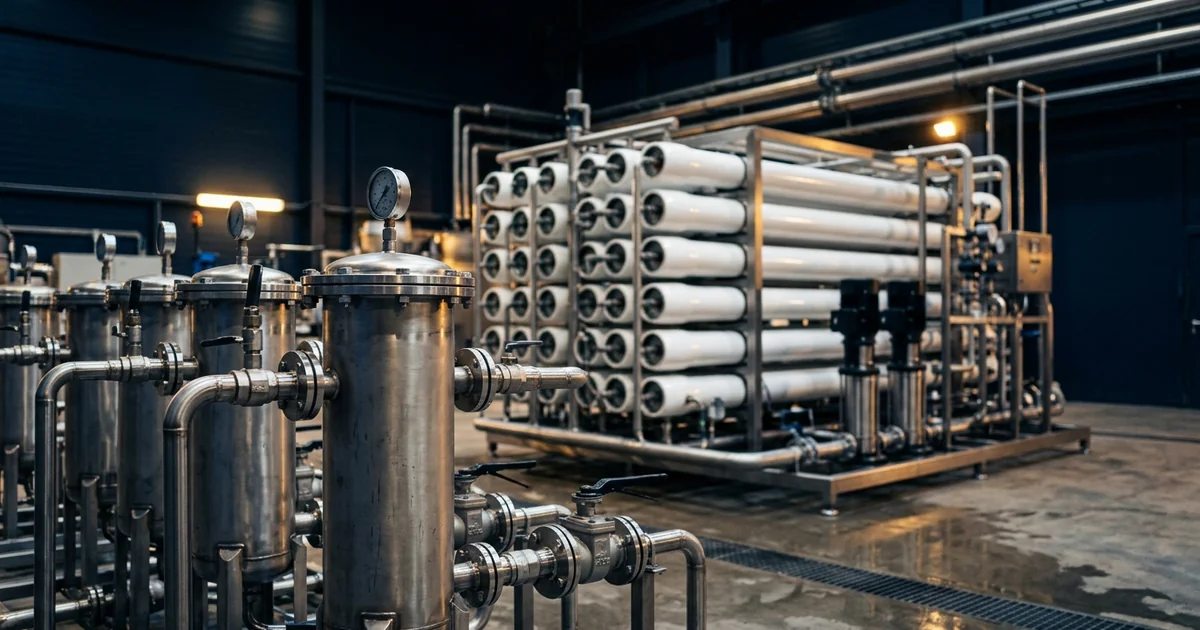
An RO plant that needs frequent membrane cleaning to hold its output is often paying for a problem upstream, and the FilmTec manual links frequent cleaning to inadequate pretreatment. Reverse osmosis pretreatment decides how fast colloids, biofilm, metals and oxidants reach the membrane surface. Weak pretreatment shows up as rising differential pressure, lost salt rejection, cleaning costs and early element replacement, and FilmTec states that oxidation damage is not covered under its warranty. This guide explains how to read the silt density index, how to remove particles, how to dechlorinate safely and how to handle iron, aluminium and hydrogen sulphide. It draws on the DuPont FilmTec technical manual, Hydranautics bulletins, ASTM methods and a peer-reviewed review of fouling indices, with formulation support from Global Formulation.
Why Reverse Osmosis Pretreatment Decides Membrane Life
An RO membrane rejects most of what the feed carries, so contaminants that pass the pretreatment concentrate at the membrane surface. The FilmTec technical manual defines fouling as the build-up of foreign material on the membrane and feed spacer until it causes operating problems. It separates colloidal fouling, biofouling, organic fouling and scaling, and it treats oxidation of the membrane as a separate risk. Each problem needs a different tool, so a pretreatment train is a chain of steps rather than a single product.
- Colloidal fouling — entrapment of silt, clay, colloidal silica, bacteria or iron flocs. An early sign is a rising pressure differential across the system.
- Biofouling — growth of a biofilm fed by nutrients concentrated at the membrane surface. It raises the feed-to-concentrate pressure drop and can end in telescoping of elements.
- Organic fouling — adsorption of humic substances, oils and other organics. In serious cases the flux loss is irreversible.
- Scaling — precipitation of sparingly soluble salts such as calcium carbonate, calcium sulphate, barium sulphate and calcium fluoride.
- Membrane degradation — oxidation of the polyamide layer by chlorine and other oxidants. Hydranautics describes this damage as irreparable.
The feed source sets how much of that chain a plant needs. FilmTec describes well water as a consistent, low-fouling source, while surface water varies with the seasons and carries both microbiological and colloidal load. Wastewater adds organic constituents that cause severe flow loss or membrane degradation when pretreatment falls short.
| Feed Source | Fouling Character | Typical Pretreatment Steps |
|---|---|---|
| Well water | Consistent, low fouling potential; anoxic wells carry ferrous iron, manganese and sometimes hydrogen sulphide | Acidification or antiscalant and a 5 µm cartridge filter, with reduced-state handling for anoxic wells |
| Surface water | Variable through the seasons, high colloidal and microbiological load | Chlorination, coagulation-flocculation, clarification, multimedia filtration, dechlorination, acid or antiscalant |
| Seawater | Bromide turns chlorine into hypobromous acid; open intakes carry biological load | Careful intake siting, media or membrane filtration, controlled chlorination and dechlorination |
| Municipal and industrial wastewater | Wide range of organic and inorganic constituents | A site-specific train, with organics evaluated in field tests case by case |
Our overview of water treatment technology and formulations places these steps within the wider chemical toolkit. Before choosing any step, a plant needs a number for its colloidal load, and the SDI test supplies it.
Silt Density Index: How the SDI Test Works and What It Misses
The silt density index measures how quickly a water plugs a fine membrane filter, and the FilmTec manual calls it the most commonly used fouling index. The test is simple to run on site with a pressure regulator, a filter holder and a stopwatch. Its weakness is that it is empirical, so a team needs to know what the number does and does not tell them. The current method is ASTM D4189-23, and the FilmTec manual describes the same procedure.
- Equipment — a 47 mm filter holder, 0.45 µm membrane filters, a pressure gauge and a needle valve on a sample line.
- Set-up — set the regulator to 207 kPa (30 psi), seat the O-ring correctly and bleed out trapped air.
- First reading — open the valve and time the collection of the first 500 mL, recorded as ti.
- Final reading — leave the flow running and time another 500 mL after 15 minutes of total flow, recorded as tf.
- Calculation — SDI equals 100 multiplied by (1 − ti/tf), divided by the elapsed time in minutes.
- Validity check — if 1 − ti/tf exceeds 0.75, repeat the test over 5 or 10 minutes instead.
The FilmTec guideline is to keep SDI15 at or below 5, and it recommends below 3 to minimise fouling. It advises measuring before the pretreatment is designed and then regularly in service, three times a day for surface waters. ASTM D4189-23 adds two cautions. SDI varies with water temperature, and values from filters made by different manufacturers are not necessarily comparable.
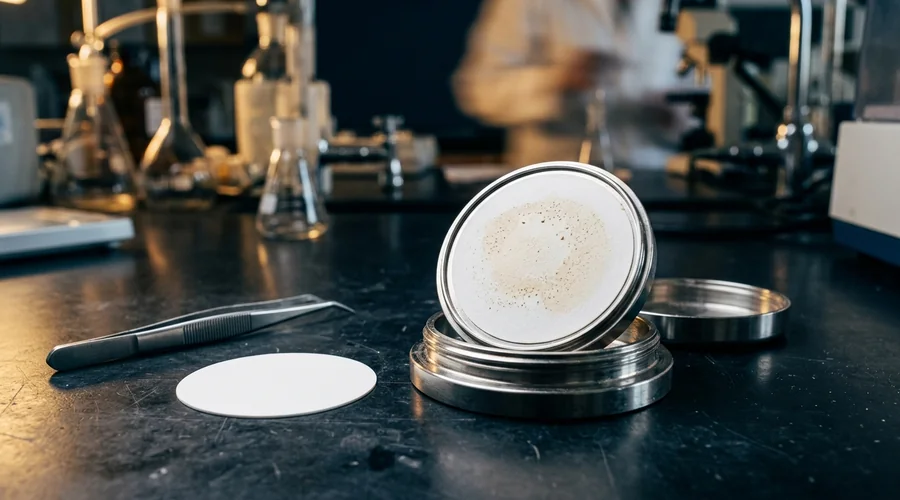
The index also has deeper limits. A 2017 review of fouling prediction in Membranes notes that SDI has no linear relation with colloid content and is not based on any fouling mechanism. Both SDI and the modified fouling index use dead-end filtration, while RO elements run in cross-flow. The modified fouling index records the volume every 30 seconds over 15 minutes and takes the slope of time over volume plotted against volume.
ASTM D8002-24 standardises this MFI-0.45 test as an alternative to the SDI. It aims to overcome the nonlinear response, the lack of temperature correction and the effects of the support pad and time. FilmTec equates an MFI below 1 with an SDI of about 3, and it lists an MFI0.45 maximum of 4 with a target below 1.
An SDI number only becomes useful when it is set against the feed limits a membrane maker publishes, which is the next step.
RO Feedwater Quality Limits at the Membrane Inlet
Feed limits turn pretreatment goals into numbers a plant can test against. FilmTec's guideline table applies at the entry to the membrane, including any effect of dosing chemicals or piping materials upstream. A feed can therefore meet a limit at the filter outlet and still fail it after corroding pipework adds iron. The manual warns that exceeding the limits leads to more frequent cleaning or sanitisation.
| Parameter | FilmTec Maximum | Condition or Note |
|---|---|---|
| SDI15 | 5 | Below 3 recommended to minimise fouling |
| MFI0.45 | 4 | Target below 1 |
| Turbidity | 1 NTU | Listed as a minimum requirement of RO feed |
| Oil and grease | 0.1 mg/L | Coagulation or activated carbon needed above this level |
| TOC | 3 mg/L | Synthetic organic compounds harm membranes more than natural organic matter |
| COD | 10 mg/L | Organic load indicator |
| AOC | 10 µg/L Ac-C | Target below 5; a measure of biodegradable carbon |
| Free chlorine | 0.1 mg/L | Hydranautics requires 0.00 ppm |
| Ferrous iron | 4 mg/L | Only at pH below 6 and oxygen below 0.5 mg/L |
| Ferric iron | 0.05 mg/L | Iron also catalyses oxidation damage |
| Manganese | 0.05 mg/L | Oxidises at a higher pH than iron |
| Aluminium | 0.05 mg/L | Forms aluminium silicates with silica |
Membrane makers do not always agree. FilmTec gives a free chlorine maximum of 0.1 mg/L, while Hydranautics' Technical Application Bulletin 110 requires 0.00 ppm free chlorine in the RO feed. A plant with elements from more than one supplier is safest designing to the stricter figure. The sections that follow show which pretreatment step moves each parameter, starting with particles.
Removing Colloids: Coagulation, Media and Membrane Filtration
Colloids are what the SDI measures, and the filtration steps in the FilmTec manual are organised around removing them. Fine clay, silica, bacteria and iron particles stay suspended, so they have to be destabilised and captured. Coagulants and flocculants make them filterable, and filters then remove them. The manual stresses that these chemicals must end up inside the agglomerates, because any that escape become a source of fouling themselves.
- Iron coagulants — ferric sulphate and ferric chloride neutralise the negative surface charge of colloids and trap them in ferric hydroxide microflocs. FilmTec prefers them for in-line coagulation.
- Aluminium coagulants — effective, but FilmTec does not recommend them because residual aluminium causes fouling problems.
- Flocculants — high molecular weight polymers such as linear polyacrylamides that strengthen microflocs or bridge particles. Anionic or nonionic grades are preferred over cationic grades.
- Cationic polymers — nearly all antiscalants are negatively charged and react with them. FilmTec reports several RO plants heavily fouled by the gel this reaction forms.
- Dose control — the manual states plainly that overdosing must be avoided, because chemical that is not captured in the flocs becomes a foulant.
The filtration route depends on how much suspended matter the raw water carries. Light loads go straight to media filters, moderate loads benefit from in-line coagulation, and heavy loads need settling first. Membrane filtration gives the lowest SDI of all the options.
| Route | Where FilmTec Applies It | Expected Result |
|---|---|---|
| Media filtration (sand, or anthracite over sand) | General removal of suspended and colloidal particles | SDI15 below 5 with a well-designed, well-run filter |
| In-line coagulation before media filters | Raw water with an SDI only slightly above 5; optimised by ASTM D4188 | Markedly better SDI reduction than filtration alone |
| Coagulation-flocculation with settling | Raw water with high suspended matter and a high SDI | Clarified water then passes to media filtration |
| Microfiltration or ultrafiltration | Feeds that need the lowest particle load; UF also removes some dissolved organics | SDI below 1 when well designed and maintained |
Media filter design is a hydraulic matter as much as a chemical one. FilmTec gives design filtration rates of 10–20 m/h, with lower rates or a second filtration pass for high-fouling feeds. Flow increases when a filter goes offline must be gradual, or previously captured particles are released. Our guides to coagulant selection, polyelectrolyte flocculant selection and the jar test cover the chemistry and the screening work. Whatever the main filter, one more barrier sits in front of the high-pressure pump.
Cartridge Filters: The Last Barrier Before the Pump
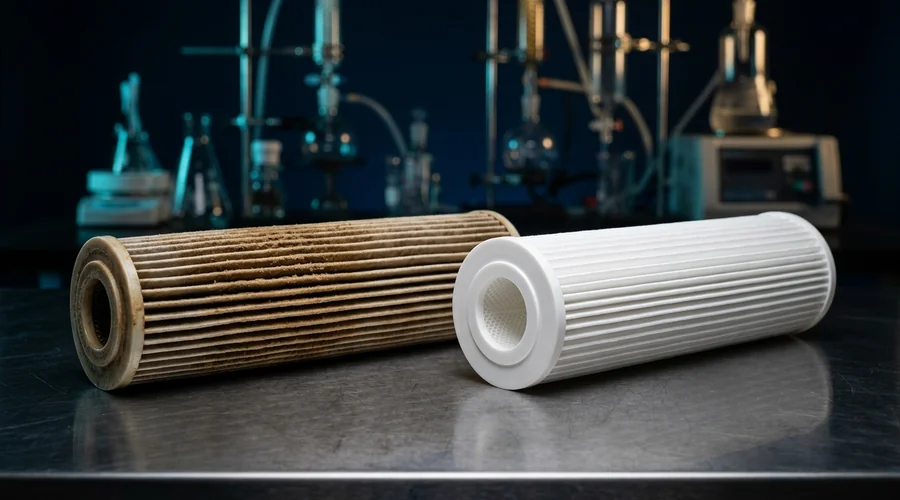
FilmTec calls a cartridge filter below 10 µm absolute the minimum pretreatment for every RO system. It protects the membranes and the high-pressure pump from particles that slip through upstream, and it is usually the last step in the sequence. It is a safety device, though, not a primary solids-removal step. Treating it as one wastes filters and, the manual warns, invites breakthrough into the membranes.
- Rating — 5 µm absolute is recommended, and 1–3 µm absolute where colloidal silica or metal silicates are a risk.
- Material — synthetic, non-degradable media such as polypropylene or nylon.
- Monitoring — a differential pressure gauge across the housing shows how fast the cartridges are loading.
- Replacement — change cartridges before the permitted pressure drop is reached, and at least every 3 months.
- Warning sign — replacement more often than every 1–3 months usually indicates a problem in the pretreatment.
- Backflushable filters — not recommended as the final safety filter, because of breakthrough risk, lower efficiency and higher biofouling risk.
Bypassing the cartridge has a specific failure mode. Hydranautics' membrane precautions bulletin TSB105.12 reports that particles of 6 to 100 microns lodge between the feed spacer and the membrane. Spacer vibration then pushes them into the polyamide surface and abrades it. The damage barely raises water flow but sharply increases permeate salinity, because raw feed leaks into the permeate.
Used cartridges are also a diagnostic sample. FilmTec recommends regular inspection of used cartridges, and analysis of deposits from cartridges and SDI pads is part of its troubleshooting routine. With hydrogen sulphide in the feed, it describes black sooty or grey pasty deposits that clog the cartridges.
Particles are only half of the pretreatment problem, and the oxidants used to control biology are the other half.
Chlorine and Polyamide Membranes: Why Dechlorination Before RO Matters
Chlorine has long been used to keep intake lines, heat exchangers and sand filters free of biological growth, but thin-film polyamide membranes do not tolerate it. FilmTec gives a free chlorine tolerance below 0.1 ppm and expects eventual degradation after about 200 to 1,000 hours at 1 ppm. At a steady 0.1 ppm leak, simple arithmetic says that budget lasts roughly 3 to 14 months. Since oxidation damage is not covered under its warranty, FilmTec recommends removing residual free chlorine before the feed reaches the membrane.
- pH — chlorine attack is faster at neutral and acidic pH than at alkaline pH.
- Temperature — attack is faster at higher temperature.
- Transition metals — iron and other metals in the water or on the membrane catalyse degradation. Hydranautics recommends no free chlorine at all when they are present.
- Other oxidants — chlorine dioxide, hydrogen peroxide, ozone and permanganate also damage RO and NF membranes when misused.
- Combined chlorine — chloramines, chloramine-T and dichloroisocyanurate release small amounts of free chlorine, so FilmTec recommends dechlorinating these too.
The first sign of chlorine attack is a loss of flux, followed by a rise in both flux and salt passage. Free chlorine is a mixture of hypochlorous acid and hypochlorite ion, and the split depends on pH. FilmTec gives 50 percent as HOCl at pH 7.5 and 90 percent at pH 6.5, at 25 °C in low-salinity water. HOCl is about 100 times more germicidal than hypochlorite. In seawater, bromide converts it to hypobromous acid, which dissociates less, so treatment works at a higher pH.
Continuous chlorination with dechlorination was standard for years, but FilmTec reports that biofouling downstream of the dechlorination point is common. Its explanation is that chlorine breaks organic matter into more biodegradable fragments, which feed bacteria once the chlorine is gone. Hydranautics' TAB110 cites a Red Sea plant study in which bacterial growth was faster just after dechlorination than in raw water. In that study, operation without chlorination gave a 33 percent lower pressure drop.
The two manufacturers draw slightly different lessons. FilmTec prefers periodic offline chlorination of the pretreatment, with the chlorinated water sent to drain and its absence verified, for example by ORP. Hydranautics says plants that chlorinate should move the dechlorination step as far from the membranes as feasible, and that the choice must be assessed for each site. Once a plant decides to chlorinate, the next question is how to take the chlorine out.
Sodium Metabisulfite Dechlorination and Activated Carbon
Two routes remove residual chlorine: a chemical reducing agent or an activated carbon bed. Both convert free chlorine to chloride, but they differ in control and in their side duties. FilmTec describes sodium metabisulfite as commonly used, and notes that alternatives such as sulphur dioxide are less cost-effective. Getting the grade, the dose margin and the monitoring right matters as much as the choice of route.
In water, sodium metabisulfite forms sodium bisulfite: Na2S2O5 + H2O → 2 NaHSO3. Bisulfite then reduces hypochlorous acid to chloride and sulphate. In theory, 1.34 mg of sodium metabisulfite removes 1.0 mg of free chlorine, and plants dose a margin above that figure. Activated carbon reacts at its surface, C + 2Cl2 + 2H2O → 4HCl + CO2, and FilmTec calls a carbon bed very effective for dechlorination.
| Factor | Sodium Metabisulfite or Bisulfite | Activated Carbon Bed |
|---|---|---|
| Mechanism | Chemical reduction of hypochlorous acid to chloride and sulphate | Surface reaction of chlorine with carbon, giving hydrochloric acid and carbon dioxide |
| Control | Dosed against measured chlorine, with ORP confirming removal | Passive bed with no dosing pump |
| Other duties in the FilmTec manual | Biostatic; short shock treatment against aerobic bacteria | Adsorbs humic substances; barrier against residual permanganate |
Metabisulfite quality and handling decide whether the chemistry works as written. FilmTec sets out specific requirements for the product and the dosing point.
- Grade — food-grade sodium metabisulfite, free of impurities.
- No cobalt — the product must not be cobalt-activated. Cobalt catalyses sulphite oxygen scavenging, as our guide to boiler oxygen scavengers explains.
- Shelf life — solid metabisulfite keeps about 4–6 months cool and dry. Solutions oxidise in air, and FilmTec's table runs from about one week for its most dilute solution to six months for its strongest.
- Injection point — downstream of the cartridge filters, so chlorine keeps protecting them, with the solution filtered through its own cartridge.
- Mixing — the reaction is rapid, but static mixers are recommended to ensure it completes.
- Storage — dechlorinated water must not be stored in tanks.
More bisulfite is not safer. TSB105.12 cites Sommariva and co-workers, who found polyamide membranes oxidised at a plant practising chlorination with bisulfite dechlorination. Oxidation needed excess bisulfite together with oxygen, higher pH and some transition metal. FilmTec similarly warns that with cobalt or copper fouling, residual bisulfite partly converts to oxidants when oxygen is in excess.
Both manufacturers rely on ORP measurement as the guard. FilmTec cites 175–200 mV thresholds as typical, with the signal shutting down the high-pressure pump. Hydranautics sets a warning at 300 mV and a shutdown at 350 mV, so the setpoints of the membrane supplier whose warranty applies are the ones to use.
Removing chlorine solves the oxidation problem but leaves the biology, which the next section addresses.
Biofouling Control Without Oxidising the Membrane
Biofouling is hard to reverse, so pretreatment aims to stop it before it starts. The FilmTec manual explains that a biofilm shields its organisms from shear and biocides, and any part left behind regrows quickly. In biologically active feeds it reports that a biofilm can appear within 3 to 5 days of inoculation. Preventive treatment works better than corrective treatment, because single attached bacteria are easier to kill than an aged biofilm.
- Nutrient limitation — FilmTec calls limiting or removing nutrients the most successful approach, for example biofiltration through slow sand or biologically active carbon.
- Chemical selection — antiscalants and acids must be chosen carefully because they can also act as nutrients. Our RO antiscalant guide covers the microbial growth test.
- DBNPA — a fast-acting, biodegradable, membrane-compatible non-oxidising biocide applied as an intermittent slug. Reducing agents deactivate it, so residual bisulfite raises the demand.
- Bisulfite shock treatment — a short, high bisulfite dose during operation. It works against aerobic bacteria but not against anaerobic organisms.
- Membrane filtration — MF or UF removes microorganisms and algae but not the low molecular weight nutrients, so FilmTec calls it no safeguard by itself.
- UV at 254 nm — germicidal and chemical-free, but limited to clean waters because colloids and organics block the radiation.
Some biocides harm the membrane or the plant. FilmTec advises against copper sulphate, citing impurities, copper hydroxide and carbonate precipitation, discharge limits and a weak effect on most bacteria. Iodine, quaternary germicides and phenolic compounds cause flux losses. Biocides and their breakdown products are not always fully rejected, so permeate is sometimes discharged during a slug.
Biology is not the only thing that changes state in the pretreatment line, because dissolved metals change state too.
Iron, Manganese, Aluminium and Hydrogen Sulphide
Anoxic well waters carry dissolved ferrous iron, manganese and sometimes hydrogen sulphide. The trouble starts when they meet oxygen or chlorine, which turns them into colloidal hydroxides or elemental sulphur. FilmTec warns that iron fouling can develop even with an SDI below 5 and iron below 0.1 mg/L in the feed. Aluminium fouling has its own sources: coagulant carry-over, post-precipitation after poor pH control, aluminium silicates and natural silt.
| Contaminant | What Goes Wrong | Pretreatment Options |
|---|---|---|
| Ferrous iron in anoxic water | Oxidises to ferric hydroxide colloids on contact with air or chlorine | Keep the water reduced (pH below 6 and oxygen below 0.5 mg/L allow up to 4 mg/L), or oxidise and filter |
| Ferric iron and manganese | Foul the membrane; iron also catalyses oxidation damage | Media filtration or MF/UF for particles; cation-exchange softening removes low levels of dissolved iron |
| Aluminium | Aluminium silicate fouling with as little as 10 mg/L silica; poisons acrylic antiscalants | Avoid aluminium coagulants; flocculate near pH 6.5 and run RO at about pH 7–9 where scaling allows |
| Hydrogen sulphide | Oxidation forms colloidal sulphur and metal sulphides that pass 5 µm cartridges | Keep the system anaerobic from well to membrane outlet; strip H2S from permeate in a degasifier |
| Oils and humic substances | Adsorb on the membrane surface | Coagulation, UF or activated carbon; pretreat when TOC exceeds 3 mg/L or oil exceeds 0.1 mg/L |
Oxidation-filtration converts iron and manganese with air, sodium hypochlorite or potassium permanganate and removes the hydroxides on media filters. Greensand oxidises ferrous iron by electron transfer and is regenerated with permanganate, which must then be rinsed out thoroughly. FilmTec applies greensand below 2 mg/L ferrous iron, and above that it doses permanganate continuously behind a barrier such as a carbon filter. Birm filtration raises pH, which shifts the Langelier Saturation Index and risks calcium carbonate scale.
Hydrogen sulphide overrides these choices. Levels as low as 0.1 mg/L adversely affect RO performance, and its presence rules out greensand oxidation-filtration. The water must not meet air, chlorine or any oxidant between the well and the membrane outlet. Wells need bubble-tight check valves so that back-flow does not draw air into the system.
With each contaminant mapped to a step, the remaining task is to assemble those steps in the right order.
Building an RO Pretreatment Train: A Decision Sequence
Good pretreatment design follows the feed analysis rather than a standard package. The FilmTec manual calls a complete and accurate feed analysis critical and stresses a total system approach, because a poorly run clarifier overloads the media filter behind it. Weak pretreatment can be partly offset with more membrane area and more frequent cleaning, but better pretreatment lowers membrane costs. FilmTec's design tables show the link directly, lowering the permitted element recovery as feed SDI rises.
- Analyse the feed — ions, temperature range, TOC, iron, manganese, aluminium, sulphide, chlorine, SDI and bacteria, by Standard Methods or ASTM procedures.
- Classify the source — well, surface, seawater or wastewater, with its seasonal swings.
- Choose the colloid route — media filtration, in-line coagulation, full coagulation-flocculation or MF/UF, sized to the SDI target.
- Decide the oxidant strategy — continuous, intermittent or no chlorination, and where dechlorination sits relative to the membranes.
- Fix dechlorination and monitoring — metabisulfite or carbon, injection point, mixing, and ORP setpoints from the membrane supplier.
- Handle metals and sulphide — reduced-state operation or oxidation-filtration, and no oxidation-filtration on a well that carries hydrogen sulphide.
- Add scale control — acid, antiscalant or softening, matched to the scaling calculation for the planned recovery.
- Check chemical compatibility — no cationic polymer carry-over into an anionic antiscalant, and reducing agent residual counted in biocide demand.
- Set the routine — 5 µm absolute cartridges, SDI logged at several points and regular cartridge inspection.
FilmTec calls an SDI instrument with connections throughout the pretreatment a great diagnostic tool, because it localises problems quickly. A plant that logs SDI after each step sees which unit has slipped. The same discipline applies to microbiology, where the manual lists six minimum sampling points from intake to permeate.
Each step in that sequence depends on chemicals, and supplying them well is a formulation job in its own right.
RO Pretreatment Chemicals and a Water Treatment Formulation Consultant
Suppliers of RO pretreatment chemicals sell into a market where the membrane maker's manual sets the rules. A dechlorinator, coagulant or biocide that meets a general water treatment specification can still fail an RO duty on grade, compatibility or carry-over. A water treatment formulation consultant checks those points against the membrane literature before a product reaches a plant. Water treatment chemical product development services then turn the specification into a stable, documented product.
- Dechlorinator grade — food-grade, cobalt-free metabisulfite or bisulfite, with packaging and stock-solution guidance that limits air oxidation.
- Coagulant choice — iron-based products for RO duty, with residual metal and pH control designed in.
- Flocculant charge — anionic or nonionic grades, tested for gel formation with the antiscalant in use.
- Biocide programme — non-oxidising products checked for membrane compatibility and for reducing agent demand.
- Drinking water approval — the 2020 edition of NSF/ANSI/CAN 60 lists sodium bisulfite and metabisulfite as dechlorinators. For RO chemicals above 500 molecular weight it assumes 0.5 percent carry-over, and 100 percent below 500 unless data justify otherwise.
- Manufacturing — industrial water chemicals contract manufacturing with batch records, stability data and technical data sheets.
The full range of services sits under water treatment, and our guide to RO membrane cleaning chemicals covers what happens when pretreatment falls short. Before a trial, collect the feed analysis, the SDI log and the membrane maker's feed limits. Those three documents decide every pretreatment choice in this guide.
Frequently Asked Questions
What is reverse osmosis pretreatment?
Reverse osmosis pretreatment is the chain of treatment steps upstream of the membranes that limits fouling, scaling and membrane degradation. It typically includes filtration, coagulation, oxidant control, dechlorination, scale control and a final cartridge filter.
The scheme depends on the feed source. Well water often needs only acid or antiscalant and a 5 µm cartridge, while surface water and wastewater need far more.
What is a good SDI value for RO feed water?
The FilmTec manual sets a maximum SDI15 of 5 and recommends below 3 to minimise fouling. Many pretreatment studies use an SDI15 below 3 as the target.
A well-run media filter usually reaches an SDI15 below 5, and a well-maintained microfiltration or ultrafiltration unit reaches below 1. Always compare values measured with the same filter brand and at similar temperature.
How is the silt density index calculated?
Water is filtered through a 47 mm, 0.45 µm membrane filter at 207 kPa (30 psi). The time to collect the first 500 mL is recorded, and the time to collect another 500 mL is recorded after 15 minutes of flow.
SDI equals 100 multiplied by one minus the ratio of the first time to the final time, divided by the elapsed minutes. If one minus that ratio exceeds 0.75, the test is repeated over 5 or 10 minutes.
Why must chlorine be removed before RO membranes?
Thin-film polyamide RO membranes are oxidised by free chlorine. FilmTec gives a free chlorine tolerance below 0.1 ppm and expects degradation after about 200 to 1,000 hours at 1 ppm, while Hydranautics requires zero free chlorine.
Attack is faster at neutral and acidic pH, at higher temperature and when iron or other transition metals are present. Oxidation damage is not covered under the FilmTec warranty.
How does sodium metabisulfite dechlorinate RO feed water?
Sodium metabisulfite dissolves to form sodium bisulfite, which reduces hypochlorous acid to chloride and sulphate. In theory, 1.34 mg of metabisulfite removes 1.0 mg of free chlorine.
The product should be food grade, free of impurities and not cobalt-activated. Overdosing is a risk too, because excess bisulfite with oxygen, higher pH and transition metals has oxidised polyamide membranes.
What size cartridge filter should be used before RO?
FilmTec calls a cartridge filter below 10 µm absolute the minimum pretreatment for every RO system and recommends 5 µm absolute. Where colloidal silica or metal silicates are a risk, it recommends 1 to 3 µm absolute.
Cartridges should be synthetic, such as polypropylene or nylon, and replaced before the permitted pressure drop and at least every 3 months. Replacement more often than every 1 to 3 months points to a pretreatment problem.
Why are aluminium coagulants not recommended before RO?
Residual aluminium fouls RO membranes, and it reacts with silica to form aluminium silicate deposits. FilmTec reports that aluminium as low as 50 ppb can cause a performance decline.
Aluminium also poisons polymer antiscalants such as acrylic acid products. FilmTec therefore recommends iron-based coagulants and keeping aluminium in the feed below 0.05 mg/L.
How can a water treatment formulation consultant help with RO pretreatment?
A consultant reviews the feed analysis and SDI data and selects coagulants, flocculants, dechlorinators and biocides that suit the membrane. The team checks compatibility, such as cationic polymer carry-over into an anionic antiscalant.
Water treatment chemical product development services then cover grade selection, stability, drinking water approval data and handover to an industrial water chemicals contract manufacturing partner.
Designing an RO Pretreatment Programme or a Dechlorinator Product?
Global Formulation supports water treatment chemical manufacturers and plant teams with pretreatment chemical selection, dechlorinator and coagulant product development, compatibility testing and contract manufacturing.
Talk to Our Formulation Team