Langelier Saturation Index and Ryznar Index Explained

A lab report lists a Langelier saturation index of +1.2 for your cooling tower make-up water. The plant team wants to know whether that means scale next week or never. The number cannot answer that question on its own. Acid feed, inhibitor selection and blowdown limits are all set from it, so a misread index turns directly into fouled exchangers or avoidable corrosion. This guide explains the Langelier and Ryznar indices: what each calculates, which inputs matter, where each fails and how a formulator uses them to design a treatment programme. It draws on standard test practices and open peer-reviewed literature, together with the formulation and scale-up support Global Formulation gives water treatment chemical manufacturers.
Langelier Saturation Index: What It Measures and What It Does Not
The Langelier saturation index is a thermodynamic statement about calcium carbonate, not a forecast of what happens inside a pipe. Langelier published the underlying work in 1936, and for most of the twentieth century it guided corrosion control by steering water toward a protective calcium carbonate film. The index compares the measured pH of a water with pHs, the pH at which that same water would be exactly saturated with calcium carbonate. A positive result means the water is oversaturated and tends to deposit calcium carbonate, a negative result means it dissolves calcium carbonate, and zero means equilibrium.
| Question | What the Langelier Index Tells You | Where the Gap Is Filled |
|---|---|---|
| Does the water deposit or dissolve calcium carbonate? | Yes. The sign of the index gives the direction of the driving force. | Not needed |
| How much scale will form? | No. The index is not quantitative. | Calcium carbonate precipitation potential (CCPP) |
| How fast will it form? | No. It carries no rate information. | Rig, pilot or field monitoring data |
| Will the deposit protect the metal? | No. It cannot say whether a deposit is protective or how much forms. | Coupon and pipe-loop studies |
| Do other scales matter? | No. It addresses calcium carbonate only. | Separate solubility checks for phosphate, sulfate and silica |
The Hach Method 8073 sheet states the limits plainly: the index is not related directly to corrosion, and its value is not a quantitative measure of calcium carbonate saturation. The Veolia water handbook makes the same point, calling the index a measure of directional tendency only. Even so, the index earns its place in industry. A 2015 cooling-water study notes that large industrial and power station cooling systems still use the Langelier or Puckorius index to control acid feed or cycles of concentration. Our guide to cooling tower water treatment covers that duty, and the wider category sits under water treatment.
Before comparing indices, it helps to see how the number is built, because every input carries its own error.
Water Scaling Index Calculation: Inputs and the pHs Equation
Every saturation index is only as reliable as the five measurements behind it. The Hach method lists them: pH, temperature, total dissolved solids, calcium hardness and total alkalinity. Each enters pHs through its own term, so a small error in one input moves the result by a predictable amount. Knowing which terms matter lets you judge a lab report before you act on it.
| Input | Basis | Effect on pHs |
|---|---|---|
| Measured pH | pH units | Not part of pHs; compared against it to give the index |
| Temperature | Degrees Celsius | Hotter water has a lower pHs, so the index rises for the same pH |
| Total dissolved solids | mg/L | Ionic strength correction; the smallest effect of the four terms |
| Calcium hardness | mg/L as CaCO3 | More calcium lowers pHs |
| Total alkalinity | mg/L as CaCO3, titrated to pH 4.5 | More alkalinity lowers pHs |
The index is the measured pH minus pHs. The common approximation builds pHs from a constant of 9.3, adds a dissolved solids term and a temperature term, and subtracts a calcium term and an alkalinity term. An open-access data brief publishes those four terms as logarithmic expressions:
- Dissolved solids term — the base-10 logarithm of total dissolved solids in mg/L, minus 1, divided by 10.
- Temperature term — 34.55 minus 13.12 times the base-10 logarithm of the temperature in degrees Celsius plus 273.
- Calcium term — the base-10 logarithm of calcium hardness in mg/L as CaCO3, minus 0.4.
- Alkalinity term — the base-10 logarithm of total alkalinity in mg/L as CaCO3.
Hach replaces the logarithms with look-up tables, and the two forms are close but not identical. Our own comparison for typical waters gave pHs values about 0.1 pH unit apart. Rigorous standards go further. The German standard DIN 38404-10 requires all specified aqueous species, including sulfate and phosphate complexes. A 2013 open-access study found that the simpler Standard Methods 2330 and Dutch NEN 6533 calculations neglect ion pairs and were not accurate enough to comply with DIN.

A clean calculation gives one number, but you still need to know which scale to read it against.
Ryznar Stability Index and Related Scaling Indices Compared
Ryznar proposed his index in 1944 after studying how waters with different saturation indices behaved in service. The Langelier index gives direction only, whereas the Ryznar stability index, twice pHs minus the measured pH, rests on operating results and separates waters that share one Langelier value. Lower Ryznar values point to scale and higher values to corrosion. Other indices followed because each fixes one weakness of these two.
| Index | Basis | Where It Applies |
|---|---|---|
| Langelier (LSI) | Measured pH minus pHs | Directional calcium carbonate tendency in drinking and cooling water |
| Ryznar (RSI) | Twice pHs minus measured pH | Separates soft corrosive from hard scaling waters with the same LSI |
| Puckorius (PSI) | Uses an equilibrium pH derived from alkalinity in place of the measured pH | Cooling systems; the 2015 study gives a range up to 93 °C |
| Larson-Skold | Chloride plus sulfate relative to alkalinity, in meq/L | Corrosive effect of chloride and sulfate; a higher index is more corrosive |
| Stiff and Davis | Adds an ionic strength and temperature constant to pH, calcium and alkalinity terms | High-salinity brines; ASTM D4582 for reverse osmosis concentrate above 10,000 mg/L dissolved solids |
| LSI for reverse osmosis | Langelier calculated on the concentrate stream | ASTM D3739 for concentrate from 10 to 10,000 mg/L dissolved solids |
The published Ryznar bands do not agree, and that matters whenever two reports are compared. Veolia's handbook says scaling increases at a Ryznar value of 6.0 or less, that scaling becomes unlikely above 7.0, and that corrosion becomes more probable above 7.5 or 8.0. An open data brief tabulates five bands from below 5.5, highly scale-forming, to above 8, highly corrosive. A 2011 report for the Newfoundland and Labrador government reports that in Ryznar's own experiments calcium carbonate deposited below 7. Our guide to scale inhibitor chemistry shows how these readings feed product choice.
Every index above still assumes a temperature, which is where plant conditions most often depart from the lab sheet.
Calcium Carbonate Saturation in Water: Temperature, Hot Surfaces and CCPP
Heat pushes calcium carbonate toward deposition, so the same make-up water behaves differently in the basin and at an exchanger wall. In the Hach look-up tables the temperature constant falls from 2.60 at 0 °C to 1.15 at 80 °C, so heating a water lowers pHs and raises the index. The Veolia handbook adds that deposit formation depends strongly on water and skin temperatures, with the most severe deposition on equipment with high surface temperatures or low velocities. An index calculated at basin temperature therefore describes the basin, not the surface where scale grows.
- Bulk-water index — calculated at basin temperature; it describes the whole system and drives acid feed and cycles of concentration.
- Hot-surface index — recalculated with the expected wall temperature of the hottest exchanger; it shows how much the driving force rises where scale starts.
- CCPP — the amount of calcium carbonate that can theoretically precipitate or dissolve, which turns a direction into a quantity.
Heating a water from 25 °C to 45 °C lowers pHs by about 0.4 pH unit in the logarithmic temperature term, so the index rises by the same amount. The 2013 study confirms that Standard Methods defines its equilibrium constants for 0 to 90 °C, while DIN, written in molarity units, holds only to about 45 °C. The authors recommend PHREEQC, a geochemical modelling program, with a validated database for hot water. That route also handles ion pairs such as calcium sulfate, which the simple equations ignore.
Direction, temperature and amount are covered, but the harder question is whether the index predicts corrosion at all.
Limits of the Langelier Saturation Index for Corrosion Prediction
The Langelier saturation index describes calcium carbonate chemistry, and corrosion depends on more than calcium carbonate. Municipal water researchers between the 1960s and the mid-1990s repeatedly reported that the index did not correlate with corrosion rate. A 1996 AWWA Research Foundation review recommended abandoning its use as a corrosion predictor. Treat the index as a scale indicator first and a corrosion hint second.
- Soft, low-alkalinity water — Hach notes that such waters can corrode despite the index, because too little calcium carbonate and alkalinity are available to form a protective scale.
- Complexed hardness — high-pH waters with enough hardness and alkalinity can still corrode, because analysis cannot separate complexed calcium and magnesium from the available fraction.
- Chloride and sulfate — high concentrations interfere with uniform carbonate film formation, which is why the Larson-Skold index counts them.
- Rate and protection — the Newfoundland report notes the index gives little insight into rate and cannot say whether a deposit forms a protective film or how much forms.
- Other scales — calcium phosphate, calcium sulfate and silica each have their own solubility limits and need their own checks.
The method also has a stated working window. Hach limits corrosivity use of the index to waters above 40 mg/L alkalinity, with sufficient calcium and a pH between 6.5 and 9.5. The 2015 cooling-water paper gives a similar window of pH 7.0 to 9.5, 25 to 80 °C and dissolved solids below 800 mg/L. In that paper's brackish-water coupon tests on mild steel, raising calcium hardness or alkalinity lowered corrosion within the tested range. The authors add that supersaturation can lead to precipitation, which removes calcium and alkalinity and raises corrosion.
The Newfoundland report draws the practical conclusion that indices should supplement field observations, corrosion product analysis and pipe-loop or coupon studies rather than replace them.
Using Saturation Indices in Water Treatment Programme Design
A formulator uses the Langelier saturation index to define the scaling duty a programme must handle, not to dose a product. The index fixes how hard the chemistry has to work at the planned cycles of concentration and the hottest surface. Threshold inhibitors work above saturation by blocking crystal growth sites, yet the Veolia handbook notes that crystals eventually form, depending on supersaturation and retention time. The degree of supersaturation therefore drives which inhibitor is selected.
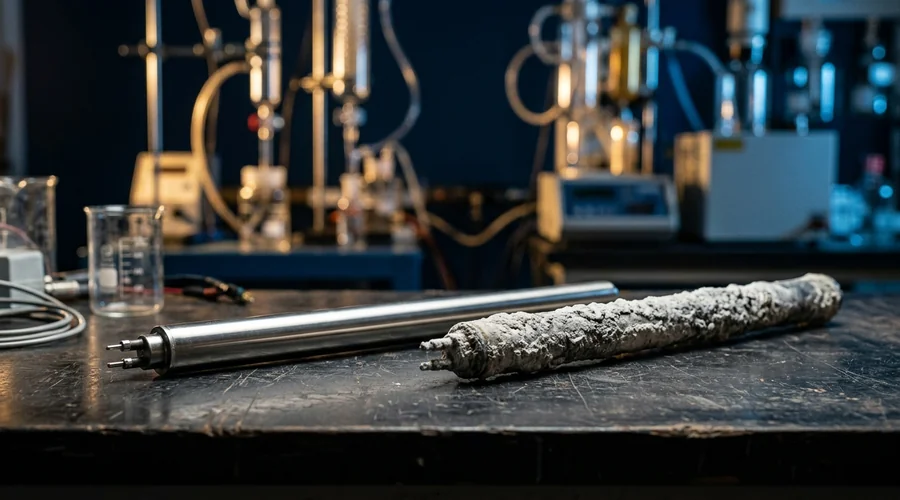
Supplier literature collected in an EPRI cooling-water report shows this in practice. PBTC is described as effective for calcium carbonate control under stressed conditions such as high hardness, high calcite supersaturation and high temperature. Our guide to cooling water corrosion inhibitors covers the corrosion side of the same programme. For reverse osmosis, ASTM D3739 notes that antiscalants or crystal modifiers suppress calcium carbonate scale and that the system supplier should be consulted first.
| Situation | Start With | Check Alongside |
|---|---|---|
| Cooling tower make-up and recirculating water | LSI and RSI or PSI at bulk and hot-surface temperature | Phosphate, sulfate and silica limits |
| Reverse osmosis concentrate up to 10,000 mg/L dissolved solids | LSI per ASTM D3739 | Antiscalant supplier data |
| Concentrate or brine above 10,000 mg/L dissolved solids | Stiff and Davis index per ASTM D4582 | Full speciation modelling |
| Chloride- and sulfate-rich water in contact with steel | Larson-Skold alongside LSI | Corrosion coupons |
| Soft, low-alkalinity water | Corrosion testing, not LSI alone | Pipe-loop or coupon data |
A workable sequence for a new programme links the index to evidence rather than letting it stand alone:
- Collect full analyses of the make-up water across seasons, including calcium hardness, alkalinity, pH and dissolved solids.
- Calculate the indices at the planned cycles of concentration, at both basin and hot-surface temperature.
- Check calcium phosphate, calcium sulfate and silica separately, since the index covers calcium carbonate only.
- Choose the control route: acid or pH control, softening, or an inhibitor class matched to the supersaturation.
- Confirm the choice with coupon, rig or pilot data before committing to full-scale production.
That sequence turns an index into a specification, and the specification is where formulation work begins.
Working With a Water Treatment Formulation Consultant
Water treatment chemical makers often receive an analysis and a request for a product that handles it. A water treatment formulation consultant translates that analysis into a scaling and corrosion duty, then matches it to inhibitor and dispersant chemistry the plant can actually blend. The saturation indices set the brief, and bench rigs and field data confirm the answer. This is where independent water treatment technology and formulation expertise saves months of trial and error.
- Index review — checking units, temperature basis and the validity window of the customer's calculations.
- Programme design — selecting acid, softening or inhibitor routes for the calculated duty.
- Product development services — building and testing the water treatment chemical formulation on bench rigs.
- Scale-up and contract manufacturing — moving a proven formulation into industrial water chemicals contract manufacturing with batch specifications.
Hard water also drives formulation problems outside treatment plants, as our note on hard water in detergent formulation shows. Before acting on any index, run a six-point check. Confirm the units and state the temperature. Stay inside the validity window and read a second index. Check the other scales, then validate with test data. A programme that passes those checks rests on evidence, and one that skips them rests on a single number.
Frequently Asked Questions
What is a good Langelier saturation index for cooling water?
No single value suits every system. Atlantic Canada drinking water guidelines ask for a treated water index of zero or slightly positive where pH or alkalinity adjustment is provided.
Cooling programmes that use threshold inhibitors deliberately run above saturation. The limit then depends on the inhibitor chemistry, the degree of supersaturation and the retention time, so it is set with rig or field data rather than a fixed index.
How is the Langelier saturation index calculated?
The index is the measured pH minus pHs, the pH at which the water would be exactly saturated with calcium carbonate. The common approximation builds pHs from a constant of 9.3 plus a dissolved solids term and a temperature term, minus a calcium term and an alkalinity term.
The inputs are pH, temperature, total dissolved solids, calcium hardness as CaCO3 and total alkalinity as CaCO3. Rigorous standards such as DIN 38404-10 use full speciation, including ion pairs, and run in modelling software.
What is the difference between the Langelier index and the Ryznar stability index?
The Langelier index is the measured pH minus pHs and gives only the direction of calcium carbonate tendency. The Ryznar index is twice pHs minus the measured pH and was built from operating results to separate waters that share one Langelier value.
A soft corrosive water and a hard scale-forming water can have the same Langelier index but different Ryznar values. Published Ryznar bands vary between sources, so always state which scale you are using.
Does a negative Langelier index mean the water is corrosive?
A negative index means the water is undersaturated with calcium carbonate and tends to dissolve it, so no protective carbonate film forms. That is not the same as a measured corrosion rate.
Studies since the 1960s found little correlation between the index and corrosion rate, and Hach states that the index is not related directly to corrosion. Corrosion depends on pH, buffering, chloride, sulfate and oxygen as well, so confirm with coupon or pipe-loop tests.
Why does temperature raise the Langelier index?
Calcium carbonate reaches saturation at a lower pH in hotter water. In the Hach tables the temperature constant falls from 2.60 at 0 degrees Celsius to 1.15 at 80 degrees Celsius, which lowers pHs.
With the measured pH unchanged, a lower pHs raises the index. This is why heat exchanger walls scale before the bulk basin shows a tendency, and why the index should be recalculated at the expected surface temperature.
Which saturation index should be used for reverse osmosis concentrate and brines?
ASTM D3739 covers the Langelier index for reverse osmosis concentrate containing 10 to 10,000 mg/L of dissolved solids. ASTM D4582 covers the Stiff and Davis index for concentrate above 10,000 mg/L.
Both practices calculate the index for the concentrate stream from the feed analysis and the operating parameters, because concentrate chemistry differs from feed water. The reverse osmosis system supplier should be consulted before an antiscalant or crystal modifier is added.
Can the Langelier index be used when scale inhibitors are dosed?
The index is calculated from water chemistry alone and does not include inhibitors. It describes the driving force for calcium carbonate deposition that the inhibitor programme has to handle.
Threshold inhibitors adsorb on newly formed microcrystallites and block growth sites, which delays precipitation. Crystals still form eventually, depending on the degree of supersaturation and the retention time, so the index helps size the duty but the performance comes from tests.
Need a Scale or Corrosion Programme Built From Your Water Analysis?
Global Formulation supports water treatment chemical makers with saturation index review, scale and corrosion programme design, bench-rig testing, product development and scale-up to contract manufacturing.
Talk to Our Formulation Team