RO Membrane Cleaning Chemicals: Acid, Alkaline and CIP
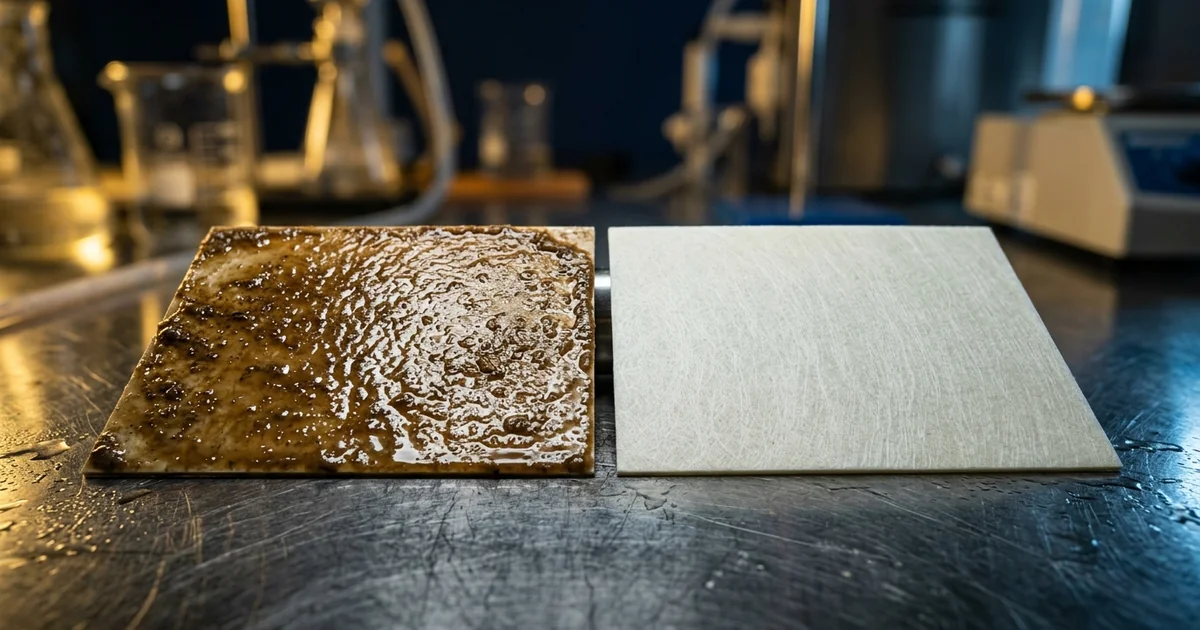
A reverse osmosis plant that has lost 10 percent of its normalised permeate flow needs a clean, but the nearest drum of acid or caustic is rarely the right answer. The choice of RO membrane cleaning chemicals decides whether foulants leave the membrane or set into it. The DuPont FilmTec manual warns that cleaning delayed too long can fail to restore performance, and that the interval between cleanings then becomes shorter. This guide explains how to identify the foulant, how acid, alkaline, chelant and reductive cleaners work, how the clean-in-place sequence runs and how a cleaner is qualified. It draws on the manufacturer's manual, a Bureau of Reclamation study of cleaning mechanisms and ASTM practices. It also reflects the formulation support Global Formulation gives water treatment chemical makers.
When an RO Plant Needs Cleaning: Triggers and Normalised Data
Cleaning should start from normalised data, not from a calendar or a hunch. Raw permeate flow falls when feed water cools, so a winter dip can look like fouling when the membrane is fine. Normalisation corrects flow, salt passage and pressure drop to reference conditions so that a real trend becomes visible. ASTM D4516 standardises this calculation for permeate flow, salt passage and the coefficient of performance.
The DuPont FilmTec manual (Form 45-D01504, Revision 20) names three triggers for cleaning:
- Permeate flow — the normalised permeate flow drops by 10 percent.
- Salt passage — the normalised salt passage rises by 5 to 10 percent.
- Pressure drop — the normalised pressure drop between feed and concentrate rises by 10 to 15 percent.
The manual adds that a pretreatment malfunction, a pressure control fault or a rise in recovery can produce the same symptoms, so those causes come first. Differential pressure should be recorded across each stage, because plugged feed channels raise it. ASTM D4472 gives a recordkeeping guide for RO and NF systems that covers start-up reports, operating data, pretreatment data and a maintenance log. Without that record the decision to clean is guesswork, and the next step depends on the same data.
Identify the Foulant Before Choosing RO Membrane Cleaning Chemicals
Cleaning works best when it is tailored to the specific fouling problem, and the manufacturer states that a wrong choice can make the situation worse. The manual notes that fouling typically consists of a combination of foulants and scalants, so the diagnosis rarely gives a single answer. The evidence is cheap to collect and sits where operators already look. Gathering it before the first clean avoids the cost of a second one.
- Performance data — trends in normalised flow, salt passage and pressure drop, stage by stage.
- Feed water analysis — a potential fouling problem can already be visible there.
- Results of previous cleanings — the response of the system to different cleanings is itself an indicator.
- Filter deposits — material collected on the SDI filter pad and the cartridge filter can be analysed.
- Visual inspection — a reddish-brown feed line or lead element suggests iron, while slimy or gelatinous material suggests biological or organic fouling. Scale on the concentrate side feels like sandpaper.
- Spent cleaning solution — metals and total organic carbon in the first solution out, compared with fresh solution, indicate the foulant type.
| Foulant | Typical Evidence | Cleaner Family Preferred by the Manufacturer |
|---|---|---|
| Calcium carbonate | Hard deposit; foaming when an acid dissolves it | Hydrochloric acid at pH 1 to 2; citric or phosphoric acid as alternatives |
| Sulfate scale (calcium, barium) | Hard scale, difficult to remove | High-pH caustic with a chelant, caught early |
| Iron and metal oxides | Reddish-brown lead element and feed line | Sodium hydrosulfite at pH 5; citric, phosphoric or sulfamic acid as alternatives |
| Organics (humics, antiscalants, oils) | Slimy or oily film; deposits on filters | High-pH caustic, with surfactant or chelant, then a low-pH acid step |
| Biofilm | Slippery wet surface, odour | High-pH caustic, with surfactant or chelant; repeated soaks |
| Silica and metal silicates | Silica, aluminium and iron in the feed and the spent solution | Caustic with surfactant preferred; caustic with chelant as alternative |
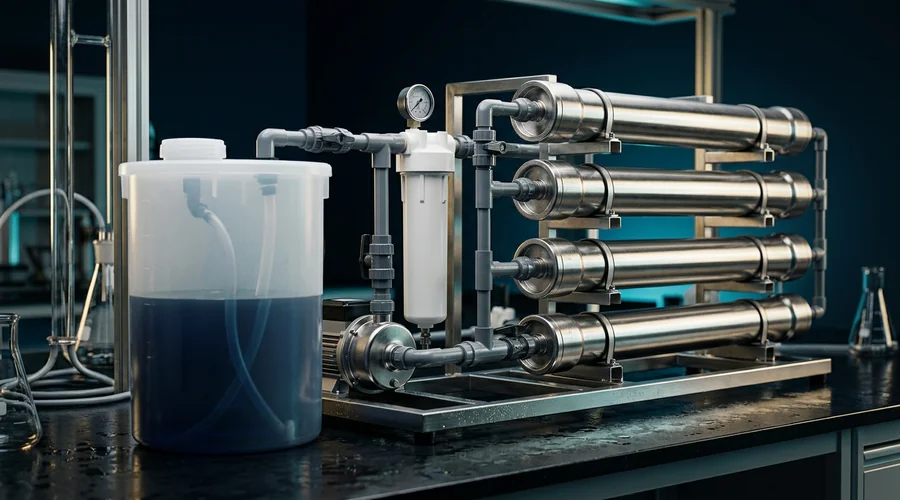
The table follows the cleaning solutions in the manual's sections 6.8 and 6.9. Our guide to RO antiscalant chemistry explains how scale reaches the membrane in the first place, and this article starts once the deposit is there. Each cleaner family works through a different mechanism, which the next two sections explain.
Alkaline Membrane Cleaner Chemistry: Hydrolysis, Chelants and Surfactants
An alkaline membrane cleaner attacks the organic and biological part of a deposit. High pH deprotonates carboxylic groups on organic foulants, which raises their negative charge and their solubility. The Bureau of Reclamation study, citing earlier work, notes that this raises solubility by nearly three orders of magnitude. Two additives then extend the reach of caustic: a chelant that strips divalent cations and a surfactant that solubilises what hydrolysis loosens.
- Sodium hydroxide — raises the pH and cleans organic-fouled membranes by hydrolysis and solubilisation.
- Chelants such as tetrasodium EDTA — remove divalent cations from complexed organic molecules. In a calcium-bridged organic layer this takes away the cross-links that hold the deposit together.
- Anionic surfactants such as sodium dodecyl sulfate — solubilise macromolecules by forming micelles around them. The manual says the most effective solution for oils usually contains a surfactant.
- Heat and soak time — warmer solutions remove organics better, and contact time is critical for biofilm.
The two main sources look different at first sight. FilmTec lists caustic alone, or caustic with sodium dodecyl sulfate, as preferred for biofouling and reports that the chelant version is slightly less effective by experience. Reclamation fouled a membrane with a model polysaccharide cross-linked by calcium. There, EDTA and sodium dodecyl sulfate cleaned effectively, while caustic at pH 11 recovered the flux poorly. Field guidance and a model deposit answer different questions, and both agree that the cleaner must match the foulant.
Alkaline chemistry handles organics, but caustic alone does not dissolve mineral scale, which needs an acid or a chelant at the right pH.
Acid Cleaning of RO Membranes: Scale and Iron Removal
Acid cleaning RO membrane elements removes the inorganic part of a deposit, mainly carbonate scale and metal oxides. Calcium carbonate dissolves easily in acid and releases carbon dioxide, which shows as foaming or bubbling in the cleaning loop. The manufacturer prefers hydrochloric acid at pH 1 to 2 for carbonate, with citric and phosphoric acids as alternatives. Sulfuric acid is excluded because the sulfate it adds risks calcium sulfate precipitation.
- Calcium carbonate — typical cleaning runs at 20 to 25 °C, and severe scale can need a solution heated above 35 °C. The clean is complete when the solution pH stops changing during recycle and high-flow pumping.
- Iron fouling — sodium hydrosulfite, a reducing cleaner, is preferred at pH 5. A typical soak lasts 2 to 4 hours, and the room needs ventilation because of its pungent odour.
- Sulfate scale — the preferred route is the high-pH chelant solution, not an acid. Added sodium chloride can help because sulfate solubility rises with salinity.
- Citric acid — an alternative for metal oxides and carbonate that the manual rates as less effective. Citric acid RO membrane cleaning can contribute to biofouling when it is not properly rinsed out.
Sulfate scale deserves a warning. The manual states that successful cleaning of sulfate scale older than one week is doubtful and that several cleaning and soak cycles can be needed. Early detection is a condition of success for any chemistry.
| Cleaner Family | Example Agents | Main Targets | Constraint Noted by the Manufacturer |
|---|---|---|---|
| Alkali | Sodium hydroxide | Organics, biofilm, silica | Biofilm best removed at high pH within the allowed envelope |
| Chelant | Tetrasodium EDTA | Sulfate scale, calcium-bridged organics, silica (alternative) | Slightly less effective than caustic alone on biofilm |
| Anionic surfactant | Sodium dodecyl sulfate | Oils, organics, biofilm, silica | Can precipitate at low temperature; avoid cleaning below 20 °C |
| Mineral acid | Hydrochloric, phosphoric | Carbonate, iron | Sulfuric acid not used |
| Organic acid | Citric acid | Carbonate, iron (alternative) | Less effective; rinse out fully |
| Weak acid | Sulfamic acid | Iron (alternative) | Listed at pH 3 to 4 |
| Reducing cleaner | Sodium hydrosulfite | Iron fouling | Ventilation; contact time is essential |
The same scale chemistry is covered in our guide to rust and scale removers for general industrial surfaces. A membrane adds a constraint of its own, namely the order in which acid and alkali are applied.
Cleaning Sequence: Why Alkaline Usually Comes First
The first cleaning step has to be chosen carefully because a fouled membrane usually carries mixed deposits. FilmTec strongly recommends alkaline cleaning as the first step. Acid cleaners react with silica, organics such as humic acids and biofilm on the membrane surface, and this can cause a further performance decline. Sometimes alkaline cleaning restores that loss, but often an extreme cleaning outside the manufacturer's limits is needed, and it can damage the membrane.
- Default to alkaline first — acid goes first only when the deposit is known to be calcium carbonate or iron oxide and hydroxide alone.
- Run two steps for mixed fouling — colloidal, organic or biological fouling combined with calcium carbonate needs alkaline cleaning followed by acid cleaning. The acid step starts once the alkaline step has removed the organic, colloidal and biological deposits.
- Test the order after a coagulant overfeed — reversing the cleaners can work better. If both orders dissolve a recovered sample equally well, the manual says to clean with high pH first.
- Clean each stage separately — otherwise foulant removed from stage one is pushed into stage two, and the improvement is minimal.
- Replace turbid or coloured solution — repeat the clean with a fresh batch instead of continuing with spent chemistry.
With the chemistry and the order chosen, the procedure decides how much of that chemistry reaches the deposit.
The Membrane CIP Procedure Step by Step
A clean-in-place run must deliver fresh chemistry to the fouled surface at the right temperature for long enough, then carry the loosened foulant out of the element. The Bureau of Reclamation study frames this as two mechanisms: the chemical reaction between cleaner and foulant, and the mass transfer of cleaner in and foulant out. Chemistry decides what can dissolve, while time, temperature and crossflow decide how much actually does. FilmTec lists six steps for every foulant, with small changes for each.
- Make up the solution — use permeate or deionised water, and make sure every chemical is dissolved and mixed before it circulates through the elements.
- Displace the process water — pump the preheated solution at about half the table flow and at low pressure. Use only enough pressure to cover the drop from feed to concentrate, so that little or no permeate forms and redeposition stays low.
- Recycle — return concentrate and permeate to the tank, let the temperature stabilise, then measure and adjust the pH.
- Soak — about one hour is sometimes enough, and difficult fouling benefits from a soak of 10 to 15 hours. Slow recirculation holds the temperature during a long soak.
- High-flow pumping — feed the solution at the table flow for 30 to 60 minutes to flush out the loosened foulant. For heavily fouled elements a flow 50 percent higher can aid cleaning, within the pressure drop limit.
- Flush out — use RO permeate or deionised water at 20 °C or above. Pre-filtered raw water is avoided because its components can react with the cleaner and precipitate foulants in the element.
Three controls keep the run on track. If the pH rises by more than 0.5 unit during an acid clean, more acid is needed. If it falls by more than 0.5 unit during an alkaline clean, more caustic is needed. During a long soak the temperature should not fall by more than 5 °C, so the solution is circulated at intervals.
- Pressure drop limit — the maximum is 15 psi per element or 50 psi per multi-element vessel, whichever is lower. These figures protect the membrane and are not cleaning criteria.
- Flow direction — for elements larger than 6 inches the flow must match normal operation to prevent telescoping.
- After the clean — divert the permeate to drain for at least 30 minutes or until it is clear, because cleaning chemicals remain on the permeate side.
- Shutdowns beyond 24 hours — store the elements in a sodium metabisulfite solution.
Suppliers of RO CIP chemicals should keep these six steps and limits intact in any membrane CIP procedure they issue. They are part of what makes a product safe to use. The steps assume a skid that can heat, mix, filter and pump, which is the next topic.
CIP Skid Design: Tank, Pump, Filter and Materials
A CIP skid is a small chemical plant that has to handle solutions from pH 1 to 13 at moderate temperatures. The FilmTec manual calls for non-corroding materials of construction for that reason. Sizing is simple, because it follows from the vessel volume and the flow each vessel needs. The manual's worked example for ten 8-inch vessels of six elements each, plus 50 feet of piping, arrives at a tank of about 2.1 m³.
- Mixing tank — polypropylene or fibre-reinforced plastic with a removable cover and a temperature gauge, sized to the empty pressure vessels plus the feed and return lines.
- Heating — an immersion heater, or a cooling coil in hot regions. Cleaning below 20 °C is not recommended because chemical kinetics are very slow.
- Pump — low pressure, in 316 stainless steel or a non-metallic composite, sized for the table flows plus losses in the piping and cartridge filter.
- Filtration — a 5 to 10 micron polypropylene cartridge filter and a 100-mesh security screen.
- Valves and lines — CPVC valves, and a line velocity of 3 m/s or less.
| Element Diameter | Feed Flow per Pressure Vessel (m³/h) | Note |
|---|---|---|
| 2.5 inch | 0.7 to 1.2 | Feed pressure 1.5 to 4.0 bar |
| 4 inch | 1.8 to 2.3 | Fullfit elements: 2.7 to 3.2 |
| 6 inch | 3.6 to 4.5 | Depends on elements per vessel |
| 8 inch | 6.0 to 10.2 | Fullfit and 440 ft² elements: 8.0 to 10.2 |
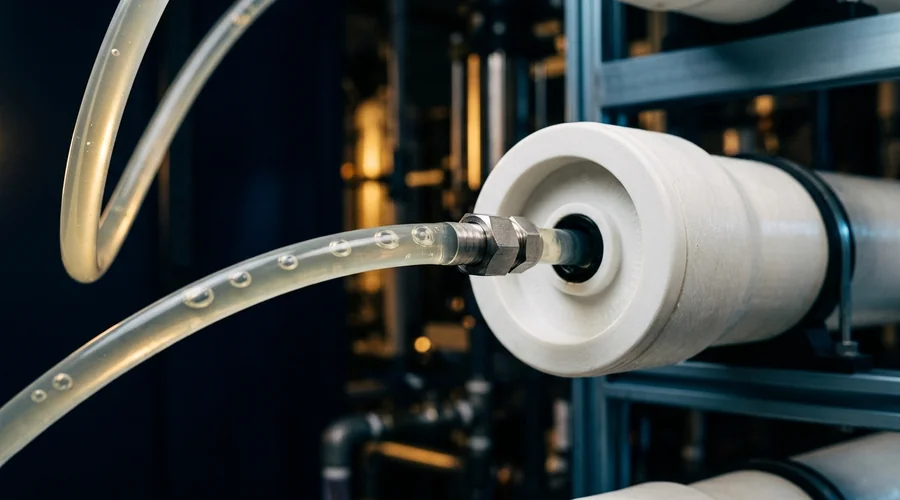
The flow values come from Table 36 of the manual and apply to the high-flow recycle step. The hydraulics suit the membrane, but chemistry still needs a pH and temperature the element can take, so the limits come next.
pH and Temperature Limits During RO Membrane Cleaning
Cleaning at the wrong pH or temperature either fails to remove the foulant or damages the membrane. The manufacturer's limits depend on the element type, and nanofiltration elements have a narrower window than reverse osmosis elements. Warm solutions clean better, but the window closes as the temperature rises. Sodium dodecyl sulfate can also precipitate at low temperature, which is one more reason to stay at 20 °C or above.
| Element Type | At 25 °C | At 35 °C | At 45 °C | At 50 °C |
|---|---|---|---|---|
| Brackish, seawater, low-energy, heat-sanitisable RO and NF90 | pH 1 to 13 | pH 1 to 12 | pH 1 to 10.5 | Contact the supplier |
| Other nanofiltration elements (NF270, NF200 and similar) | pH 1 to 12 | pH 1 to 11 | pH 3 to 10 | Not allowed |
The values are the pH ranges in Table 35 of the manual. They define the envelope inside which any cleaner must work, whatever the label says.
Cleaning removes deposits within these limits, and where biofouling keeps returning the system also needs sanitisation.
Sanitisation After Cleaning: Peroxide, Heat and What to Avoid
Cleaning removes deposits, but a biofilm regrows quickly if living organisms remain. The FilmTec manual says a biofilm can appear within 3 to 5 days after inoculation with viable organisms in biologically active feedwater. The most common sanitisation frequency is every 3 to 5 days at peak biological activity and about weekly at low activity, set site by site. Sanitisation applies biocidally effective solutions or hot water while the system is offline, and it has its own compatibility limits.
- Hydrogen peroxide or peroxide with peracetic acid — used successfully on FilmTec membranes. The solution stays at or below 25 °C, a pH of 3 to 4 gives the best biocidal result, and use is limited to once or twice a week.
- Iron control — iron or other transition metals together with peroxide degrade the membrane, so an acid clean removes iron first.
- Chlorine products — free chlorine, chlorine dioxide and combined-chlorine biocides are generally not recommended.
- Iodine, quaternary and phenolic biocides — they cause flux losses and are not recommended.
- Hot water — suitable for heat-sanitisable elements. It reaches dead legs, is easy to validate and leaves no chemical to rinse out.
The manual recommends an alkaline clean before sanitising, because deposits harbour microorganisms, and removing them raises the degree of sanitisation. After the elements are clean, one extra cleaning removes the last biofilm layer, which would otherwise attract and trap dirt. In severe biofouling, slug dosing of a biocide can enhance the result of the cleaning.
Biocides follow their own compatibility protocol, with a one-year soak test or a 1,000-hour continuous test, so a sanitiser needs separate evidence from a cleaner.
Formulating and Qualifying RO Membrane Cleaning Chemicals
A cleaner formulator works inside constraints that the membrane sets. The product must dissolve the foulant at a pH and temperature the element tolerates. It must rinse out completely, because cleaning chemicals remain on the permeate side after cleaning. It must also pass a compatibility protocol, since the manual warns that a cleaner with excellent cleaning performance can still degrade a membrane over time.
- Alkaline products — an alkalinity source combined with a chelant, an anionic surfactant or both. Test them on calcium-organic deposits as well as biofilm, given the Reclamation result.
- Acid products — mineral or organic acid systems for carbonate and iron, with no sulfate-forming acids. Rinsability matters most for organic acids.
- Reducing products — hydrosulfite-based iron cleaners, where odour, ventilation and contact time drive the use instructions.
- Documentation — the Reclamation report notes that the composition of commercial cleaners is often unknown to users, so a clear technical sheet is a selling point.
The manual describes a qualification protocol using flat-cell membrane coupons for cleaners used about once a month or less:
- Soak test — soak at least three coupons in normal-strength solution for two weeks, ideally at the maximum allowed cleaning temperature, then retest at standard conditions.
- Two-hour cleaning test — circulate double-strength solution over the membrane at the recommended temperature and 50 psi for two hours.
- Rinse — flush with low-conductivity water so that both the permeate and brine sides are confirmed rinsed.
- Pass criteria — flux loss below 5 percent and no rise in salt passage after the two-hour test, and no rise in salt passage after the two-week soak.
For drinking water supply, NSF/ANSI/CAN 60 (2020 edition) defines separation process cleaners and sets how carryover into finished water is assumed. Where the manufacturer supplies no data, it assumes 100 percent carryover for ingredients below 500 molecular weight. Our guides to surfactant selection for cleaning formulations and industrial degreaser formulation cover the surfactant and alkaline building blocks in more depth. Qualification gives a cleaner its credibility, and what happens when even a good cleaner fails is the next question.
When Cleaning Fails: Limits, Emergency Cleaning and Autopsy
Cleaning is not a guaranteed repair. The manufacturer states that cleaning cannot succeed when the membrane itself is damaged or when it is heavily fouled or scaled, typically with permeate flow below 50 percent of specification. Waiting too long also makes the next fouling event come faster. Recognising these limits early separates a salvageable system from one that needs new elements.
- Emergency cleaning — when the pressure drop has doubled or normalised flow has fallen by 50 percent, standard cleaning has limited success. The manufacturer gives no warranty on harsher methods or on performance afterwards.
- Cleaning evaluation — procedures are tried on membrane samples first and applied to the whole system once they prove effective.
- Spent solution analysis — metals and organic carbon in the used solution point to the foulant that was removed.
- Autopsy — the destructive analysis of an element is the final method to determine the cause of a performance loss.
Our articles on coagulant selection and polyelectrolyte flocculant selection cover the pretreatment side. Cleaning treats the symptom, and the fix that lasts is the correction of the upstream cause.
Working With a Water Treatment Formulation Consultant
Decisions at the bench decide how a cleaner behaves on a plant. A product that damages a membrane after repeated use, rinses slowly or works only on one foulant traces back to early formulation choices. A water treatment formulation consultant tests those choices against realistic deposits before launch. Water treatment chemical product development services then carry the work through documentation, scale-up and supply.
- Product range design — alkaline, acid, chelant and reducing cleaners matched to the foulants and membrane types of the target market.
- Compatibility programme — coupon soak and cleaning tests planned with a partner laboratory against the protocol above.
- Rinsability and carryover — ingredient choices reviewed for rinse-out and for drinking water use where required.
- Procedure sheets — CIP instructions that keep inside the supplier's pH and temperature limits.
- Scale-up and supply — transfer to an industrial water chemicals contract manufacturing partner with defined quality checks.
The full range of services sits under water treatment, and our overview of water treatment technology and formulations places cleaners beside the other product families. Anyone planning a new range can start with our guide to starting a water treatment chemical manufacturing business. Before committing to a product, collect the target membrane types, the common foulants and the rinse-water quality available on site. Those three inputs shape every decision in this article.
Frequently Asked Questions
What chemicals are used to clean RO membranes?
The standard cleaners are acids and alkalis. Acid cleaners such as hydrochloric acid remove inorganic precipitates including carbonate scale and iron, while alkaline cleaners based on sodium hydroxide remove organic fouling and biological matter.
Chelants such as tetrasodium EDTA, anionic surfactants such as sodium dodecyl sulfate and reducing cleaners such as sodium hydrosulfite extend the range. The right choice depends on the foulant found on the membrane.
Should an RO membrane be cleaned with acid or alkaline first?
The DuPont FilmTec manual strongly recommends alkaline cleaning as the first step. Acid cleaners react with silica, organics such as humic acids and biofilm, which can cause a further decline in performance.
Acid should go first only when the deposit is known to be calcium carbonate or iron oxide and hydroxide alone. For mixed fouling the manual calls for an alkaline clean followed by an acid clean.
When does an RO membrane need cleaning?
The manufacturer gives three triggers based on normalised data. They are a 10 percent drop in permeate flow, a 5 to 10 percent rise in salt passage and a 10 to 15 percent rise in pressure drop.
Normalising the data matters because a cold feed lowers permeate flow without any fouling. The manual also says a pretreatment fault or a change in recovery should be ruled out before cleaning.
Why is sulfuric acid not used to clean RO membranes?
The FilmTec manual says sulfuric acid should not be used for cleaning because of the risk of calcium sulfate precipitation. The acid adds sulfate to a loop that already carries calcium from the dissolved scale.
Hydrochloric acid is the preferred choice for carbonate scale, with citric and phosphoric acids as alternatives.
Can citric acid be used for RO membrane cleaning?
Yes. The manufacturer lists citric acid as an alternative for metal oxides and calcium carbonate scale, but rates it as less effective than the preferred cleaners.
The manual also warns that citric acid can contribute to biofouling when it is not rinsed out properly. Complete flushing with permeate or deionised water is part of the procedure.
How long should the cleaning solution soak in the membranes?
A soak of about one hour is sometimes enough, and difficult fouling benefits from an overnight soak of 10 to 15 hours. Slow recirculation holds the temperature during a long soak, which should not fall by more than 5 °C.
High-flow pumping then runs for 30 to 60 minutes to carry the loosened foulant out of the elements. After the flush, the permeate goes to drain for at least 30 minutes or until it is clear.
What happens if RO membrane cleaning is delayed?
The manufacturer states that cleaning delayed too long can fail to restore performance, and that the time between cleanings becomes shorter as the elements foul or scale faster. Sulfate scale older than one week is especially hard to remove.
When the pressure drop has doubled or normalised flow has fallen by 50 percent, standard cleaning has limited success. Harsher cleaning carries no warranty from the manufacturer.
How can a water treatment formulation consultant help with membrane cleaners?
A consultant designs the cleaner range around the foulants and membrane types of the target market. The work includes selecting alkalinity, chelant, surfactant and acid systems and planning compatibility tests with coupons.
The same team prepares procedure sheets that respect the supplier's pH and temperature limits and supports scale-up to an industrial water chemicals contract manufacturing partner.
Developing a Membrane Cleaning or Sanitising Product?
Global Formulation supports water treatment chemical makers with cleaner range design, compatibility test planning, procedure sheets, scale-up and technology transfer to a contract manufacturing partner.
Talk to Our Formulation Team