RO Antiscalant Selection: Chemistry and Scaling Control
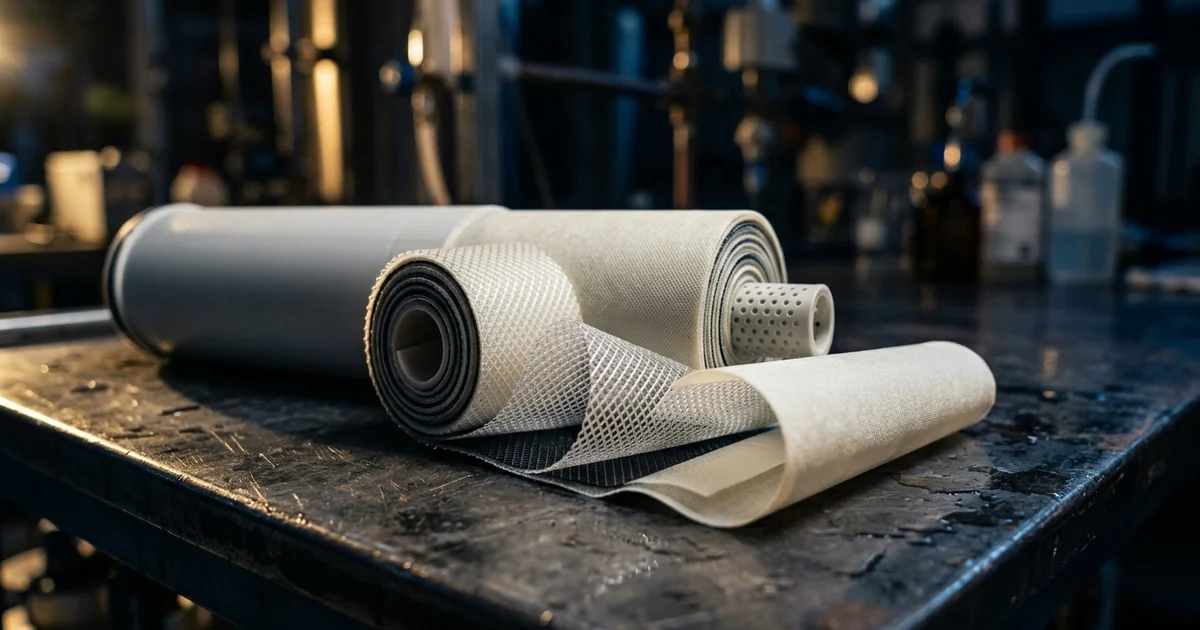
A reverse osmosis system fed with water rich in calcium, bicarbonate or sulfate can scale within hours, according to the FilmTec troubleshooting guide. The deposit usually starts in the last stage, feels hard and rough, and cannot be wiped off. An RO antiscalant prevents this by holding supersaturated salts in solution, but only when its chemistry matches the scalants that the concentrate stream actually reaches. A mismatched product can leave silica untouched, gel with upstream cationic polymers or feed the biofilm. This guide explains how membranes scale, how scaling is predicted, how phosphonates and polymers differ and how to test a product before it reaches a plant. It draws on the DuPont FilmTec manual, ASTM practices and open peer-reviewed studies, together with the formulation support Global Formulation gives water treatment chemical makers.
Why RO Membranes Scale and What an RO Antiscalant Must Control
Membrane scaling is a concentration problem. Every litre of permeate removed leaves its dissolved salts behind in a smaller volume of concentrate. The DuPont FilmTec manual states that at 50 percent recovery the concentrate carries almost double the feed concentration. Sparingly soluble salts cross their solubility limit first, so the scale that limits a plant depends on recovery and feed chemistry.
- Concentration factor — with complete salt rejection, the concentrate is 1 divided by (1 minus recovery) times the feed. That gives four times at 75 percent recovery and ten times at 90 percent. This is simple mass-balance arithmetic, not a measured plant value.
- Concentration polarisation — as element recovery rises, the effective osmotic pressure at the membrane surface rises with it. The FilmTec manual links this to lower permeate flow and to scaling or fouling.
- Position in the system — scaling usually starts in the last stage and moves gradually to the upstream stages.
- Speed — waters with high calcium, bicarbonate or sulfate can scale a system within hours. Barium and fluoride scaling is typically very slow because their concentrations are low.
- Seawater — osmotic pressure limits recovery to 30 to 45 percent, so scaling is a smaller problem than in brackish water. FilmTec still recommends a scale inhibitor above 35 percent recovery.
| Scalant | Where It Appears | −log Ksp at 25 °C | First Controls Before Dosing |
|---|---|---|---|
| Calcium carbonate | Brackish waters high in calcium and alkalinity | 8.5 (calcite) | Acid addition, softening, lower recovery |
| Calcium sulfate | Waters high in calcium and sulfate; sulfuric acid dosing adds sulfate | 4.3 | Lower recovery, softening |
| Strontium sulfate | Waters carrying strontium and sulfate | 6.4 (at 17.4 °C) | Same adjustments as calcium sulfate |
| Barium sulfate | Waters carrying barium; slow because concentrations are low | 10 | Same adjustments as calcium sulfate |
| Calcium fluoride | Fluoride-bearing waters | 10.5 | Lower recovery |
| Silica | Most natural feeds; polymerises into colloid and gel | Not a crystal; limit set by temperature and pH | Lower recovery, pH, temperature, metals removal |
| Calcium phosphate | Municipal wastewater reuse | Several phosphate minerals | Low feed pH, removal of aluminium and iron |
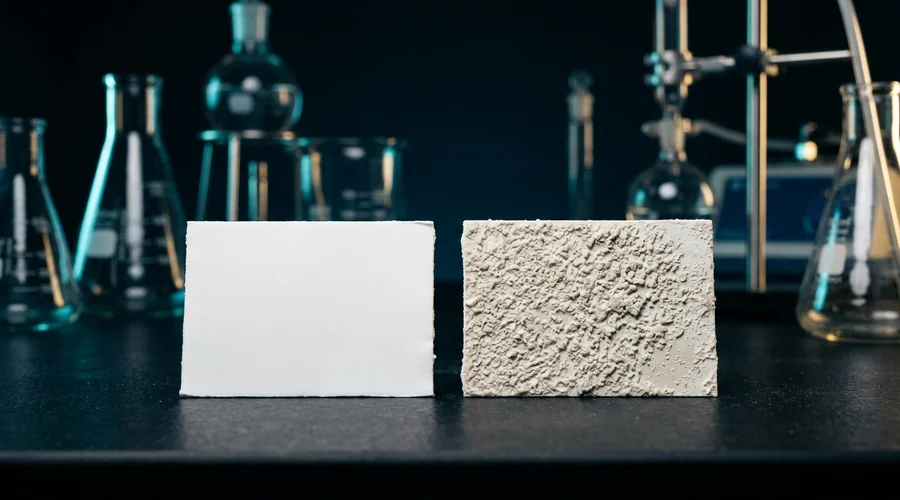
The solubility values come from FilmTec Table 11 and compare cleanly only between salts of the same stoichiometry, such as the three sulfates. A higher number means a less soluble salt. Our guide to scale inhibitor chemistry covers threshold inhibition across cooling, boiler and RO systems, while this article stays on the membrane. Different scalants respond to different controls, so the next step is to calculate which one limits recovery.
Predicting Scale: Ion Product, LSI and Silica Solubility
A scaling prediction is the specification for the antiscalant. The designer calculates the concentrate composition from the feed analysis and the recovery, then compares each salt with its solubility limit. ASTM publishes standard practices for these calculations, and the FilmTec manual adapts them. The result shows which scalant limits recovery and how far beyond saturation the product must hold it.
| Practice | Scale Covered | Applicability and Status |
|---|---|---|
| ASTM D3739-19 | Calcium carbonate, Langelier saturation index | Concentrates from 10 to 10,000 mg/L total dissolved solids; active |
| ASTM D4582-23 | Calcium carbonate, Stiff and Davis stability index | Concentrates above 10,000 mg/L, including seawater; active |
| ASTM D4692-01 (2026 reapproval) | Calcium, strontium and barium sulfate | Brackish water and seawater, RO and nanofiltration; active |
| ASTM D4993-89 | Silica | Withdrawn in 2023; the FilmTec manual still cites the 2003 reapproval |
- Ion product against Ksp — scaling can occur when the ion product in the concentrate reaches the solubility product. FilmTec advises adjusting the design when the calcium sulfate ion product exceeds 0.8 of Ksp.
- Carbonate — without an antiscalant, the concentrate LSI must be negative. FilmTec says polymeric organic scale inhibitors allow an LSI above 1 and refers the maximum to the supplier's literature.
- Acid — acid addition controls carbonate scale only. Sulfuric acid adds sulfate and can create a sulfate scaling risk.
- Silica — the concentrate silica concentration is compared with a solubility value corrected for temperature and pH.
- Operating plants — once a system runs, the indices can be recalculated from the measured concentrate analysis and compared with the projection.
Our guide to the Langelier and Ryznar indices explains how the carbonate index is built and where it fails. The RO versions differ because they work on the concentrate, not the feed.
Once the limiting scalant is known, the chemistry of the product can be matched to it.
RO Antiscalant Chemistry: Phosphonates, Polymers and Blends
Antiscalants do not soften water. They interfere with how crystals form and grow, so a supersaturated concentrate stays clear while it crosses the membrane. The literature describes three recurring actions: delaying nucleation, slowing crystal growth and dispersing particles before they attach. Which action dominates depends on the molecule and on the scalant it faces.
- Sodium hexametaphosphate — inexpensive but unstable. FilmTec says hydrolysis in the dosing tank lowers efficiency and creates a calcium phosphate scaling risk, so the manual generally does not recommend it.
- Organophosphonates — more effective and stable than sodium hexametaphosphate. FilmTec adds that they act as antifoulants that keep insoluble aluminium and iron in solution.
- Amino-phosphonates — EPRI reports that they are generally excellent inhibitors for sulfate salts and widely used in RO scale inhibitors.
- Carboxylate polymers — high molecular weight polyacrylates are generally known for reducing silica scale formation by dispersion, according to FilmTec. Polyacrylic and polymaleic compounds also inhibit the nucleation and growth of gypsum crystals.
- Phosphonate action — a 2025 open-access review reports that complexation with calcium lowers the activity of free Ca2+ and of amorphous calcium sulfate nuclei, which delays gypsum crystallisation. More phosphonate groups complex calcium more effectively.
- Polyacrylic acid action — the same review reports that anionic polyacrylic acid was much more effective against gypsum than neutral or cationic polymers in membrane distillation tests. It impedes the transformation of amorphous calcium sulfate nuclei into gypsum crystals.
- Charge — FilmTec notes that nearly all antiscalants are negatively charged, which sets up the incompatibilities in section 5.
| Chemistry Class | Main Role in RO | Reported Strength | Reported Limit |
|---|---|---|---|
| Sodium hexametaphosphate | Carbonate and sulfate inhibition | Low cost | Hydrolyses in the dosing tank and adds a calcium phosphate risk |
| Organophosphonates | Carbonate and sulfate inhibition; antifoulant for dissolved iron and aluminium | More effective and stable than sodium hexametaphosphate | Adds phosphorus to the feed and the brine |
| High molecular weight polyacrylates | Gypsum inhibition and dispersion, including silica per FilmTec | Strong effect on gypsum in the cited studies | Poisoned by iron and aluminium; gels with cationic polymers |
| Amine and PEG-type polymers | Research route to silica control | Hinder silicic acid polymerisation in static tests | Mixed or negative results in RO membrane tests |
Each row is a trade-off, and a formulator can combine classes to cover more than one scalant. Our guide to cooling tower water treatment shows how the same phosphonates behave when chlorine and heat enter the picture. In RO the dominant question is simpler: which scalant is the limit, and can any molecule hold it? Silica is where the answer is hardest.
Silica and Calcium Phosphate: Where an RO Antiscalant Reaches Its Limit
Silica does not crystallise. It polymerises from silicic acid into colloids and gel, and that difference changes which antiscalants can work. The 2025 open-access review states that current antiscalants are predominantly designed for crystallisation-driven scale such as calcite and gypsum. FilmTec says silica is usually the only reason to adjust operating variables for scale control, so recovery, pH and temperature matter as much as the dose.
- Natural levels — FilmTec reports dissolved silica in most feedwaters at 1 to 100 mg/L, mostly as undissociated silicic acid at or below neutral pH.
- Solubility levers — solubility rises below about pH 7.0 and above about pH 7.8. It also rises with temperature, up to the 45 °C limit for continuous use. A higher pH demands carbonate scale control.
- Metal silicates — FilmTec reports that aluminium is the most powerful precipitant of silicic acid. It says both aluminium and iron must stay below 0.05 mg/L in the feed, even when silica is below saturation.
- Polymer claims differ — FilmTec says high molecular weight polyacrylates can increase silica solubility. The 2025 review reports that an anionic polyacrylic acid that worked on gypsum had no effect on silica scaling in membrane distillation.
- Static versus dynamic — a 2023 Water Research study found that poly(ethylene glycol) performed well in static tests but poorly in membrane distillation and RO. Amine polymers extended recovery in membrane distillation but increased flux decline in RO.
- Calcium phosphate — this scale appears in municipal wastewater reuse. FilmTec says a low feed pH helps, aluminium and iron must be removed upstream, suitable commercial antiscalants exist and fouled membranes clean best at low pH.
Beyond failing to stop a scale, the product itself can foul the membrane, which is the subject of the next section.
Compatibility, Fouling and Biofouling Risks of an RO Antiscalant
An antiscalant that prevents scale can still damage a membrane. Fouling from the product arrives by two routes: reaction with other chemicals in the feed and nutrition for microorganisms. Both are documented in the FilmTec manual and in open peer-reviewed work. A formulator who ignores them ships a product that passes the jar test and fails in the plant.
- Cationic polymers — nearly all antiscalants are negatively charged and react with cationic coagulants or flocculants. FilmTec reports that membranes in several RO plants were heavily fouled by a gel formed this way.
- Multivalent metals — polymeric organic antiscalants form gum-like precipitates with aluminium, and acrylic-acid-based products are deactivated, or poisoned, by iron and aluminium. FilmTec describes the cleaning of these deposits as difficult.
- Overdosing — FilmTec says overdosing should be avoided. Gross overfeeding of any chemical can foul a membrane by convective deposition, and FilmTec warns against dosing that continues while the system is stopped.
- Nutrient effect — dosed chemicals such as antiscalants or acids must be selected carefully because they can serve as nutrients. Antiscalant fouling can also feed microorganisms.
- Phosphorus — the KAUST study grew biofilms in membrane fouling simulators at 3 and 6 µg P per litre. Those levels were measured at a seawater plant without and with a phosphorus-based antiscalant. Biofilms grown at the higher level were harder to remove by hydraulic cleaning.
- Brine — the same authors note that antiscalant phosphates concentrate in the brine and act as an algal nutrient when the brine is discharged to sea.
- Cleanability — a second KAUST study concluded that raising feed phosphorus to the level seen after phosphate-based antiscalant dosing harmed hydraulic cleanability and pressure drop restoration.
| Hazard | What Happens | Control From the Manual |
|---|---|---|
| Cationic coagulant or flocculant carry-over | Gum-like gel with the anionic antiscalant on the lead elements | Keep cationic polymer out of the RO feed and review all chemicals together |
| Iron or aluminium in the feed | Polymer antiscalant is deactivated; metal silicates form | Remove metals upstream and choose a product with stated tolerance |
| Overdose or dosing at standstill | Deposit of the chemical by convection | Interlock acid and antiscalant dosing pumps with the feed pump drive |
| Growth in the dosing tank | Microbes grow when the product is diluted below a threshold | Run a microbiological growth test and set a minimum dilution |
| Shutdown with brine in the vessels | Concentrated salt solution stays in the pressure vessels | Fit a flush system, which is mandatory with antiscalants, and flush with water free of scale inhibitors |
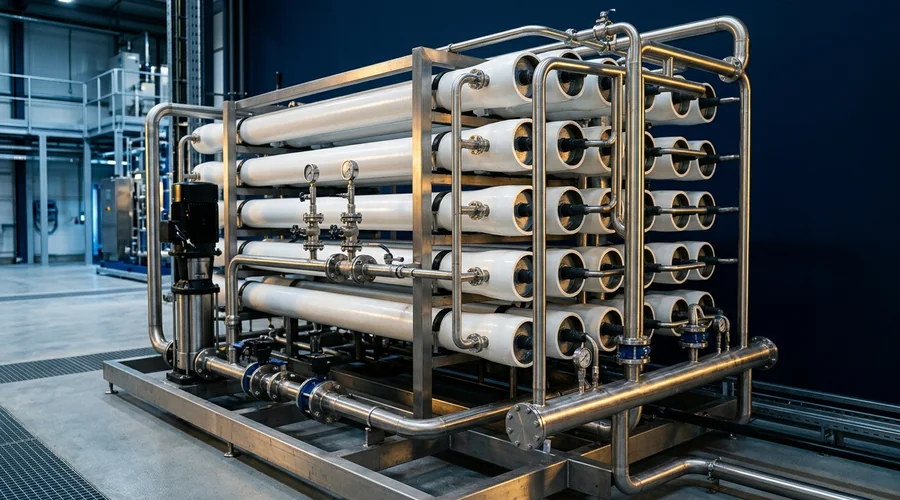
Many of these hazards start upstream, so our guides to coagulant selection and polyelectrolyte flocculant selection are worth reading with this one. Compatibility is a property of the whole chemical programme, not of a single drum. That is why selection has to follow a fixed sequence.
Selecting an RO Antiscalant: A Decision Sequence
Selection starts with the water and ends with evidence from the supplier. The sequence below places cheaper controls ahead of chemistry, because acid and softening change the scalant mix that a product must handle. Each step produces an input for the next.
- Analyse the feed — FilmTec says a complete feedwater analysis is required for sulfate scaling calculations. Include calcium, barium, strontium, sulfate, fluoride, silica, alkalinity, phosphate, iron, aluminium, pH and temperature.
- Fix recovery and layout — project the concentrate composition at the last element of the last stage.
- Find the limiting scalant — compare ion products, the LSI or Stiff and Davis index, and silica solubility.
- Use cheaper controls first — acid for carbonate, softening for calcium and a lower recovery for silica.
- Match the chemistry — use the table below to choose a direction for the limiting scalant.
- Screen against upstream chemicals — coagulants, flocculants, biocides and cleaning chemicals all interact with the product.
- Request the supplier's limits — FilmTec directs dosage and maximum index questions to the antiscalant manufacturer.
- Verify in operation — track normalised permeate flow, salt passage and differential pressure, and inspect a tail element if performance drifts.
| Limiting Situation | Chemistry Direction | Watch-Point |
|---|---|---|
| Carbonate only | Acid, or an organophosphonate or carboxylate polymer that allows a higher LSI | The LSI ceiling comes from supplier data |
| Calcium, strontium or barium sulfate | Amino-phosphonate or polymer with sulfate data | Acid adds sulfate; lower recovery or soften if the projection fails |
| Calcium fluoride | Adjust antiscalant dose or type, per FilmTec | Lower recovery if the product cannot hold it |
| Silica-limited | Lower recovery, adjust pH and temperature; test any polymer dynamically | Remove aluminium and iron first |
| Iron or aluminium present | Remove upstream; organophosphonates keep dissolved metals in solution | Polymer products are poisoned |
| Phosphate in wastewater reuse | Low feed pH and a phosphate-capable antiscalant | Reduce calcium, fluoride and aluminium |
| Permeate used as drinking water | Check the listing the regulator requires | NSF/ANSI/CAN 60 scope names corrosion and scale control chemicals |
The last row reflects the standard's scope, which covers health effects requirements for such chemicals and sets no performance requirement. The 2020 edition text states this, so confirm the current edition and the local rule. A selection is still only a hypothesis until it has been tested.
Testing an RO Antiscalant: From Bottle Test to 1,000 Hours
Testing an antiscalant is a ladder, and each rung answers a different question. Bench tests rank candidates quickly, but membrane tests decide whether a product is safe and effective on a real element. FilmTec states that its compatibility procedures show only whether a chemical appears compatible, not whether it works. A complete file therefore needs both performance data and compatibility data.
| Test | What It Answers | What It Cannot Answer |
|---|---|---|
| Static induction-time or jar test | How long a supersaturated solution stays clear with the product | Behaviour on a flowing membrane, which the 2023 study showed can differ |
| Dynamic membrane test | Flux decline and salt passage under supersaturation | Months of exposure to the product itself |
| Microbiological growth test | The lowest dilution at which the diluted product still resists growth | Scale control |
| 1,000-hour membrane compatibility test | Whether normalised permeate flow and salt passage hold during continuous dosing | Whether the product prevents scale |
| Field monitoring and autopsy | Real plant response, crystal type and deposit chemistry | A design value before the plant exists |
- Microbiological test — the diluted product is stored for one month and plate counts are taken weekly. The lowest concentration with declining counts becomes the minimum approved dilution in the dosing tank.
- Repeat rule — if the biocide composition of the antiscalant changes, the membrane compatibility test must be repeated.
- Compatibility baseline — the element first runs for at least 12 hours without the chemical. The test is invalid if permeate flow is more than 15 percent below the clean-membrane expectation.
- Autopsy clues — scale on a tail element is hard and rough and cannot be wiped off, and a foaming reaction with acid indicates carbonate. The type is confirmed by chemical analysis, EDXRF or ICP.
- Field evidence — FilmTec states that field observations and experience are by far the most reliable indication of compatibility and success.
With the tests defined, the remaining question is how the product itself is built.
Formulating an RO Antiscalant Product: Design Constraints
A finished antiscalant is a system, not a single molecule. The active chemistry sets scale control, while the rest of the product decides stability in the drum, behaviour in the dosing tank and tolerance of the plant's other chemicals. Formulation choices therefore trace back to the tests above. The constraints below come from the manuals and studies cited in this article.
- Active selection — match the phosphonate, polymer or blend to the limiting scalant, and state plainly which scalants the product does not cover, silica in particular.
- Hydrolytic stability — sodium hexametaphosphate hydrolyses in the dosing tank and adds a calcium phosphate risk, so storage and dilution stability belong in the specification.
- Dilution behaviour — define the minimum dilution at which the diluted product resists microbial growth, using the FilmTec test design.
- Biocide changes — any change to the biocide system triggers a repeat of the 1,000-hour membrane test.
- Phosphorus decision — weigh the open evidence on biofilm cleanability and brine nutrients against the need for scale data. A phosphorus-free product still needs its own scale-control evidence.
- Compatibility statement — publish the tolerance for cationic polymers and metals, because FilmTec names both as causes of gel and deactivation.
- Evidence file — keep static, dynamic, microbial and 1,000-hour data together, with the water chemistry and membrane type named.
- Regulatory check — where permeate becomes drinking water, ask the regulator which listing applies.
Our overview of water treatment technology and formulations places antiscalants among the other product families. Anyone planning a range can start with our guide to starting a water treatment chemical manufacturing business. The product is only as credible as its evidence file, and building that file is where outside help pays off.
Working With a Water Treatment Formulation Consultant
Choices made at the bench decide how an antiscalant behaves in a plant. A product that gels with a customer's flocculant, fails on silica or lacks a microbial test traces back to early formulation decisions. A water treatment formulation consultant tests those decisions against realistic waters before launch. Water treatment chemical product development services then carry the work through documentation, scale-up and supply.
- Scale projections — limiting scalant and recovery ceiling for the target waters.
- Route selection — phosphonate, polymer or blend matched to the scalant and the discharge rules of the target market.
- Compatibility mapping — behaviour with the coagulants, flocculants and cleaning chemicals the customer already uses.
- Test programme — static, dynamic, microbial and 1,000-hour studies planned with a partner laboratory.
- Documentation — an evidence file and compatibility statement that a plant owner can review.
- Scale-up and supply — transfer to an industrial water chemicals contract manufacturing partner with defined quality checks.
The full range of services sits under water treatment. Before committing to a product, collect a complete feed analysis, the recovery target and a list of every chemical upstream of the membrane. Those three inputs shape every decision in this article.
Frequently Asked Questions
What does an RO antiscalant do?
An RO antiscalant is a chemical dosed into the feed of a reverse osmosis system to stop sparingly soluble salts from forming scale on the membrane. It does not soften the water.
It interferes with nucleation and crystal growth so that a supersaturated concentrate stays in solution. The DuPont FilmTec manual states that an inhibitor lets the system operate above the solubility product when dosed according to the manufacturer's instructions.
Which scales can an RO antiscalant control?
The FilmTec manual says antiscalants can control carbonate, sulfate and calcium fluoride scaling, and that suitable commercial products exist for calcium phosphate. Barium and strontium sulfate follow the same adjustments as calcium sulfate.
Silica is the weak point. A 2025 open-access review states that current antiscalants are predominantly designed for crystallisation-driven scale, while silica forms by polymerisation.
Can an antiscalant replace acid dosing?
For carbonate scale it can. FilmTec says the concentrate LSI must be negative when no antiscalant is used. It adds that polymeric organic scale inhibitors allow an LSI above 1, with the exact ceiling set by the supplier.
Acid controls carbonate only, and sulfuric acid adds sulfate that can raise the sulfate scaling risk. An antiscalant also covers sulfate and fluoride scale, so the choice depends on which scalant limits the design.
Why do some antiscalants foul RO membranes?
Nearly all antiscalants are negatively charged. FilmTec reports that membranes in several RO plants were heavily fouled by a gel formed between cationic polyelectrolytes and antiscalants.
Polymeric products are also deactivated by iron and aluminium, and the resulting deposit can feed microorganisms. Gross overfeeding is a third route, because the chemical deposits on the surface by convection.
Is a phosphonate or a phosphorus-free antiscalant better?
Neither wins on every water. Phosphonates are more effective and stable than sodium hexametaphosphate, and EPRI reports that amino-phosphonates are widely used in RO scale inhibitors and generally excellent for sulfate salts.
Open studies from KAUST link added feed phosphorus to biofilms that are harder to clean by hydraulic flushing. They also note that phosphorus in brine can feed algae when discharged to sea. A phosphorus-free product still needs its own scale-control data on the target water.
Can an antiscalant stop silica scale?
Results are mixed. FilmTec says high molecular weight polyacrylates can increase silica solubility by dispersion. A 2025 review reports that an anionic polyacrylic acid that worked on gypsum had no effect on silica scaling in membrane distillation.
A 2023 Water Research study found that bench results did not predict RO behaviour. Amine polymers that helped in membrane distillation increased flux decline in RO, so silica control usually starts with recovery, pH, temperature and metals removal.
How is an RO antiscalant tested?
A complete file has four layers. These are a static clarity test, a dynamic membrane test, a microbiological growth test of the diluted product and a 1,000-hour membrane compatibility test.
FilmTec describes the last two. The compatibility test needs a baseline of at least 12 hours and no loss of normalised permeate flow or salt passage during continuous dosing. It shows only that the product does no harm, so a separate test must show that it prevents scale.
How can a formulation consultant help with an RO antiscalant?
A consultant projects the limiting scalant for the target waters, selects the phosphonate, polymer or blend route and maps compatibility with the upstream chemicals the customer uses. The same team plans the static, dynamic, microbial and 1,000-hour programme with a partner laboratory.
The work continues into the evidence file, the compatibility statement and scale-up to a contract manufacturer. A regulatory check for markets where the permeate becomes drinking water, such as an NSF/ANSI/CAN 60 listing, belongs in the same plan.
Developing an RO Antiscalant or Testing an Existing One?
Global Formulation supports water treatment chemical makers with antiscalant formulation, compatibility mapping, test programme design, product development and contract manufacturing.
Talk to Our Formulation Team