EIFS Insulation Adhesive and ETICS Base Coat Chemistry
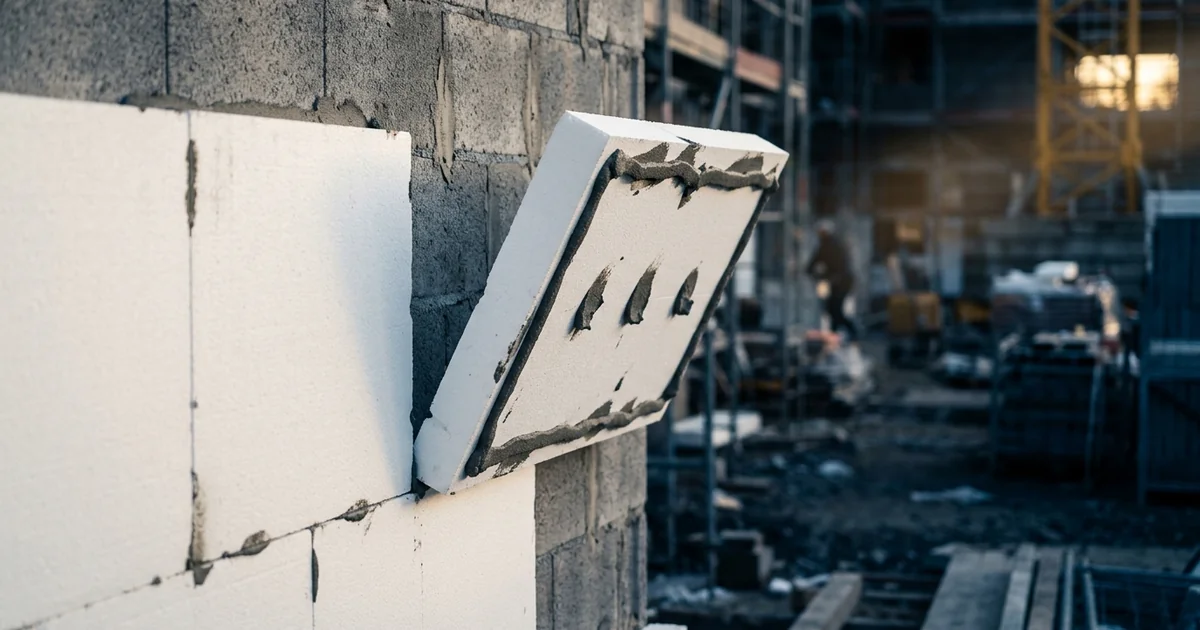
When an external insulation facade cracks along its board joints or sheds its render, the mortars and how they were applied are the first things to check. The adhesive holds the boards to the wall, and the base coat carries the mesh that holds the render together. An EIFS insulation adhesive and its matching base coat have to meet bond, water absorption and durability criteria set specifically for these systems. This guide explains the ETICS and EIFS system, the ETAG 004 bond and bonded-area rules, base coat and mesh requirements, impact categories, hygrothermal testing and the matching ASTM methods. It draws on the EOTA guideline text, a current European Technical Assessment and ASTM standard scopes, with formulation support from Global Formulation.
What ETICS and EIFS Are: Layers and System Types
ETICS and EIFS are two names for the same idea: insulation fixed to the outside of a wall and protected by a reinforced render. ETAG 004, the European guideline for these systems, applies them to masonry and concrete walls. The render is applied directly to the insulation boards with no air gap, and at least one of its layers contains a reinforcement. The system must give the wall a thermal resistance above 1 m²K/W, but it is non-load-bearing and is not meant to make the building airtight.
- Purely bonded — boards fully bonded or bonded in strips and dabs, with the adhesive carrying the load.
- Bonded with supplementary fixings — the adhesive carries the load, and anchors give stability until it dries or in a fire.
- Mechanically fixed with supplementary adhesive — anchors carry the load, and the adhesive mainly keeps the installed system flat.
- Purely mechanically fixed — anchors or profiles only.
North America uses the term EIFS. ASTM E2568 describes PB EIFS as expanded polystyrene or polyisocyanurate board, adhesive or mechanical attachment, glass fibre mesh, a base coat and a textured finish coat. It excludes EIFS with drainage, which has its own drainage efficiency method in ASTM E2273-25.
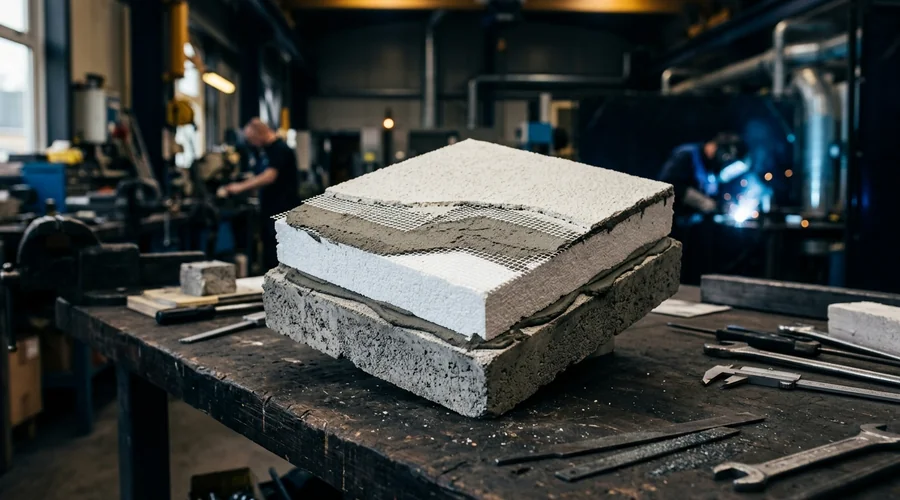
| Layer | Role (ETAG 004 Definitions) | Main Requirement Covered Here |
|---|---|---|
| Adhesive | Bonds the insulation product to the wall substrate | Bond to substrate and to insulation, dry and after water |
| Insulation product | Prefabricated board with high thermal resistance | Water absorption, shear strength, tensile strength |
| Base coat | Applied directly onto the insulation; carries the reinforcement and most mechanical properties | Bond to insulation, water absorption, crack behaviour |
| Reinforcement | Glass fibre mesh, metal lath or plastic mesh embedded in the base coat | Residual strength after alkali ageing |
| Key coat (optional) | Very thin coat preparing the base coat for the finish | Compatibility with base and finish coats |
| Finishing coat | Weather protection and decorative finish | Water absorption, vapour diffusion, impact |
Our overview of construction chemicals technology and formulations places these mortars in the wider product range. The adhesive is the first mortar applied, so it comes first.
EIFS Insulation Adhesive: Bond Criteria and Bonded Area
In a bonded system the insulation adhesive holds the whole system on the wall, so its criteria cover both dry and wet conditions. ETAG 004 notes that adhesives, base coats and finishing coats range from purely polymeric to purely cementitious binders. They come as factory dry mortars, powders needing extra binder, pastes needing cement, or ready-to-use pastes. Whatever the form, the adhesive has to grip two very different surfaces: a mineral wall and a soft, low-strength insulation board.
| Bond Test (ETAG 004) | Dry | 2 h After Water Immersion | 7 Days After Water Immersion |
|---|---|---|---|
| Adhesive to substrate | 0.25 MPa | 0.08 MPa | 0.25 MPa |
| Adhesive to insulation product | 0.08 MPa | 0.03 MPa | 0.08 MPa |
| Base coat to insulation product | 0.08 MPa after each conditioning, or cohesive failure in the insulation | ||
The wet tests follow 2 days of immersion, then either 2 hours or at least 7 days of drying at 23 °C and 50 percent relative humidity. For the adhesive-to-insulation bond, a result below 0.08 MPa still passes if the rupture occurs inside the insulation product. That rule recognises a simple fact: a board of low tensile strength cannot transmit more stress than it can carry.
The bonded area is calculated, not guessed. ETAG 004 sets the minimum bonded surface S as 0.03 MPa multiplied by 100 and divided by B. Here B is the minimum mean dry bond between adhesive and insulation, and S must exceed 20 percent. An adhesive that bonds to the insulation at less than 0.03 MPa would need more than 100 percent coverage, so such a system must be mechanically fixed.
Bead patterns, coverage geometry and pull testing on site are covered in our guide to acoustic and thermal insulation adhesives. The adhesive only fixes the board, though, and the base coat decides how the facade weathers.
ETICS Base Coat Render: The Layer That Carries the System
ETAG 004 defines the base coat as the coat applied directly onto the insulation, with the reinforcement embedded in it. The guideline adds that it provides most of the mechanical properties of the rendering. It has to bond to a board that moves with temperature, hold a mesh fully embedded and keep water out. Its formulation therefore balances adhesion, flexibility and water resistance at once.
- Bond to insulation — at least 0.08 MPa after each conditioning, or cohesive failure in the insulation, both before and after hygrothermal ageing.
- Water absorption — if the reinforced base coat absorbs 1 kg/m² or more in 1 hour, each complete rendering system must absorb less than 1 kg/m² in that hour.
- Freeze-thaw route — if both the base coat and the rendering system absorb less than 0.5 kg/m² in 24 hours, the system is judged freeze-thaw resistant. No separate cycling test is then needed.
- Vapour diffusion — the rendering system's diffusion resistance should normally not exceed 2.0 m on cellular plastic insulation or 1.0 m on mineral wool.
- Crack behaviour — the render strip tensile test reports the characteristic crack width, or elongation at rupture for organic renders that do not crack.
The cohesive-failure rule has a practical consequence for mineral wool systems. A 2023 European Technical Assessment for a mineral wool ETICS reports a base-coat bond below 80 kPa with cohesive failure in the insulation, both before and after ageing. The base coat passed because the board, not the mortar, was the weakest link.
Finish coat chemistry sits on top of this layer, and our guides to silicate mineral facade paints and texture coatings cover it. The base coat's strength, meanwhile, depends heavily on the reinforcement buried inside it.
Glass Fibre Mesh and Alkali Resistance
Glass fibre and cement are an uneasy pairing, because cement pore water is strongly alkaline and alkali attacks glass. ASTM E2098/E2098M-25 states the problem directly: base coats containing Portland cement expose the mesh fibres to weakening by alkali. A mesh that loses its strength no longer reinforces the base coat. Both European and North American methods therefore test the mesh after alkali exposure, not only as delivered.
- ETAG 004 ageing — samples are immersed for 28 days in an alkaline solution of sodium, potassium and calcium hydroxides at 23 °C, then rinsed, dried and tensile tested.
- Standard mesh criterion — after ageing, at least 50 percent of the as-delivered strength and at least 20 N/mm.
- Reinforced mesh criterion — after ageing, at least 40 percent of the as-delivered strength and at least 20 N/mm.
- ASTM E2098 result — breaking force per unit width and as a percentage of the unexposed mesh, used to compare meshes in the laboratory.
- Metal lath — galvanised or austenitic stainless steel, with a zinc coat of at least 20 µm applied after welding.
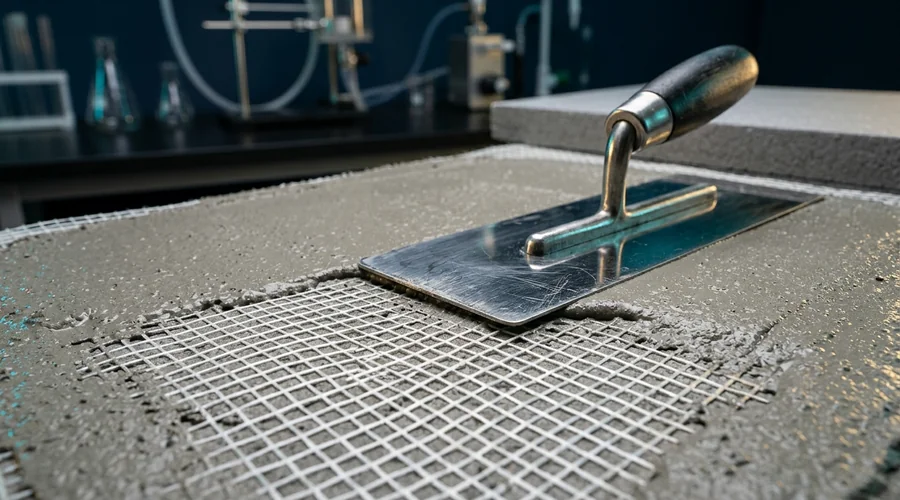
ETAG 004 separates two mesh roles. Standard mesh is embedded over the whole area and tied at joints by overlapping. Reinforced mesh is added on top to improve impact resistance and is generally laid without overlaps. ASTM notes that its alkali test does not simulate service conditions, and that EIFS performance also depends on proper installation and other factors. Mesh choice also drives the next property buyers ask about: impact resistance.
Impact Resistance: Categories I, II and III
A facade at ground level beside a car park faces very different abuse from one on the tenth floor. ETAG 004 handles this with three use categories, judged by hard-body impact with a steel ball and by a perforation test. The categories describe exposure examples, which Member States can apply differently, and they do not allow for vandalism. The rendering system, including any reinforced mesh, sets the category.
| Category | Example Use (ETAG 004 Table 8) | 10 J Impact | 3 J Impact | Perforation Test |
|---|---|---|---|---|
| I | Readily accessible at ground level, vulnerable to hard body impacts | No deterioration | No deterioration | Not perforated with a 6 mm indentor |
| II | Liable to thrown or kicked objects, or lower levels with careful access | Rendering not penetrated | No deterioration | Not perforated with a 12 mm indentor |
| III | Not likely to be damaged by normal impacts | Not required | Rendering not penetrated | Not perforated with a 20 mm indentor |
Superficial damage without cracking counts as no deterioration. In North America, ASTM E2486/E2486M-22 is the impact test method for Class PB and PI EIFS. The ETA we read placed its mineral wool system in category II. Impact covers sudden loads, while slow weathering is tested on a full-size rig.
Hygrothermal, Freeze-Thaw and Fire Testing
Weathering damage builds up through repeated heating, wetting and cooling. ETAG 004 reproduces that on a large test rig built with the complete system. The rig first faces 80 heat-rain cycles: heating to 70 °C, an hour of water spray and two hours of drainage. After conditioning it then faces 5 heat-cold cycles between 50 °C and −20 °C.
- Blistering or peeling — of any finishing coat, not allowed.
- Joint cracking — failure or cracking at insulation board joints or profiles, not allowed.
- Detachment — of the render coat, not allowed.
- Water-path cracking — cracks letting water reach the insulation, normally 0.2 mm or less, not allowed.
- Bond after ageing — at least 0.08 MPa, or cohesive failure in the insulation.
The insulation board has its own limits. Its water absorption must not exceed 1 kg/m² after 24 hours of partial immersion. For bonded systems, its shear strength must be at least 0.02 N/mm², with a shear modulus of at least 1.0 N/mm². The guideline only assesses insulation with a thermal conductivity of 0.065 W/(m·K) or less. In North America, ASTM E2485/E2485M-26 covers freeze-thaw resistance of EIFS.
Fire is classified separately under EN 13501-1, from A1 to F. The 2023 ETA links its classification to the organic content and heat of combustion of each component, which ties fire performance straight back to the mortar formulation. It also notes that no European reference fire scenario exists for facades, so some Member States require additional large-scale tests. Test results only hold, however, if the system is installed the way it was tested.
Installation Rules That Decide Field Performance
An ETICS is assessed as a system, and the assessment assumes it is installed by trained installers following the holder's instructions. ETAG 004 lists those assumptions explicitly, from substrate preparation to maintenance. Each one protects a property that was tested in the laboratory. For the mortar supplier, these rules belong in the technical data sheet, because they decide whether the tested bond values are ever reached on site.
- Substrate — strong, dry and free of loose material. New concrete must be free of mould oil, and old organic finishes need systematic removal.
- On-site testing — where substrate quality is in doubt, every result must reach at least 0.08 N/mm² for a bonded ETICS to be used.
- Board layout — rows staggered, joints tightly butted, and no render in the joints.
- Flatness — boards must form a flush surface so the reinforced base coat goes on at an even thickness.
- Embedment — the reinforcement fully embedded in the base coat, at the thicknesses stated in the assessment.
- Movement — facade lengths limited by the displacement test result, with expansion joints where needed.
- Storage — components protected from moisture during transport and storage.
ASTM C1397-25 is the North American practice for applying Class PB EIFS and EIFS with drainage. ETAG 004 also expects the finishing coat to be maintained, with prompt repair of local damage using compatible products. The standards behind all these rules have changed names over the years, which the next section untangles.
ETAG 004, EAD 040083 and the ASTM EIFS Standards
Product developers meet two families of documents, European and North American, and each has its own history. ETAG 004, whose 2011 edition is quoted in this guide, was written under the old Construction Products Directive. European Technical Assessments are now issued under Regulation (EU) 305/2011 on the basis of EAD 040083-00-0404, which the 2023 ETA we read cites in its 2019 edition. Check the current EAD for any criteria that changed from the ETAG.
| Property | European Route | North American Method (Active Edition) |
|---|---|---|
| System definition | ETAG 004 / EAD 040083-00-0404 | ASTM E2568-17a(2026), PB EIFS specification |
| Bond and tensile adhesion | Adhesive and base coat bond tests | ASTM E2134/E2134M-25 |
| Mesh alkali resistance | 28-day alkaline ageing, residual strength | ASTM E2098/E2098M-25 |
| Impact | Categories I, II, III | ASTM E2486/E2486M-22 |
| Freeze-thaw | Capillarity route or cycling | ASTM E2485/E2485M-26 |
| Drainage | No separate drainage test in ETAG 004 | ASTM E2273-25 |
| Insulation board | Harmonised specification of the board | ASTM E2430/E2430M-25 for EPS |
| Application | Installation assumptions in the ETA | ASTM C1397-25 |
The newer EAD-based ETA format also lists characteristics for foam adhesives, including their bond strength and post-expansion behaviour. CE marking under the Construction Products Regulation then follows from the assessment, and our guide to CE marking under the CPR explains that process. With the targets set, the formulation work can begin.
Formulating Adhesives and Base Coats for ETICS
Cement mortars modified with redispersible polymer powder are used for both layers. The patent background of US 6,709,508 describes the powder as an organic binder that improves adhesion to the substrate and the flexibility of the coating. Fillers, thickeners for rheology, dispersants and set-control additives complete the typical dry mortar. The skill lies in balancing these against bond, water absorption and crack criteria at the same time.
- Binder balance — the cement and polymer fractions together set strength, adhesion to the board and flexibility.
- Polymer powder — an organic binder for adhesion and flexibility. Our guide to polymer-modified cementitious systems explains the film-forming mechanism.
- Cellulose ether — the water retainer in the mix. ETAG 004 lists water retention capability among the identification tests for fresh mortar.
- Water resistance — the base coat formulation has to meet the 1 kg/m² and 0.5 kg/m² absorption figures in the rendering system it is sold with.
- Fire — organic content and heat of combustion of each mortar feed the reaction-to-fire classification.
- Shelf life — the same patent notes that tensile bond strength often falls when dry mortars are stored for long periods, so storage stability needs testing.
ETAG 004 also lists identification tests for the mortars: density, dry extract, ash content and particle size grading as delivered, plus water retention and fresh density of the mixed mortar. Those tests also give the manufacturer a basis for factory production control. The same polymer and cellulose ether logic appears in our tile adhesive formulation guide, though the targets differ. A specialist partner shortens the route from those targets to an assessed system.
Working With a Construction Chemicals Formulation Consultant
An ETICS adhesive or base coat is assessed as part of a system, so a mortar maker cannot prove it alone. A construction chemicals formulation consultant sets the targets against the ETAG or EAD criteria and the ASTM methods for the intended market. The work covers mortar design, testing and the technical file. Construction chemical product development services then carry the product into production with the controls the assessment requires.
- Target setting — bond, water absorption, crack and impact targets for the chosen insulation and finish.
- Mortar development — adhesive and base coat design for cementitious, polymer-modified or paste systems.
- Mesh compatibility — alkali ageing data and embedment trials with the chosen mesh.
- Pre-assessment testing — bond after water, water absorption and storage stability before the formal assessment.
- Documentation — installation instructions, technical data sheets and factory production control tests.
- Scale-up — transfer to a contract formulation scale-up partner with batch records and identification limits.
The full range of services sits under construction chemicals. Before a project starts, fix the insulation product, the target market and the impact category the system must reach. Those three choices set every mortar target in this guide.
Frequently Asked Questions
What is the difference between ETICS and EIFS?
Both describe an insulation board fixed to an external wall and covered with a reinforced render. ETICS is the European term used in ETAG 004 and EAD 040083-00-0404, while EIFS is the North American term used in ASTM standards such as E2568.
ASTM E2568 covers PB EIFS on expanded polystyrene or polyisocyanurate boards and excludes EIFS with drainage. ETAG 004 covers masonry and concrete walls with bonded or mechanically fixed systems.
What bond strength must an EIFS insulation adhesive reach?
Under ETAG 004, the adhesive must bond to the substrate at 0.25 MPa or more when dry and 0.25 MPa seven days after water immersion. Two hours after immersion the minimum is 0.08 MPa.
To the insulation board it must reach 0.08 MPa dry, 0.03 MPa two hours after water and 0.08 MPa after seven days. A lower value is accepted only if the failure occurs inside the insulation product.
How much of the board must be covered with adhesive?
ETAG 004 calculates the minimum bonded surface as 0.03 MPa multiplied by 100 and divided by the adhesive's minimum mean dry bond to the insulation. The result must exceed 20 percent.
If the adhesive bonds to the insulation at less than 0.03 MPa, the formula gives more than 100 percent. Such a system must be mechanically fixed.
What does the base coat do in an ETICS?
The base coat is applied directly onto the insulation, and the reinforcement is embedded in it. ETAG 004 states that it provides most of the mechanical properties of the rendering.
It must bond to the insulation at 0.08 MPa or fail inside the insulation, and it controls water absorption. The finishing coat then adds weather protection and decoration.
Why must the glass fibre mesh be alkali resistant?
The mesh sits inside base coats that contain Portland cement, which exposes the glass fibres to alkali attack. ETAG 004 ages mesh for 28 days in an alkaline hydroxide solution at 23 °C.
Standard mesh must then keep at least 50 percent of its original strength and at least 20 N/mm. ASTM E2098/E2098M-25 is the North American method for the same property.
What are impact categories I, II and III?
ETAG 004 ranks ETICS by resistance to hard body impact and perforation. Category I suits accessible ground-level zones exposed to hard impacts, category II zones liable to thrown or kicked objects, and category III zones unlikely to be damaged.
Category I requires no deterioration after a 10 joule impact, while category III requires only that a 3 joule impact does not penetrate the rendering. The categories do not allow for vandalism.
Which tests prove an ETICS can survive weather?
ETAG 004 uses a large rig exposed to 80 heat-rain cycles and then 5 heat-cold cycles. Blistering, render detachment, cracking at board joints and cracks letting water reach the insulation are not allowed.
Water absorption tests on the base coat and rendering decide whether a separate freeze-thaw test is needed. ASTM E2485 is the freeze-thaw method for EIFS.
How can a construction chemicals formulation consultant help with ETICS products?
A consultant sets the adhesive and base coat targets against the ETAG or EAD criteria and the ASTM methods for the target market. The team develops the mortar, runs bond, water absorption and storage tests, and checks mesh compatibility.
Construction chemical product development services then cover the technical file, factory production control tests and transfer to a contract formulation scale-up partner.
Developing an ETICS Adhesive or Base Coat, or Preparing for an ETA?
Global Formulation supports construction chemical manufacturers with adhesive and base coat mortar development, bond and water absorption testing, mesh compatibility, assessment preparation and scale-up with a contract manufacturing partner.
Talk to Our Formulation Team