Legionella Cooling Tower Control: Water Management Guide
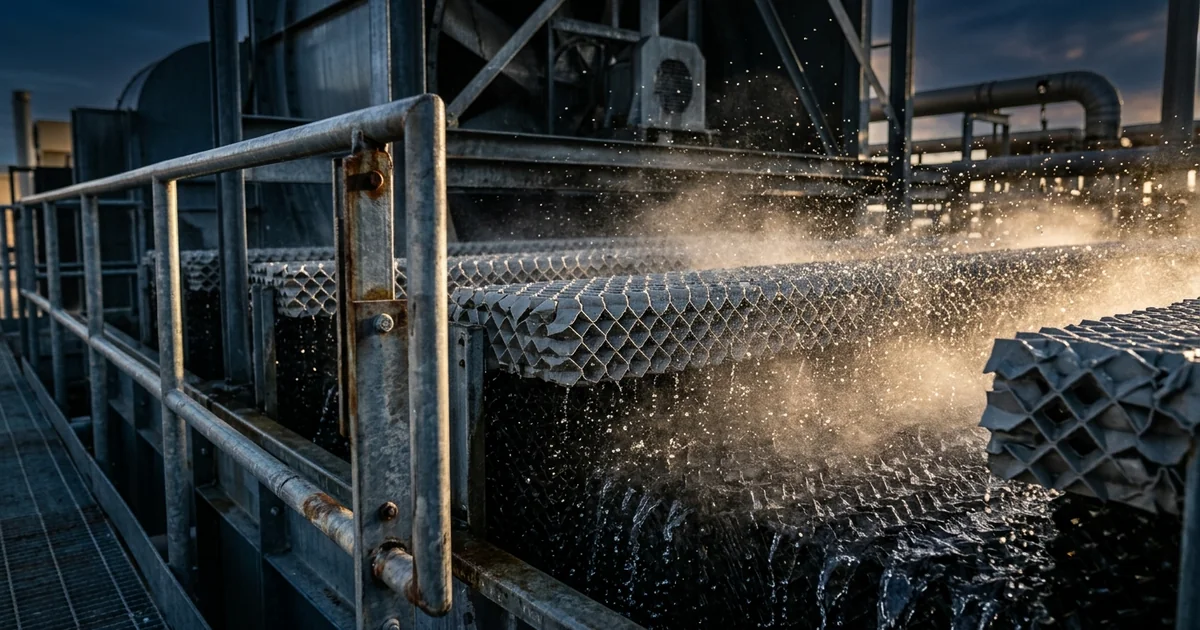
A cooling tower can look clean from the roof and still hold every ingredient of a Legionnaires' disease outbreak. It has warm recirculating water, surfaces for biofilm and a fan that throws droplets into the air. Legionella cooling tower control is therefore a management problem as much as a chemistry problem, because no single biocide dose protects a system that is fouled, stagnant or poorly documented. A missed control costs money in cleaning shutdowns and, in the worst case, harms people. This guide explains the risk factors, the role of biofilm and amoebae, the written control scheme, the biocide programme, the monitoring action levels and the response to a positive result. It draws on the UK Health and Safety Executive's HSG274 technical guidance and peer-reviewed studies of cooling tower microbiology, with formulation support from Global Formulation.
Legionella Cooling Tower Risk: Five Conditions in One Plant
The Health and Safety Executive lists five conditions that create a reasonably foreseeable Legionella risk in a water system. A cooling tower meets all of them in normal operation, which is why HSE gives evaporative cooling systems a dedicated part of its guidance. Legionella are found in almost all natural water sources in low numbers, so the question is never whether the organism can arrive. The question is whether the system lets it multiply and escape.
| Condition in HSG274 | How a Tower Supplies It | Control Lever |
|---|---|---|
| Water is stored or recirculated | The basin and the loop reuse the same water for weeks | Bleed, make-up quality, no stagnant sections |
| Water temperature between 20 and 45°C in all or part of the system | Warm return water and parts of the system can sit in this range | Enclosed basin, sound design, operating regime |
| Deposits such as rust, sludge, scale and organic matter | The tower acts as an air scrubber, so deposits build up over time | Corrosion, scale and fouling control, cleaning |
| Droplets are produced and dispersed | Airflow through the fill pack carries drift out of the tower | Drift eliminators and their upkeep |
| People are exposed | A tower placed near air inlets, windows or occupied areas exposes more people | Siting and the exposure assessment |
Each condition is a control lever, and the written scheme described below ties the levers together. Biofilm is the condition that chemistry alone struggles to remove, so it comes first.
Biofilm, Amoebae and Why Biocides Alone Fall Short
Biofilm is where Legionella control is won or lost. HSE notes that biofilm can harbour and protect legionella and provide an environment for its growth, so both surface-attached and free-floating bacteria need control. Protozoa add a second layer, because amoebae are natural hosts for Legionella pneumophila. Studies of cooling towers show how closely these organisms live together.
- Tower microbiome — a one-year sequencing study of three tower basins found site-specific communities that changed with the seasons. The groups shared by all three towers were mainly associated with biofilm, and Legionella-related groups appeared at generally low abundance.
- Amoeba partners — the same study's co-occurrence analysis captured known interactions between amoeba-associated bacteria and their hosts. A review of amoeba-associated microorganisms in cooling towers adds that standards typically concern only L. pneumophila, even though protozoa, other bacteria and viruses are also isolated.
- Shelter from hypochlorite — in a 2007 laboratory study, seven strains became non-culturable after hypochlorite treatment, while L. pneumophila inside Acanthamoeba polyphaga survived a four-times higher concentration. Non-culturable cells were resuscitated when the treated water was co-cultured with amoebae.
- Disinfectant differences — a 2011 comparison found that monochloramine worked equally on free and co-cultured L. pneumophila, while chlorine and chlorine dioxide were less efficient on the co-cultured bacteria.
- Mixed results — a 2004 study with thermotolerant amoebae found that association increased the sensitivity of Legionellae to chlorine. Amoebal cysts still remained viable after very high chlorine doses and 80°C.
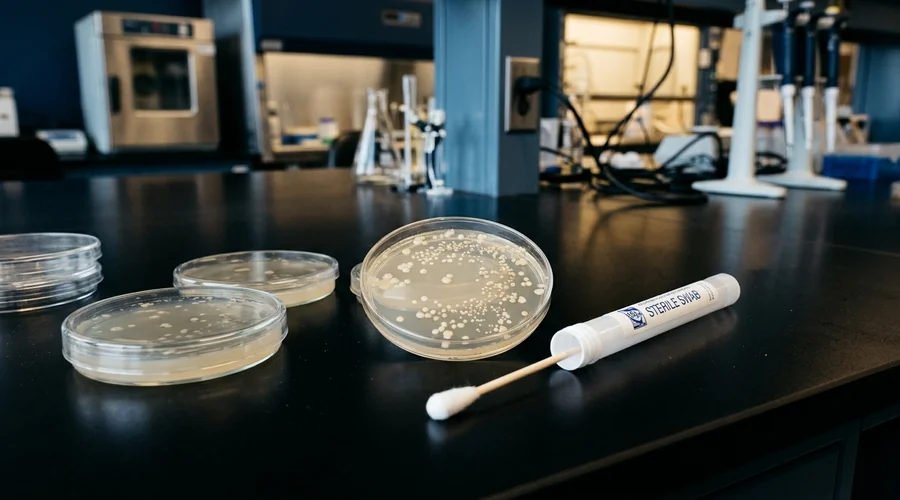
If biofilm and hosts shape the risk, the management system has to say who looks after them and how, which is the job of the written scheme.
Risk Assessment and the Written Control Scheme
In the UK, a Legionella risk assessment is a legal duty, and it is the starting point for any programme elsewhere. HSE's appendix lists what it must cover: how the system operates, where Legionella can grow, how it can escape as aerosol and who can be exposed. The assessment feeds a written control scheme that is specific to the plant on site. Competence matters, because inadequate management, lack of training and poor communication contribute to outbreaks.
- Growth potential — normal operating characteristics and intermittent use, low-flow areas and dead legs, process contamination, temperatures that promote growth, and the effectiveness of existing controls.
- Aerosol release — spray or splashes escaping from the tower, the process or associated operations, in normal or abnormal use.
- Exposure — the location of the equipment, the number of people likely to be exposed and their susceptibility.
- Scheme review — procedures, logbooks, treatment reports, cleaning records, analysis results, evidence of corrective action and evidence of competence.
The written scheme then states purpose, scope, management structure, a current schematic diagram, safe operation and the precautions in place. It lists the tests, inspections and calibrations with their frequencies and corrective actions, and the remedial action if the scheme proves ineffective. It also holds the safety information for the disinfectants used and an incident plan for very high microbial activity, repeat positive results and outbreaks. HSE adds that the assessment needs review after certain events. They include a change to the system or its use, new information, a check showing controls are no longer effective, a change of key personnel or a case of legionellosis. The scheme sets the duties, and the next section covers the engineering that makes them achievable.
Design and Operation: Drift, Dead Legs and Standby Plant
Good design removes risk that chemistry would otherwise have to carry. HSE asks for cooling systems that are safe to maintain, easy to clean and disinfect, and that limit the release of water droplets. Operation matters as much as design, because cases of legionellosis have been associated with systems that were not clean or properly commissioned. The table lists the points that HSG274 stresses most.
| Feature | What the Guidance Asks For |
|---|---|
| Drift eliminators | Fitted to every tower with fans; modern types should cut drift loss to under 0.01 percent of the water flow, with tight joints and no damage or scale build-up |
| Base tank | Fully enclosed against direct sunlight, sloped to a drain at the lowest point |
| Materials | Avoid natural rubber and untreated timber, which support microbial growth |
| Pipework | Keep it simple, with no dead legs or undrainable sections; flush stagnant sections such as standby pumps with biocide-treated water, typically once a week |
| Siting | Away from air conditioning and ventilation inlets and open windows |
| Idle or standby systems | If idle for more than a few days or on wet standby, dose with biocide and circulate at least once a week, running duty and standby pumps |
| Commissioning | Do not fill until commissioning begins; coordinate mechanical work, cleaning, disinfection and the water treatment system |
Hardware limits the aerosol, but the water inside the tower still needs a chemical programme, which is the next topic.
Chemical Control Programme: Biocides, Inhibitors, Dispersants
HSE treats water treatment as an essential control measure that must handle corrosion, scale and fouling as well as microbes. The links are direct: scale protects bacteria and reduces the effectiveness of biocides, deposits support growth, and soluble iron from corrosion can promote Legionella growth. A programme that controls only microbes leaves the conditions for regrowth in place. The biocide regime sits on top of that base.
| Programme Element | Role Against Legionella |
|---|---|
| Biocide regime | Keep the total viable count at or below 1×10⁴ cfu/ml and prevent Legionella proliferation; dosing should be automated |
| Corrosion inhibitors | Limit corrosion products and soluble iron; applied continuously, often by a pump paced from the make-up meter |
| Scale control | Softening, scale inhibitors, acid dosing or limits on concentration prevent scale that shelters bacteria |
| Dispersants and filtration | Keep solids mobile; side-stream filtration removes a share of circulating solids |
| Bio-dispersants | Special surfactants that help biocides penetrate and disperse biofilm |
| Make-up pre-treatment | Filtration, disinfection, reverse osmosis or softening to steady the incoming water |
Oxidising biocides, mainly chlorine and bromine compounds, form hypochlorous or hypobromous acid, which are more active than the corresponding ions, and their activity declines as pH rises. Bromine keeps more of its activity at higher pH. Chlorine dioxide is not affected by pH, does not react with ammonia and is often less affected by organic contamination. It is also more complex to dose, and its volatility makes a residual hard to hold, so HSE calls it a niche option. Overdosed oxidisers raise corrosion rates and degrade inhibitors, so dosing points must keep the two apart until both are well diluted. Our guides to oxidising and non-oxidising biocides and chlorine dioxide generation cover the chemistry in depth.
Non-oxidising biocides are normally shot dosed. Dosing frequency depends on system volume, half-life, re-infection rate and the contact time, which HSE gives as typically at least four hours. A programme should alternate two biocides with different kill mechanisms to limit tolerance, and pH and temperature affect efficacy. Concentration is hard to measure, although colorimetric and titration kits exist for isothiazolinone mixtures, bronopol and THPS, with coloured or turbid water able to mask the result.
Our guide to cooling tower water treatment covers the scale and corrosion side. The test results that show whether the programme works come from monitoring.
Monitoring: Dip Slides, Legionella Culture and qPCR
Monitoring answers two different questions. The first is whether the biocide programme is controlling microbes this week, and the second is whether Legionella itself is present this quarter. HSE sets a daily and weekly routine for the first and at least quarterly Legionella testing for the second. The action levels then turn each result into a decision.
| Task | Frequency in HSG274 |
|---|---|
| Check operation against the manual; visual check of water cleanliness | Daily |
| Physical condition of the system; dip slide analysis or equivalent | Weekly |
| Control function, conductivity sensor calibration, blow-down function | 1 to 3 monthly, by risk |
| Water distribution, sprays, troughs, drift eliminators, pack, base tank, fans (if accessible) | 1 to 3 monthly, by risk |
| Legionella culture | At least quarterly; weekly at commissioning or after a new treatment programme, until control is shown |
| Cleaning and disinfection | As determined by the risk assessment |
HSE then ties results to actions. The first scale reads the general aerobic count from dip slides, the second reads Legionella by culture.
| Result | Reading | Action Required |
|---|---|---|
| Aerobic count up to 1×10⁴ cfu/ml | Under control | No action |
| Above 1×10⁴ and up to 1×10⁵ cfu/ml | Caution | Review the programme, adjust the biocide dose if appropriate and resample after 24 hours |
| Above 1×10⁵ cfu/ml | Action | Shot dose or raise the continuous dose, then resample after 24 hours; review control measures if the count persists |
| Legionella not detected, or up to 100 cfu/l | Maintain controls | Keep the aerobic count below 1×10⁴ cfu/ml |
| Legionella above 100 and up to 1,000 cfu/l | Low-level count | Reassess the programme, adjust the biocide if the aerobic count shows poor control, resample to verify and again to check remedial action |
| Legionella above 1,000 cfu/l, or persistent low-level results | Immediate action | Resample, shot dose or raise the continuous dose, reassess the whole programme and resample within 48 hours |
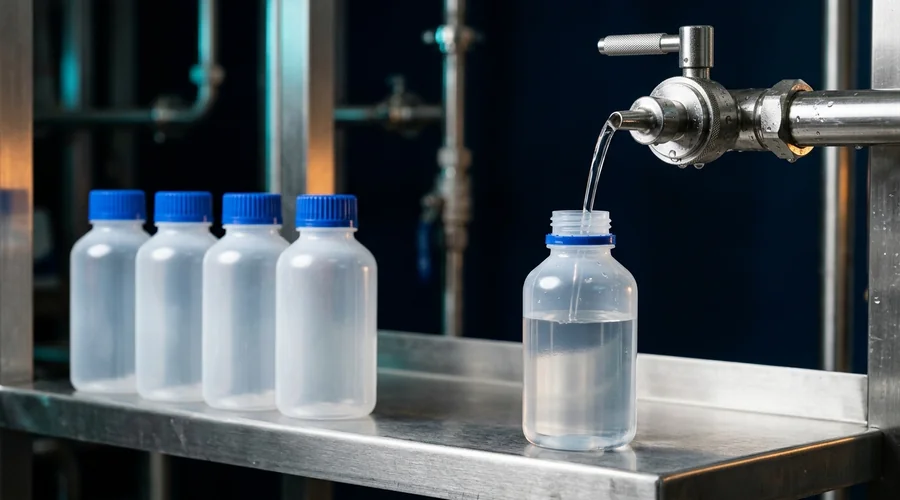
The sampling method shapes the result. HSE refers to BS 7592:2022 for sampling, with the biocide neutralised where possible, which is difficult for non-oxidising biocides. Samples should be taken near and downstream of the heat source, and just before a non-oxidising shot dose. Culture should follow BS EN ISO 11731:2017 in a UKAS-accredited laboratory, with incubation of 7 to 10 days. To detect levels below 100 cfu/l reliably, the portion plated should be equivalent to at least 30 ml of the original sample.
Quantitative PCR gives a faster answer. Its high negative predictive value suits it to ruling out sources in an outbreak and to checking a system before restart, but it detects DNA from live and dead cells. Its genomic units per litre are not directly comparable with culture counts in cfu/l.
When a result lands in the action band, the response follows a fixed sequence.
Responding to a Positive Result: Shot Dose, Clean, Disinfect, Restart
A high count triggers a sequence, not a single action. The first response is a precautionary shot dose or a higher continuous dose, followed by resampling and a review of the whole programme. A persistent problem points to the system itself, since deposits shelter Legionella and protect it from biocides. If a cooling system is implicated in an outbreak, emergency disinfection and cleaning must take place as soon as possible under the site incident plan.
- Disinfect before cleaning with an oxidising biocide and a bio-dispersant, to protect cleaning staff from aerosols. This step can be omitted where continuous automated dosing has consistently held microbial control.
- Circulate the disinfectant with the fans off for mixing, then switch the fans on so that it reaches the internal surfaces that get wet in operation.
- Clean manually and avoid methods that create excessive spray, such as high-pressure jet washing. Where jetting is needed, tent and isolate the area, close nearby windows and air inlets, and give staff suitable respiratory protection.
- Apply chemical cleaning where the deposit type calls for it, then sluice until the water going to drain is clear.
- Refill and disinfect again, then neutralise the residual before discharge with a reducing agent such as thiosulphate, sulphite or bisulphite, and check whether trade effluent consent is needed.
- Restart with a start-up dose of treatment chemicals including biocide, and record the work with photographs.
The disinfectant level and the circulation time trade against each other: the shorter the circulation, the higher the level required. Chlorine loses efficacy above pH 8, so HSE advises a heavy bleed-off, acid or added bromide rather than a larger chlorine residual. Bromine and chlorine dioxide do not need that adjustment. Cleaning frequency follows fouling, with HSE giving three typical timescales that are not prescriptive.
- Dirty environment — at least every three months for a tower prone to process or environmental contamination.
- Comfort cooling — at least twice a year for an air conditioning system.
- Clean industrial duty — at least every 12 months.
Photographs before and after cleaning help set the frequency. With the response covered, the last two sections look at the products and the people behind the programme.
Formulating Legionella-Control Products for Cooling Water
Product developers sit upstream of every control measure above. The biocide regime, inhibitor package and dispersants must work together, so compatibility is a design requirement and not a late check. HSE notes that high concentrations of oxidising biocides can degrade other cooling water chemicals, and that dosing arrangements must keep them apart until they are well diluted. Several formulation decisions follow from the guidance.
| Decision | Guidance Behind It |
|---|---|
| Oxidiser form and control | Halogen products come as tablets, granules or solutions; dosing can be controlled by redox or amperometric systems that follow oxidant demand |
| Waters that defeat chlorine | Ammonia or high organic loading can blunt chlorine and bromine; chlorine dioxide or a non-oxidising programme is the alternative |
| Non-oxidising pairs | Programmes alternate two biocides with different kill mechanisms, so products are designed and supplied as complementary pairs |
| Bio-dispersants | Used with oxidisers to penetrate biofilm, so they must tolerate the oxidiser |
| Single or separate products | Inhibitors and dispersant polymers can come as one multi-functional product or be dosed separately on large systems |
| Verification | Oxidiser residuals are easy to test in the field, while non-oxidising actives need dedicated kits or supplier methods |
| Safety and documents | Each chemical needs a safety data sheet and a COSHH risk assessment, and dosing should be automated to limit operator exposure |
Biocidal active approval and product authorisation add a regulatory layer in many markets, as our guide to the EU Biocidal Products Regulation explains. Premises disinfection products follow different standards, covered in our guide to hospital-grade disinfectants. The last section turns to working with specialists.
Working With a Water Treatment Formulation Consultant
Legionella control sits across water chemistry, microbiology, mechanical design and documentation, so a water treatment formulation consultant works across all four. The brief usually starts with the system type, the make-up water and the claims the product must support. Water treatment chemical product development services then carry a formulation from bench tests to field trials. Contract partners handle scale-up and supply.
- Programme design — biocide, inhibitor and dispersant packages matched to the make-up water and metallurgy.
- Compatibility testing — checks of oxidisers, inhibitors and bio-dispersants in the same programme.
- Verification methods — selection of field test methods that let customers confirm residuals.
- Customer documents — data sheets, dosing guidance and safety information that fit a site's written scheme.
- Regulatory pathway — the approval route for biocidal claims in the target market.
- Scale-up — industrial water chemicals contract manufacturing for pilot batches and supply, as in our guide to starting a water treatment chemical business.
The full range of services sits under water treatment, and our overview of water treatment technology and formulations shows how the product families connect. Before approaching a consultant, collect the system type, the make-up water analysis, the current programme, recent dip slide and Legionella results and the claims you need. Those inputs show where the programme leaves gaps.
Frequently Asked Questions
What is Legionella control in a cooling tower?
Legionella control is the set of design, operating, chemical and monitoring measures that stop Legionella bacteria multiplying in cooling water and reaching people as aerosol. It rests on a risk assessment and a written control scheme specific to the plant.
The chemical programme must control microbes, corrosion, scale and fouling together, because deposits and biofilm shelter the bacteria. Cleaning, drift control and regular testing complete the system.
What conditions let Legionella grow in a cooling tower?
HSE lists five conditions. Water is stored or recirculated, and its temperature is between 20 and 45°C in all or part of the system. Deposits such as rust, sludge, scale and organic matter support growth, droplets can be produced and dispersed, and people can be exposed.
A cooling tower meets all five in normal operation. Control therefore means removing or limiting each condition, not relying on one biocide.
How often should cooling tower water be tested for Legionella?
HSG274 recommends routine Legionella testing at least quarterly, using culture by BS EN ISO 11731 in an accredited laboratory. At commissioning, or after a new or modified treatment programme, sampling should initially be weekly until control is shown.
General microbial activity is checked more often, with dip slides or an equivalent test every week. More frequent Legionella sampling is also needed after a positive result or when the risk assessment calls for it.
What do the Legionella action levels mean?
In HSG274, a result that is not detected or up to 100 cfu per litre means controls should be maintained and the aerobic count kept below 10,000 cfu per millilitre. A result above 100 and up to 1,000 cfu per litre calls for reassessment of the programme and resampling.
A result above 1,000 cfu per litre, or persistent low-level results, needs immediate action. Resample, shot dose or raise the continuous dose, reassess the whole programme and resample within 48 hours.
Why can a biocide programme fail to clear Legionella?
Legionella lives in biofilm and in deposits, and it can grow inside amoebae. Laboratory studies show that amoebae protect Legionella from hypochlorite in some conditions, and that the effect varies with the disinfectant and the amoeba strain.
Scale and deposits also reduce biocide effectiveness. That is why HSE requires both attached and free-floating bacteria to be controlled, and why cleaning and deposit control sit beside the biocide dose.
How often should a cooling tower be cleaned and disinfected?
The frequency is set by the risk assessment, based on the fouling potential of the system. HSG274 gives three typical timescales that are not prescriptive. They are at least every three months in a dirty environment and at least twice a year for air conditioning comfort cooling. A clean industrial application needs cleaning at least every 12 months.
Inspections should be more frequent if water quality deteriorates, and photographs before and after cleaning help justify the interval.
Is qPCR better than culture for Legionella testing?
They answer different questions. Culture gives a count in cfu per litre that the HSE action levels are written for, but takes 7 to 10 days. Quantitative PCR is much faster and its high negative predictive value makes it a good screen for ruling out sources and for checking a system before restart.
PCR detects DNA from live and dead cells, and its genomic units per litre are not directly comparable with culture counts, so each result needs interpretation by a competent person.
How can a water treatment formulation consultant help with Legionella control?
A consultant designs the biocide, inhibitor and dispersant package for the make-up water and metallurgy, tests compatibility between oxidisers and the rest of the programme, and selects field verification methods. They also help prepare the documents that customers need for their written schemes.
Water treatment chemical product development services then cover pilot batches and scale-up, including industrial water chemicals contract manufacturing.
Developing a Legionella-Control Programme or Biocide Product?
Global Formulation supports water treatment chemical makers with programme design, biocide and inhibitor compatibility work, field verification methods and scale-up to a contract manufacturing partner.
Talk to Our Formulation Team