Industrial Water Biocide: Oxidising vs Non-Oxidising
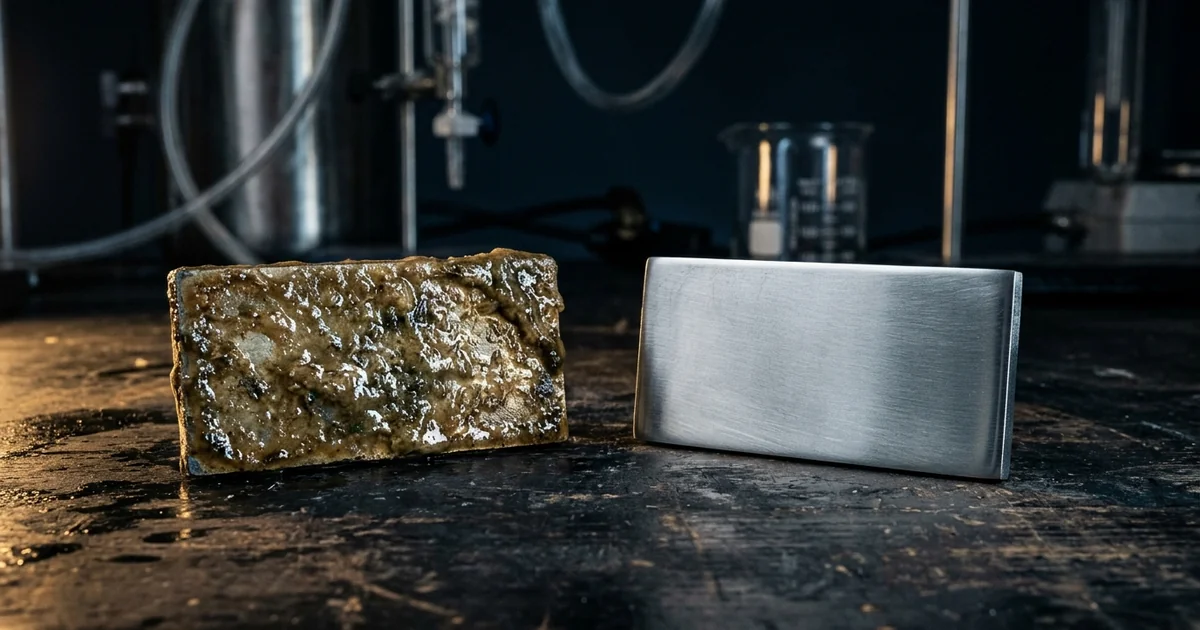
A cooling system can look clean and still carry a biofilm that insulates heat exchangers, feeds corrosion and shelters Legionella. Floating bacteria are easy to kill, but the cells that matter sit in a slime layer that shields them from the dose in the bulk water. An industrial water biocide programme therefore has to match chemistry to the target: oxidising agents for fast kill, non-oxidising agents for longer contact and dispersants to open the slime. This guide compares both classes on mechanism, pH behaviour, biofilm penetration, dosing, compatibility, discharge rules and monitoring. It draws on Veolia's cooling-tower guidance, US EPA decisions, 40 CFR 423 and laboratory studies, with formulation support from Global Formulation.
Industrial Water Biocide Basics: Planktonic Cells, Biofilm and Fouling
Microbial control starts with where the organisms live, not with which chemical is on the shelf. Bacteria enter an open cooling system from the air, the makeup water or a process leak, then attach to a surface and multiply into a biofilm. Veolia's cooling-tower guidance states that the ultimate objective of a biocide is to prevent that biofilm and limit pathogens. The damage differs by organism, as the list shows.
- Slime-forming bacteria — gram-negative organisms create slime that fouls heat exchangers and cuts cooling efficiency.
- Biofilm and corrosion — biofilm can lead to microbiologically influenced corrosion and severe localised metal loss.
- Algae and fungi — mats impede water flow, damage wood and tower structures and spoil appearance.
- Pathogens — Legionella pneumophila can create health concerns.
Veolia notes that dust brings nutrients into open towers and that food plants, oil contamination, secondary wastewater makeup and phosphates raise the risk. Higher biochemical oxygen demand or total organic carbon in the water means a greater risk of biological fouling. Our guide to cooling tower water treatment covers the wider scale, corrosion and fouling picture. With the target defined, the next section compares the two chemical classes aimed at it.
Oxidising vs Non-Oxidising Biocides: How the Classes Differ
The two classes kill in different ways and fail in different ways. Oxidising biocides work electrochemically: the oxidiser gains electrons and the cell component loses them, which changes a life function enough to kill the organism or stop it multiplying. Non-oxidising biocides work through poisoning processes such as interfering with reproduction, stopping respiration or lysing the cell wall. The table sets them side by side using Veolia's descriptions.
| Feature | Oxidising | Non-Oxidising |
|---|---|---|
| Examples | Chlorine, bromine, iodine, chlorine dioxide, ozone, hydrogen peroxide | Isothiazolines, DBNPA, carbamates, glutaraldehyde, methylene bisthiocyanate, polyquaternary amines |
| Mode of action | Oxidation of cell components | Poisoning: reproduction, respiration or cell wall lysis |
| Feed pattern | Continuous or intermittent | Generally shot-fed |
| Contact time | Acts on cells it reaches in the bulk water | Several hours up to a day |
| Selection factors | Water pH decides the active form of a halogen | Water pH, retention time, spectrum, biodegradability, toxicity and compatibility |
Veolia stresses that no single solution exists. The choice depends on water chemistry, pH, the organisms to control, compatibility with corrosion and scale inhibitors, system volume, retention time, temperature, design, materials of construction, discharge permits and cost. Oxidisers come first, because most programmes are built on a halogen.
Oxidising Biocide for Cooling Water: Chlorine, Bromine and Chlorine Dioxide
Chlorine is the usual base of an oxidising programme because it is cost-effective and accepted as a Legionella biocide. In water it exists as hypochlorous acid and hypochlorite ion, and the acid is the stronger oxidiser and penetrates cell walls better. The US EPA alternative disinfectants guidance manual gives the pKa of hypochlorous acid as about 7.5, so the mix shifts toward hypochlorite as pH rises. That shift is why pH decides whether chlorine or another oxidiser fits.
- Chlorine at neutral pH — hypochlorous acid dominates below the 7.5 to 8.0 range.
- Chlorine at alkaline pH — hypochlorite dominates above that range, yet Veolia notes it remains a strong oxidiser able to oxidise biofilm.
- Reservoir effect — the ratio of acid to ion is fixed for a given pH, so as hypochlorous acid is used up, hypochlorite shifts to replace it.
- Bromine — hypobromous acid has a pKa of 8.7 at 25 °C in the EPA manual, so more of it stays in the acid form at high pH.
- Combined bromine — Veolia says combined bromine compounds are more effective biocides than combined chlorine compounds and suggests bromine for high-demand or ammonium-rich waters.
- Chlorine dioxide and ozone — chlorine dioxide is more pH-independent and ozone is a stronger oxidant, and our guide to chlorine dioxide water treatment covers generation and chlorite limits.
The chlorine source matters as much as the species. Liquid sodium hypochlorite is commonly the most cost-effective, according to Veolia. Di- and trichloroisocyanurates cost more, but the cyanuric acid slows degradation by sunlight, and calcium hypochlorite adds calcium and scaling potential to the water. Oxidisers handle the bulk water, and the non-oxidising class is chosen for contact time and for different chemistry.
Non-Oxidising Biocide Selection: Isothiazolinone, DBNPA and Glutaraldehyde
Veolia's guidance says the choice of a non-oxidising biocide depends on pH, available retention time, efficacy against bacteria, fungi and algae, biodegradability, toxicity and compatibility. These products are generally shot-fed to hold a high enough concentration for long enough, and kill time runs from several hours up to a day. Hydrolysis rate sets how long a dose lasts, and it differs enormously between actives. The table uses US EPA decisions to show the contrast.
| Active | Chemistry Notes | Hydrolysis at 25 °C |
|---|---|---|
| DBNPA | Degrades to products including dibromoacetonitrile and dibromoacetic acid, depending on pH, light and nucleophiles | Half-life of 67 days at pH 5, 63 hours at pH 7 and 73 minutes at pH 9 |
| Glutaraldehyde | Stable under acidic to neutral conditions and degrades faster in alkaline water, forming a cyclic dimer | Half-life of 628 days at pH 5, 394 days at pH 7 and 63.8 days at pH 9 |
| Isothiazolinones | Highly electrophilic toward bacterial protein thiols, with rapid degradation and low environmental persistence | Not tabulated here |
The thiol chemistry of isothiazolinones comes from the abstract of a 2026 evolution study. The numbers show why pH belongs in the selection. DBNPA at alkaline pH is gone within hours, which suits a fast, short contact. Glutaraldehyde has a half-life of weeks even at pH 9 and of months at pH 7. The glutaraldehyde decision lists recirculating cooling and process water systems, paper mills, air washers and heat transfer systems among its use sites. The cells that matter, though, sit inside a slime layer, and that is where chemistry meets structure.
Biofilm Penetration: Why Biocides Fail and What Opens the Slime
Biofilm is a community of bacteria held together by extracellular polysaccharide, and it protects them from the dose in the bulk water. A trade review in Power magazine states that bacteria in biofilms have proven 10 to 1,000 times more resistant to biocides than planktonic cells. It adds that oxidisers can be depleted in the outer polysaccharide layer before they reach the dense inner population. Dormant inner cells also resist biocides that act as metabolic poisons.
- Dispersants and biopenetrants — Veolia lists DTEA II, a fatty acid amide, dodecylamine acetate, polyquaternary amines, DOSS, polyoxyalkylenes and enzymes, which loosen the biofilm matrix so biocides reach the organisms.
- Mechanical cleaning — brushes, scrapers or foam balls remove biofilm from heat-exchange surfaces, and the magazine calls pairing them with biocide very important in recirculating systems.
- Frequent oxidiser feed — an intermittently fed oxidiser must go in often enough to meet biofilm while it is thin, as Veolia advises.
- Contact time — a 1993 laboratory study of Legionella biofilms found that free chlorine needed at least 48 h of contact with the biofilm.
- Non-oxidiser strength — in the same study, products containing isothiazolinones and DBNPA were the most effective of five commercial biocides against sessile cells.
- Combination dosing — a 1998 supplier conference paper reported synergy between a halohydantoin and isothiazolones and preferred simultaneous addition, so read it as laboratory data from a vendor.
Penetration and contact time are programme design variables, not product claims. The next section turns them into a dosing plan.
Biocide Dosing Programme: Continuous, Shot and Combined Feed
A biocide dosing programme sets what is fed, how often and for how long. Veolia says a continuously fed oxidiser is always available to kill planktonic cells before they reach a surface. An intermittent feed must be frequent enough to act while any biofilm is still thin. Non-oxidisers are shot-fed on top because they need concentration and contact time.
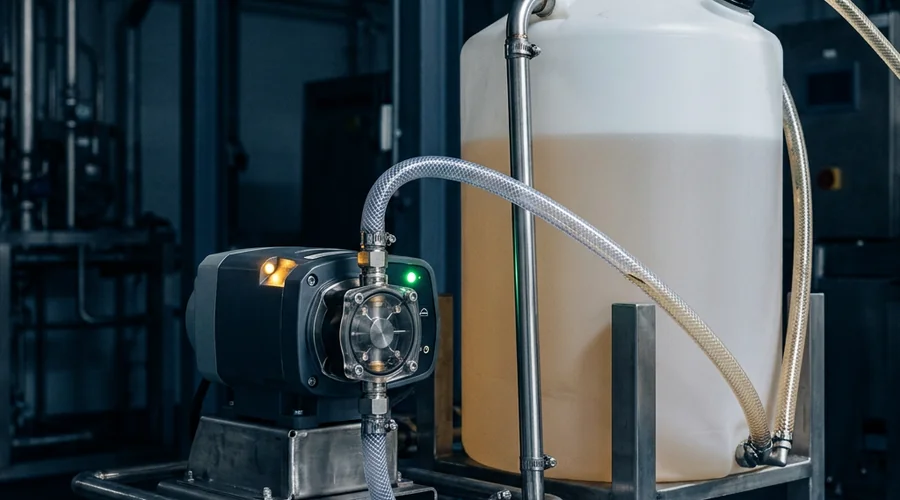
- Continuous low residual — Veolia calls a continuous low oxidant residual a very effective means of preventing biofilm formation.
- System volume and retention time — these set how long a shot stays effective.
- Organism targets — bacteria, fungi and algae differ in susceptibility to each active.
- Food source and activity — Veolia supplements chlorine with a biodispersant or a non-oxidiser as the food source and biological activity demand.
- Water chemistry and pH — the halogen speciation and the hydrolysis rate of the non-oxidiser both move with pH.
- Discharge permits — the allowed residual at the outfall caps how hard an oxidiser can be pushed.
Exposure level also matters for stewardship. In a 2026 laboratory evolution study of Pseudomonas aeruginosa under methylisothiazolinone, preservative-level exposure selected mutations that raised the meropenem minimum inhibitory concentration 8- to 16-fold. Trace-level exposure raised horizontal gene transfer capacity. It is one organism under laboratory conditions, so it flags a question for stewardship and not a field rule. Programme design meets the regulator at the point where the water leaves the system.
Compatibility With Scale and Corrosion Inhibitors
A biocide works inside a chemical mixture, not in clean water, and Veolia lists compatibility with corrosion and scale inhibitors among the factors that decide the choice. A laboratory study of cooling-water amoebae shows why: chlorine, bromine and isothiazolinone biocides all left no detectable viable protozoa after 4 h. Molybdate and organic phosphates still lengthened the kill times for bromine and isothiazolinones. The authors conclude that these formulations can need higher doses than current practice alongside molybdate- and phosphate-based inhibitors.
- Residence time — the study found that disinfection of planktonic protozoa is strongly influenced by the residence time of the formulation and less by the active constituent.
- Species effects — at recommended doses, the biocides had species-specific effects on environmental amoeba isolates.
- Why amoebae matter — the authors describe predator-prey relationships in cooling systems as key to the dissemination of Legionella.
Screen every biocide in the actual inhibitor package, for example the chemistry in our post on cooling water corrosion inhibitors, and not in clean water alone. A biocide that passes in deionised water can fail in the formulated programme. Compatibility sits alongside the legal limits on what leaves the system.
Discharge Limits and Biocide Regulation
Biocide choice ends at the discharge point. In the United States, 40 CFR 423.13(d)(1) sets limits for cooling tower blowdown from steam electric power plants, with free available chlorine at 0.5 mg/L maximum and 0.2 mg/L average. The same paragraph requires that the 126 priority pollutants in cooling tower maintenance chemicals are not detectable, except chromium and zinc, which have set limits. Paragraph (d)(2) allows chlorine discharge from one unit at a time and for no more than two hours a day unless the discharger demonstrates otherwise.
- DBNPA — EPA's 1994 decision made single flow-through cooling tower use ineligible, finding an unreasonable risk to aquatic organisms. Most other aquatic industrial uses need secondary biological treatment of the effluent. EPA also requires protective equipment or a closed system for handlers who open-pour it into cooling towers.
- Discharge permits — the EPA fact sheet on DBNPA states that a discharge permit is required for discharges to waterways.
- EU product types — a Union authorisation for a C(M)IT/MIT family covers product type 11 (preservatives for liquid-cooling and processing systems) and product type 12 (slimicides). It is valid until 31 August 2032.
- Labels govern use — each registered or authorised product carries its own permitted uses, so a formulator must work inside the label or authorisation.
Our post on the EU Biocidal Products Regulation explains the authorisation pathway for disinfectant products. The limits above apply to steam electric plants, and other sectors follow their own permits. Compliance steers the chemistry as much as efficacy does, and monitoring shows whether the programme works.
Monitoring Biocide Performance: Plate Counts, ATP and Coupons
A programme is only as good as the measurement that checks it. Plate counts, ATP and dip slides measure the water, while coupons and surface inspection measure what grows on metal. The two views can disagree, since a trade review states that planktonic counts and biofilm prevalence are not well correlated. A sound protocol therefore uses both.
| Method | What It Measures | Note |
|---|---|---|
| ASTM D5465 | Colony-forming units on membrane filters and standard pour and spread plates | Practices for counting colonies and reporting results |
| ASTM D4012 | Cellular ATP by bioluminescence, with light proportional to the ATP concentration | Covers microorganisms in laboratory cultures and in waters |
| Dip slides | Agar paddles dipped in the water and compared with a colony-density chart | Our metalworking fluid biocide post covers the technique |
| Coupons and surface inspection | Sessile growth on metal | Shows biofilm that water samples miss |
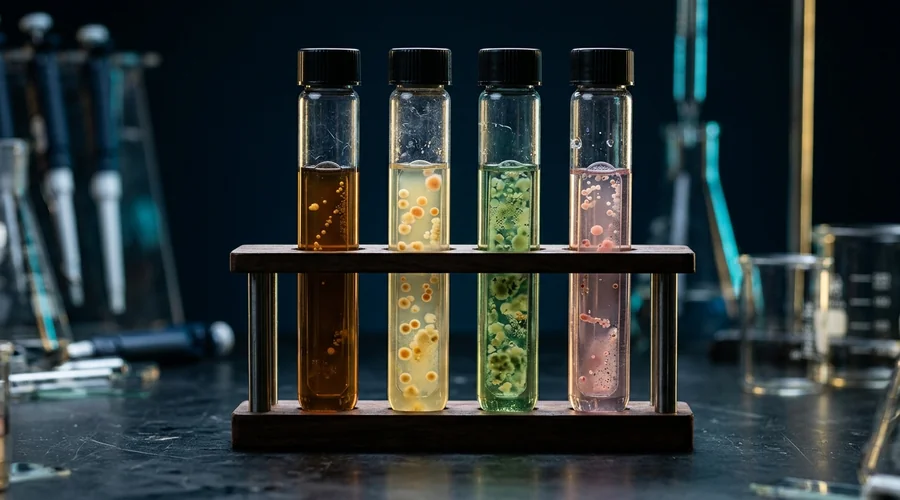
Record each result against the dosing log so that a rise in counts can be matched to a missed shot, a pH excursion or a change in makeup water. Trends matter more than single numbers. The monitoring data feed the decision sequence in the next section.
Choosing a Programme: A Decision Sequence
A biocide programme is a chain of constraints, and the order in which you test them matters. Start with the risk and the pH window, because they decide which oxidiser can work. Then add the non-oxidiser, the penetrant and the compatibility and discharge checks. The sequence below turns the earlier sections into a repeatable screen.
- Map the risk — Legionella exposure, food sources, makeup water quality and process leaks.
- Set the pH window — decide whether chlorine, bromine or chlorine dioxide fits the tower's pH.
- Choose the base oxidiser and feed pattern — a continuous low residual or a frequent intermittent feed.
- Add the non-oxidiser — selected on pH, retention time, spectrum, biodegradability, toxicity and compatibility, and shot-fed.
- Add a penetrant or mechanical cleaning — where biofilm is already established.
- Check inhibitor compatibility — run kill-time tests with the full inhibitor package present.
- Check the discharge route — limits, permits and the label or authorisation.
- Monitor and adjust — water counts or ATP together with surface checks.
The sequence produces a shortlist, not a recipe. Pilot trials on the real water then settle the choice.
Working With a Water Treatment Formulation Consultant
Biocide programmes combine microbiology, halogen and organic chemistry, inhibitor compatibility and regulation, so a development project spans several disciplines. A water treatment formulation consultant joins those strands into one plan. The aim is a product whose performance holds in the real water and passes the discharge test. Water treatment chemical product development services then carry the plan into pilot batches and production.
- Programme design — oxidiser, non-oxidiser and penetrant matched to pH, retention time and food load.
- Compatibility screening — kill-time tests inside the finished inhibitor package.
- Test protocol — plate count, ATP and surface checks set up for routine use.
- Regulatory mapping — labels, authorisations and discharge rules for each market.
- Stability and handling — storage, materials and safe feed of oxidisers and shot products.
- Scale-up and transfer — handover to an industrial water chemicals contract manufacturing partner with defined specifications.
The full range of services sits under water treatment, and our guide to starting a water treatment chemical manufacturing business covers equipment and economics. Before approaching a consultant, collect your water analyses, system volumes and discharge permit. Those three inputs decide which programme is realistic.
Frequently Asked Questions
What is an industrial water biocide?
An industrial water biocide is a chemical that kills or controls bacteria, fungi and algae in cooling, process and other industrial water systems. Veolia describes the ultimate objective as preventing biofilm from forming and limiting pathogens such as Legionella.
The two main classes are oxidising biocides, such as chlorine and bromine, and non-oxidising biocides, such as isothiazolinones, DBNPA and glutaraldehyde. Most programmes combine both with a dispersant.
What is the difference between oxidising and non-oxidising biocides?
Oxidising biocides kill through an electrochemical process in which the oxidiser gains electrons from cell components. Non-oxidising biocides poison the cell by interfering with reproduction, stopping respiration or lysing the cell wall.
Oxidisers are fed continuously or intermittently, while non-oxidisers are generally shot-fed and need several hours up to a day to kill. Selection of a non-oxidiser depends on pH, retention time, spectrum, biodegradability, toxicity and compatibility.
Does chlorine still work at high pH in cooling water?
Chlorine loses some strength but keeps working. Hypochlorous acid, the stronger oxidiser, has a pKa of about 7.5, so hypochlorite ion dominates above a pH of roughly 7.5 to 8.0. Veolia notes that hypochlorite is still a strong oxidiser able to oxidise biofilm.
Options for alkaline towers include carrying more free chlorine while corrosion control holds, switching to bromine, adding a non-oxidising biocide or biopenetrant, and using chlorine dioxide or ozone. Hypobromous acid has a pKa of 8.7, so bromine keeps more of its acid form at high pH.
Why use oxidising and non-oxidising biocides together?
Each class covers the other's weakness. An oxidiser fed continuously kills floating cells before they settle, while a shot-fed non-oxidiser supplies the concentration and contact time that attached cells need.
A 1998 supplier conference paper reported synergy between a halohydantoin and isothiazolones against filamentous biofilms and preferred simultaneous addition. Treat that as laboratory data from a vendor and confirm it in your own water.
How does pH affect DBNPA and glutaraldehyde?
Both degrade faster as pH rises, but at very different speeds. EPA reports a DBNPA half-life of 67 days at pH 5, 63 hours at pH 7 and 73 minutes at pH 9 at 25 °C.
Glutaraldehyde is far more persistent, with half-lives of 628 days at pH 5, 394 days at pH 7 and 63.8 days at pH 9. DBNPA therefore suits a short, fast contact in alkaline water, while glutaraldehyde holds its concentration for longer.
Why do biocides fail against biofilm?
Bacteria in a biofilm sit in a layer of extracellular polysaccharide. A trade review in Power magazine states that they are 10 to 1,000 times more resistant to biocides than floating cells. It adds that oxidisers can be depleted in the outer layer before they reach the dense inner population.
Dispersants and biopenetrants loosen the matrix, and mechanical cleaning removes biofilm from heat-exchange surfaces. Frequent oxidiser feed also helps, because it meets the biofilm while it is still thin.
How are biocide discharges regulated?
In the United States, 40 CFR 423.13(d)(1) limits cooling tower blowdown from steam electric power plants to 0.5 mg/L maximum and 0.2 mg/L average free available chlorine. Other sectors follow their own permits, and a discharge permit is required for waterway discharges of DBNPA.
EPA made single flow-through cooling tower use of DBNPA ineligible for reregistration in 1994. In the EU, preservatives for liquid-cooling and processing systems are product type 11 and slimicides are product type 12 under the Biocidal Products Regulation.
How can a water treatment formulation consultant help with biocide products?
A consultant helps design the oxidiser, non-oxidiser and penetrant programme for the target pH, retention time and food load. They also run kill-time tests inside the finished inhibitor package and map the labels, authorisations and discharge rules for each market.
Water treatment chemical product development services then cover pilot batches and transfer to an industrial water chemicals contract manufacturing partner.
Developing an Industrial Water Biocide or Fixing a Biofouling Problem?
Global Formulation supports water treatment makers with biocide programme design, inhibitor compatibility screening, regulatory mapping and scale-up to a contract manufacturing partner.
Talk to Our Formulation Team