Spray Drift Control Agents: Chemistry and Formulation

A spray that leaves the nozzle with too many fine droplets loses product to the wind before it reaches the crop. The fine fraction stays airborne longer, which is why drift tracks the share of fine droplets in the spray. A spray drift control agent is the formulation tool that shifts the droplet spectrum toward larger droplets. This guide explains how polymers, emulsions and oils change atomisation, why shear and nozzle choice decide whether they work, and how to test them. It draws on a peer-reviewed formulation review, open-access field and laboratory studies, and ASTM E2408. It also reflects the formulation support Global Formulation gives agrochemical manufacturers.
Spray Drift and Droplet Size: Why Control Agents Exist
Drift starts at the nozzle, where a liquid sheet breaks into droplets of many sizes. The smaller a droplet, the longer it stays airborne and the more easily a crosswind carries it away. The spray drift review in Emilia Hilz's Wageningen thesis, shortened in a 2013 paper with Vermeer, relates drift to the percentage of fine droplets. Drift control agents exist to reduce that fine fraction at the formulation level.
- Fine droplets — the review reports that droplets below 100 µm contribute significantly to drift losses. Other researchers it cites treat droplets below 50, 150 or 200 µm as the most drift-prone.
- Evaporation — droplets of a few microns can evaporate before they settle, and evaporation shrinks fine droplets further depending on humidity and temperature.
- Operating factors — wind speed, application height, driving speed and nozzle spacing all influence the fate of droplets. Air-assisted and shielded sprayers can reduce drift.
- Nozzle design — orifice size, operating pressure and entrained air set droplet size and velocity. Air-induction nozzles incorporate air bubbles into the liquid and produce coarser sprays than a conventional flat fan.
- Formulation and tank additives — a 2019 open-access field study lists nozzle type, nozzle size, formulation type and tank additives as drift reduction technologies. Each one modifies the droplet size distribution at atomisation.
| Spray Class | Droplet Diameter in the ASAE S-572 Scheme Quoted in the Review |
|---|---|
| Very fine | Below 100 µm |
| Fine | 100 to 175 µm |
| Medium | 175 to 250 µm |
| Coarse | 250 to 375 µm |
| Very coarse | 375 to 450 µm |
| Extremely coarse | Above 450 µm |
The same 2019 study notes that formulation and adjuvant choice can have effects equivalent to nozzle type on downwind deposition. That is why this article treats the additive as an engineering lever. The classes above come from the review, so check the current edition of the classification standard before quoting limits in a specification. To see how an additive moves a spray from one class to the next, look at how the liquid sheet breaks up.
How Spray Drift Control Agents Change Atomisation
Atomisation is a contest between the forces that stretch a liquid sheet and the forces that resist stretching. A drift control agent works by changing how the liquid resists. The review identifies three physical properties that control spray formation: shear and extensional viscosity, surface tension, and the presence of inhomogeneities such as emulsion droplets or solid particles. Each drift control chemistry acts through one or more of them.
- Viscosity route — polymer-based drift control additives were commonly used in the United States and Australia when the review was written. The viscosity increase shifts the droplet size distribution toward larger sizes.
- Sheet breakup — a spray liquid without inhomogeneities breaks up through waves that grow into ligaments and then droplets. Viscous liquids sustain high stretching before breaking and suppress the growth of those disturbances.
- Extensional viscosity — this is the resistance of a fluid to stretching in an extensional flow. For a Newtonian liquid it is three times the shear viscosity, a ratio known as the Trouton ratio.
- Polymer efficiency — polymer liquids that show elongational thickening increase droplet size most efficiently. Their shear viscosity is typically much smaller than their extensional viscosity, so far less polymer is needed when extensional viscosity rises.
- Emulsion route — dilute emulsions perforate the liquid sheet at an early stage, shorten the sheet length at breakup and give coarser sprays.
| Route | Mechanism at the Nozzle | Materials Reported in the Review | Main Limit |
|---|---|---|---|
| Polymer thickening | Raises extensional viscosity so the sheet resists stretching | Polyacrylamides, polysaccharides and other water-soluble polymers | Shear breakdown in the pump and nozzle |
| Emulsified oil | Perforates the sheet early and shortens its breakup length | Vegetable oil, mineral oil and organosilicone emulsions | Effect depends on nozzle type |
| Surfactant (reference case) | Lowers dynamic surface tension | Wetters and spreaders | Finer spray with flat fan and hollow cone nozzles |
The third row is not a drift control chemistry, yet surfactants are part of many pesticide formulations and additives and can undo the first two. Which chemistry suits a product depends on stability and nozzle behaviour, which the next section compares.
Polymer, Emulsion and Oil Chemistry in Drift Control Agents
Three chemical families dominate drift control: water-soluble polymers, oil emulsions and surfactant-oil adjuvants. Each one pulls the droplet spectrum coarser through a different physical route. They also fail in different ways, and that matters more to a formulator than the headline drift reduction. The review and the recent studies allow a comparison on mechanism and stability.
- Polymer structure — three parameters set the extensional viscosity: chain rigidity, molecular weight and concentration. Rigid, low molecular weight polymers show constant extensional viscosity, while high molecular weight flexible polymers show a strong rise with strain rate.
- Critical elongational rate — extensional viscosity begins to rise only above a critical rate, which is lower for higher molecular weight and higher concentration.
- Synthetic polymers — polyacrylamide serves as the industry reference in a 2024 open-access study of an alginate-based adjuvant. Non-ionic and anionic polyacrylamides differ in shear stability, according to the review.
- Natural polysaccharides — stiffer polysaccharides are less sensitive to shear. The 2024 study tested sodium alginate across pressures, doses and nozzles against polyacrylamide and concluded that it has significant potential to mitigate drift.
- Emulsified oils — vegetable oil, mineral oil and organosilicone emulsions increase droplet size and reduce the fine fraction through flat fan, hollow cone and twin-fluid nozzles. Recirculation in the tank does not remove this effect.
- Surfactant-oil adjuvants — in a three-year ground-sprayer field study, adjuvants based on a paraffinic petroleum oil and on a modified vegetable oil, each with nonionic surfactant, reduced deposition. The vegetable-oil adjuvant reduced drift more in that study.
- Pesticide formulation type — the same field study measured 37 percent less drift from a suspension concentrate than from a wettable powder of the same active ingredient. The authors call generalisations premature.
| Chemistry | Principal Effect | Behaviour Under Shear and Tank Conditions |
|---|---|---|
| Non-ionic polyacrylamide and polyethylene-type polymers | Raise extensional viscosity | Often more strongly affected by recirculation than polysaccharides and anionic polyacrylamides |
| Anionic polyacrylamide | Raises extensional viscosity | Less affected by recirculation than the non-ionic types |
| Stiffer polysaccharides | Raise extensional viscosity | Less sensitive to shear |
| Emulsified oils | Perforate the sheet and coarsen the spray | Not affected by recirculation, but dependent on nozzle type |
Our guides to agricultural adjuvants and to methylated seed oil and crop oil concentrate adjuvants cover the oil and surfactant side in depth. The 2019 field study adds evidence on oil type. The vegetable-oil result matches earlier work the authors cite, although other researchers found the effect of oil type on droplet size to be small.
Chemistry sets the potential, and the pump and the water decide how much of it reaches the nozzle.
Shear Stability, Water Quality and Tank-Mix Limits
A drift control polymer is specified at the bench but stressed in the pump and the tank. The long chains that give the best extensional viscosity are the ones that break under shear. The review quotes estimated nozzle shear rates from roughly 16,000 to 700,000 per second, against about 50 per second in the tank. Recirculation, fertiliser and water quality then decide whether the viscosity measured on the bench survives in the field.
- Recirculation — intensive recirculation, especially at the end of a spray session, can easily destroy weak polymeric structures, lower the viscosity and produce finer sprays than before shearing.
- Pump type — ASTM E2408 states that many drift control polymers are irreversibly destroyed by recirculation through high-shear pumps such as gear or centrifugal pumps.
- Chain type — long-chain polymers are highly sensitive to recirculation, while stiffer polysaccharides are less so.
- pH and salts — polymer viscosity depends on salt concentration and pH when fertiliser is added to the tank. A higher pH can neutralise polyelectrolyte chains and make them contract.
- Water quality — ASTM E2408 notes that results are affected by the quality of the make-up water, which should be stated with the result.
- Emulsion systems — the drift reduction from emulsified oils is not affected by tank recirculation.
Surviving the pump is necessary, but the nozzle and the crop decide whether the coarser spray is useful.
Nozzle Interaction and the Efficacy Trade-Off
Drift control agents are never used alone, because the nozzle decides how much of the effect survives. A 2026 study of pulse-width-modulated nozzles found that droplet size depends on adjuvant type, duty cycle and nozzle type together. Coarser sprays also change coverage on the target. Formulators therefore design for a droplet size window and not for a maximum.
- Flat fan and hollow cone — polymer and emulsion routes coarsen the spray, while lower dynamic surface tension makes it finer.
- Air induction — additives that lower surface tension often produce coarser sprays than water in these nozzles. Dilute emulsions can prevent air intake, whereas microemulsions can enhance it, and emulsions can reduce mean droplet size.
- Spray geometry — higher polymer concentration decreases the spray cone angle and fan width, so the footprint shrinks. In an extreme case the nozzle spacing has to be readjusted.
- Pulse-width modulation — in the 2026 study a drift control agent markedly increased droplet size and reduced fine droplets, while a non-ionic surfactant gave a moderate increase. Both made the spectra more uniform.
- Coverage and retention — impaction increases with droplet size, while retention generally increases with decreasing droplet size and decreasing dynamic surface tension.
| Nozzle Type | Polymer or Emulsion Additive | Surface Tension-Lowering Additive |
|---|---|---|
| Flat fan | Coarser spray, fewer fines | Finer spray |
| Hollow cone | Coarser spray with emulsions | Finer spray |
| Air induction | Emulsions can reduce mean droplet size, and fines stay unchanged or rise | Often coarser than water |
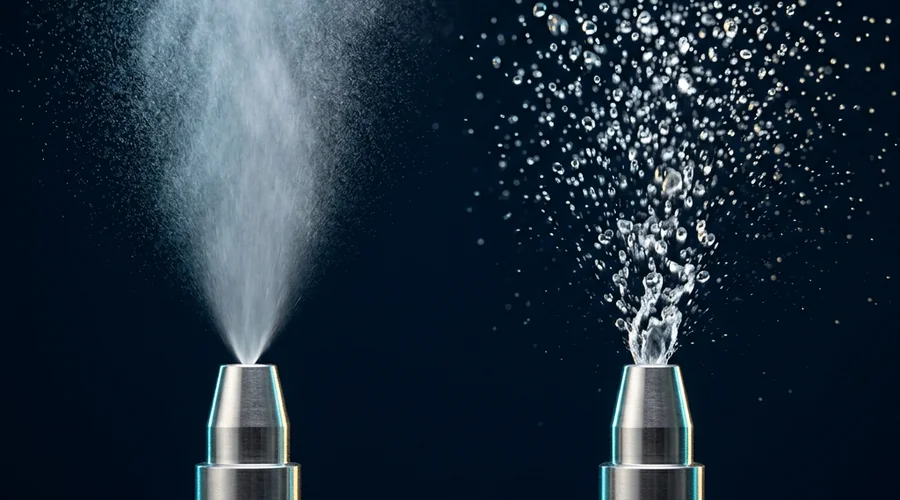
The review warns that coarser sprays from low-drift nozzles or additives can reduce biological efficacy, because large droplets give relatively low coverage and can rebound or scatter. It concludes that a narrow droplet size spectrum is required for an optimised application. The 2026 authors reach the same practical conclusion from their data, which is that adjuvant formulations should be tailored to each nozzle type.
Measurement is how those claims are turned into evidence.
Testing Drift Control Agents: Droplet Size, Screen Factor and Wind Tunnels
Drift cannot be read from a bench instrument the way viscosity can, so drift control claims rest on a ladder of tests. Droplet spectra come first, extensional viscosity second, wind tunnel work third and field trials last. Each rung answers a different question, and none replaces the next. A formulator needs all four to support a claim.
| Test | What It Measures | Limit |
|---|---|---|
| Droplet sizing by laser diffraction, phase Doppler or imaging | Volume median diameter, DV10, DV90, relative span and the share of volume below a threshold such as 100 or 150 µm | Different techniques give different data, especially for coarse sprays, and emulsion droplets or air bubbles disturb diffraction readings |
| Screen factor, ASTM E2408 | Relative extensional viscosity of dilute spray mixes, used to compare polymers and to check breakdown during recirculation | A relative value, affected by make-up water quality and by whether the sample was pumped first |
| Wind tunnel, ISO 22856 as cited in the review | Relative drift risk of nozzles and spray mixes | Cannot reproduce field wind and turbulence |
| Field trial with a tracer dye | Ground and airborne deposition downwind | Weather varies between runs, so repeatability is limited and trials are expensive |
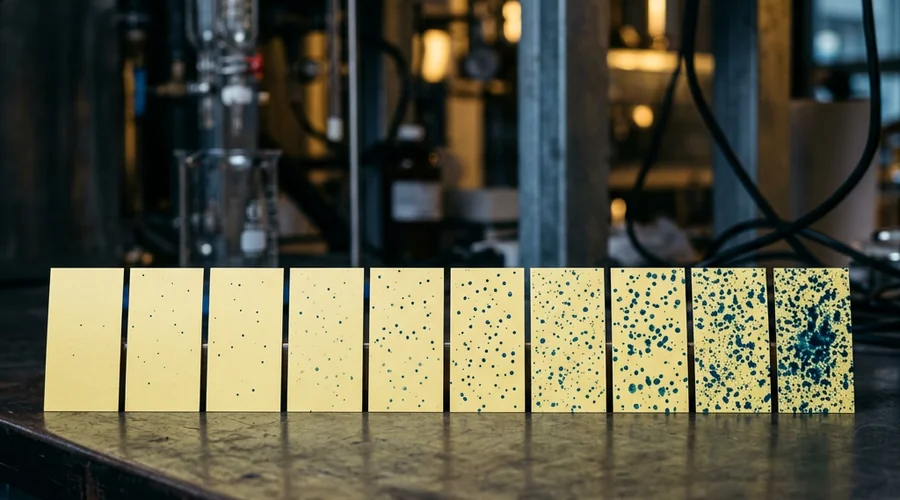
The ASTM test gives a number a formulator can use at the bench. Its scope covers tank mixes with dissolved, emulsified or dispersed materials. Its significance section lists uses such as comparing polymers for drift control potential and comparing tank mixes. It also covers finding how far polymer solutions break down during recirculation. The 2019 field study found that wind-tunnel droplet spectra agreed strongly with field deposition trends, which supports using droplet statistics to estimate the drift reduction of spray solutions.
Regulatory positions on additives vary by country and change over time. When the review was written, drift control additives were permitted in the United Kingdom and, more recently, in the Netherlands. Formulation effects were not yet built into European drift mitigation scenarios. A formulator should confirm the current rules for each target market. With the evidence ladder in place, the remaining job is design.
Formulating a Drift Control Product: Practical Constraints
A drift control product has to coarsen the spray, survive shear, stay compatible with the tank mix and avoid hurting coverage. Those aims pull against each other, so formulation is a negotiation and not a maximisation. The sources above translate into a short list of design decisions. Each one links back to a property that can be measured.
- Polymer selection — balance chain rigidity, molecular weight and concentration against shear stability, because the most efficient long chains are the most fragile.
- Surface tension control — polymers have little effect on surface tension, so surfactants control it. Check that any wetter in the product or the tank does not erase the coarsening.
- Pesticide formulation fit — the 2019 study found that the effect of an adjuvant depended on the formulation type it was combined with. Its authors suggest that selecting a formulation with good drift potential lowers the need for drift adjuvants, whose performance varies between combinations.
- Fertiliser and pH tolerance — polyelectrolyte polymers change viscosity with salt and pH, so test in the target tank mix.
- Test matrix — cover flat fan, pre-orifice and air-induction nozzles, the operating pressure range, defined water quality and a post-pump sample.
- Coverage check — confirm that the coarser spray does not cost efficacy on the intended crop and target.
Our guides to tank mix compatibility testing and to suspension concentrate formulation and wet milling cover the compatibility and formulation-type questions in more detail. Treat the finished product as a system, because the polymer or oil, the surfactant, the carrier and the tank all interact. A drift claim holds only for the combinations that were tested.
Working With an Agrochemical Formulation Consultant
Formulation decisions made at the bench shape how a drift control product behaves in the field. A polymer that thins after prolonged recirculation, a wetter that cancels the effect or a product tested on a single nozzle all trace back to bench-scale choices. An agrochemical formulation consultant tests those decisions against realistic nozzles and tank mixes before launch. Agrochemical product development services then carry the work through documentation and manufacturing.
- Route selection — polymer, emulsion or oil-surfactant chemistry matched to the target market and sprayer fleet.
- Shear stability programme — screen factor measured after a defined pumping regime, in the target water and fertiliser mix.
- Nozzle matrix studies — droplet size spectra across nozzle classes and pressures, reported as median diameter, span and fine fraction.
- Compatibility mapping — behaviour with the pesticide formulation types and tank-mix partners the customer uses.
- Claim substantiation — a test file that names the nozzle, pressure and tank mix, and checks the rules of each market.
- Scale-up and contract manufacturing — moving a bench product to a contract formulation agrochemical manufacturer with defined quality checks.
Anyone planning a new range can start with our guide to starting a herbicide and pesticide formulation unit. The broader picture sits in our overview of agrochemical technology and formulations. The full range of services falls under agro chemicals. Before committing to a polymer, run a short trial that sprays the product through a recirculating pump for a fixed period and compare droplet size before and after.
Frequently Asked Questions
What is a spray drift control agent?
A spray drift control agent is a tank additive or formulation component that shifts the droplet spectrum of a spray toward larger droplets and reduces the fine fraction. Fine droplets stay airborne longer and are carried off target by wind.
Common chemistries are water-soluble polymers that raise extensional viscosity and oil emulsions that perforate the liquid sheet early. Their effect depends on the nozzle, the pressure and the rest of the tank mix.
How do drift control agents reduce drift?
They change how the liquid sheet from the nozzle breaks into droplets. Polymers raise the extensional viscosity, which is the resistance to stretching, so the sheet breaks later and forms larger droplets.
Dilute emulsions work differently. They perforate the sheet at an early stage and shorten its length at breakup. The result is a coarser spray and a smaller fine fraction in flat fan, hollow cone and twin-fluid nozzles.
Which droplet sizes cause spray drift?
The Hilz review reports that droplets below 100 µm contribute significantly to drift losses. Other researchers it cites treat droplets below 50, 150 or 200 µm as the most drift-prone.
Because the threshold varies, test reports usually give the volume median diameter together with the share of spray volume below a chosen size, such as 100 or 150 µm.
Do drift control polymers lose their effect in the tank?
They can. Intensive recirculation, especially at the end of a spray session, can destroy weak polymer structures and produce finer sprays than before shearing. ASTM E2408 states that many drift control polymers are irreversibly destroyed by high-shear pumps such as gear or centrifugal pumps.
Long-chain polymers are the most sensitive, and stiffer polysaccharides are less so. Fertiliser salts and higher pH can also lower the viscosity of polyelectrolyte polymers, so test in the tank mix the customer will use.
Can a drift control agent reduce spray efficacy?
Coarser sprays can reduce biological efficacy, because large droplets give relatively low coverage and can rebound or scatter. The Hilz review concludes that a narrow droplet size spectrum is needed for an optimised application.
Results vary by product and crop. A 2019 field study found that two oil adjuvants reduced deposition without an apparent trade-off in efficacy, but their effect depended on the formulation they were combined with.
How is the performance of a drift control agent tested?
Testing follows a ladder. Droplet sizing by laser diffraction, phase Doppler or imaging comes first. The screen factor test in ASTM E2408 comes next, then wind tunnel comparison and finally field trials with a tracer.
Each step has limits. Different droplet sizing techniques give different data for coarse sprays, and wind tunnels cannot reproduce field turbulence. A drift reduction rating applies only to the nozzle and product combination that was tested.
Does a surfactant or wetter affect drift control?
Yes. A lower dynamic surface tension generally gives finer sprays from flat fan and hollow cone nozzles, which works against a drift control agent. In air-induction nozzles, additives that lower surface tension often give coarser sprays than water.
Polymers have little effect on surface tension, so the surfactant in the product or tank controls it. Test the complete tank mix, because a surfactant and dilute emulsion mixture produced finer sprays and more airborne drift in one wind-tunnel experiment.
How can a formulation consultant help with drift control products?
A consultant selects the chemistry route, whether polymer, emulsion or oil-surfactant, and builds a test programme around shear stability, nozzle classes and tank-mix partners. The programme reports droplet size spectra and screen factor data after a defined pumping regime.
The same team prepares the claim file that names the nozzle, pressure and tank mix, and checks the rules of each target market. It also supports scale-up and contract manufacturing of the approved product.
Developing a Drift Control Product or Testing an Existing One?
Global Formulation supports agrochemical manufacturers with drift control polymer and emulsion formulation, shear stability and nozzle test programmes, tank-mix compatibility work, product development and contract manufacturing.
Talk to Our Formulation Team