Wastewater Treatment Design: Flow, Load, Treatability
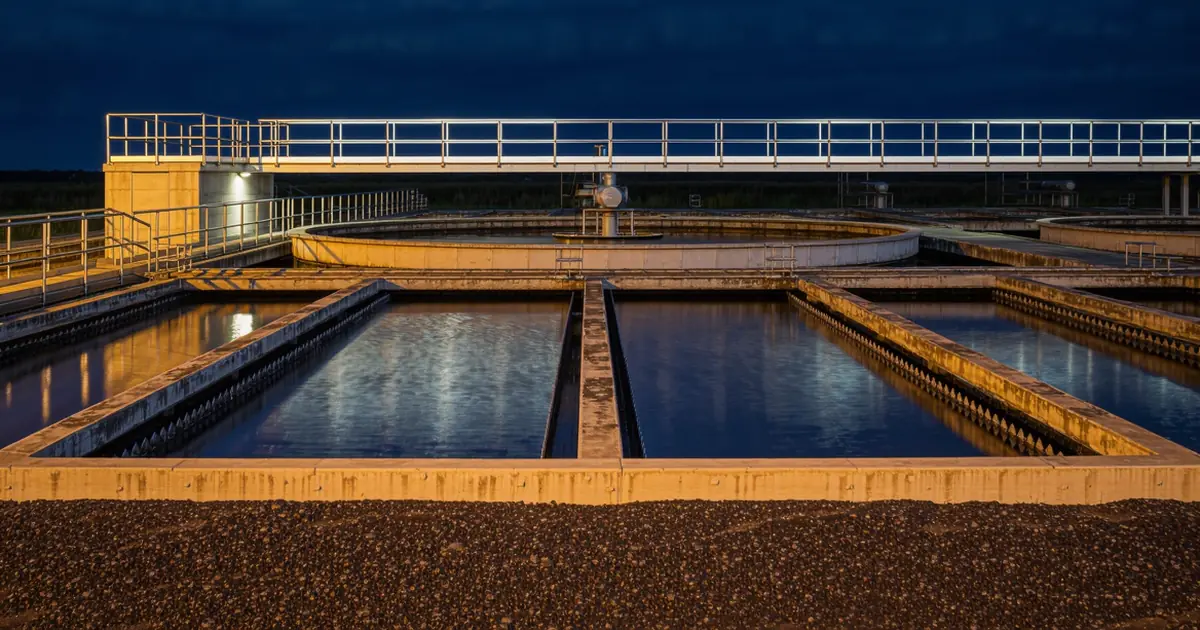
A project team asks a designer for a treatment plant and cannot say how much wastewater there is, how strong it is or how it varies. Wastewater treatment design turns the design flow, the design load, the treatability of the wastewater and the discharge standard into a process route with sized units. This guide covers the design basis behind that work, for industrial and municipal-type wastewater. It explains how design flows and loads are defined, how treatability evidence is gathered and how those inputs choose the treatment steps. It draws on the US EPA's municipal wastewater primer, the 2014 Ten States Standards and Directive 91/271/EEC, and every figure is labelled by source and region. The approach reflects the water and wastewater engineering work that Global Formulation provides to plant owners.
Wastewater Treatment Design Basis: The Four Values to Fix
Every sizing decision in a treatment plant rests on a short list of values that someone must fix and record. The design basis is the document that holds them, with the source of each. Four groups matter: the design flows, the design loads, the treatability evidence and the discharge or reuse standard. The table shows what each group fixes and where the evidence comes from.
| Input | What to fix | Where the evidence comes from |
|---|---|---|
| Design flows | Average, maximum day, peak hour and peak instantaneous flow for a stated design year | Flow records or measurements for an existing site; water-use data and a per-capita basis for a new one |
| Design loads | Mass per day of BOD5, suspended solids and any named pollutant, in the same forms as flow | Sampling stream by stream across the production cycle; a named convention for domestic flows |
| Treatability | Evidence that the chosen route works on this wastewater | Bench, settling or pilot tests on real samples |
| Standard | The rule or permit, the receiving medium and the point where compliance is measured | The regulator, labelled by jurisdiction |
Our guide to effluent treatment plant design covers the factory-side detail, including sampling, equalisation volumes and layout. This guide stays on how the values are defined and tested, because those definitions decide whether two quotations are comparable. Where the discharge standard is concerned, the jurisdictions are set out in that guide and are not repeated here.
Figure 1 shows the order in which the values are fixed. The standard is named before the treatability tests, because it sets how far the tests must look. A change in any input sends the work back before the units are sized.
Design Flow: Average, Maximum Day, Peak Hour and Peak Instantaneous
Design flow is not one number. The Recommended Standards for Wastewater Facilities, known as the Ten States Standards, come from ten US states and the province of Ontario. Their 2014 edition requires the design year's flows to be identified in four forms and used as the basis of design. The table gives the definitions and what each form is used for.
| Design flow | Definition in the Ten States Standards | What it is used for |
|---|---|---|
| Average | The average of the daily volumes over a continuous 12 months; for facilities with a critical seasonal high loading, such as industrial facilities, the average over the seasonal period | The base figure for volumes, and the seasonal average for a seasonal industrial site |
| Maximum day | The largest volume received in a continuous 24 hours | Daily throughput, paired with the maximum day BOD5 when removal is tested |
| Peak hourly | The largest volume received in one hour | The hydraulic peak on unit processes, pumping, piping and settling tanks |
| Peak instantaneous | The instantaneous maximum flow rate received | The highest rate a structure must pass; fine screens must treat it with one unit out of service |
How the flows are established depends on the site. For an existing system the Standards require projections from actual flow data to the extent possible. For a new system serving domestic users they base sizing on 100 gallons, or 380 litres, per person per day. They add the flow from industrial plants and major institutional and commercial facilities unless water-use data or another justification gives a better estimate.
The ratio of peak to average decides whether the plant needs a buffer. In their wet weather provisions the Standards state that flow equalisation shall be considered when the ratio of design peak hourly flow to design average flow is 3:1 or more. A batch plant discharges in pulses, so an industrial flow does not follow a per-capita pattern. Measured flow over a production cycle replaces any formula for such sites. Utility streams such as cooling tower blowdown count as flow too, and our guide to cooling tower water treatment covers their chemistry. Our water flow mapping and site balance work is how measured flow is obtained.
Design Load: BOD5, Per-Capita Bases and Population Equivalents
Load is the mass of each pollutant that arrives per day, and the design carries it in the same forms as flow. The Ten States Standards define the design average, maximum day and peak hourly BOD5 as weights per day. For domestic wastewater they also set a per-capita basis, while European Union law uses a different unit. The comparison below shows why the convention must be named.
| Convention | Basis | Source and region |
|---|---|---|
| Per-capita design load | At least 0.17 lb (0.08 kg) of BOD5 and 0.20 lb (0.09 kg) of suspended solids per person per day, unless information justifies another design. For nitrification, the Standards give 0.036 lb (0.016 kg) of TKN per person per day | Ten States Standards, 2014 edition, for domestic wastewater; ten US states and Ontario |
| Population equivalent | One population equivalent is the organic biodegradable load with a five-day BOD of 60 g of oxygen per day | Directive 91/271/EEC, European Union |
The directive has since been recast. Directive (EU) 2024/3019 entered into force on 1 January 2025, so the current text governs any definition that applies to a European project. The two conventions give different answers for the same wastewater, as the invented example below shows. It describes no real plant and uses plain arithmetic.
| Quantity | Working | Result |
|---|---|---|
| Daily BOD5 load | 120 m³/day × 1,500 g/m³ (1 mg/L equals 1 g/m³) | 180,000 g/day, or 180 kg BOD5/day |
| In population equivalents | 180 kg ÷ 0.060 kg per p.e. | 3,000 p.e. |
| In per-capita domestic loads | 180 kg ÷ 0.08 kg per person | 2,250 persons' worth of domestic load |
The same wastewater is 3,000 population equivalents or 2,250 persons' worth, depending on the convention. State the load in kilograms per day first and name the convention beside any equivalent. Industrial loads are measured stream by stream, and the per-capita bases apply to domestic wastewater only.
Treatability: The Evidence That a Route Works on This Wastewater
A treatment route chosen from a table of technologies is a hypothesis until it is tested on the real wastewater. Treatability work tests that hypothesis at bench or pilot scale before equipment is ordered. The Ten States Standards recommend pilot testing to verify performance predictions, particularly when significant amounts of industrial wastes are present. The EPA primer explains why: toxic compounds impair the activated sludge process unless they are controlled at source.
| Question | Test | Design decision it settles |
|---|---|---|
| How much coagulant does the chemical step need? | A jar test on the real wastewater | The coagulant dose and the chemistry of the coagulation stage |
| Will the solids settle at the planned loading? | A settling test; the Ten States Standards require one where a pilot study is warranted by unusual waste characteristics, treatment requirements or loadings beyond their limits | The clarifier overflow rate and solids loading |
| Does the biology tolerate the wastewater at the planned load? | A bench or pilot biological test on the real wastewater over a representative period | Whether biological treatment suits the stream, or whether a toxic stream must be separated first |
| Which pollutants pass through the chosen route? | Analysis of the treated test effluent against the standard | Whether a further step is needed beyond secondary treatment |
The samples must represent the variation described in the flow and load sections. A test on a blended average hides the stream that causes the trouble, so the tests run stream by stream and on the blend. Reference texts such as Metcalf and Eddy's Wastewater Engineering: Treatment and Resource Recovery and the Water Environment Federation's Manual of Practice 8 hold the design equations that the tests verify. The chemistry of the coagulants and flocculants themselves belongs to our water treatment vertical.
Wastewater Treatment Steps: Primary, Secondary and Tertiary Treatment
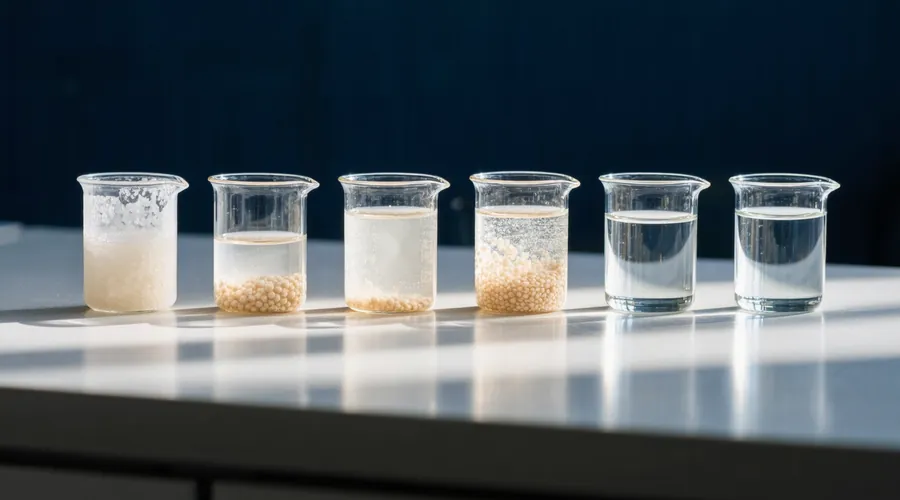
The steps in a wastewater treatment plant follow a standard order that the design inputs then adjust. The EPA's primer describes preliminary, primary and secondary treatment, and then treatment beyond secondary, which it calls advanced treatment. This guide uses tertiary treatment for that last stage. The table gives each step, what it does and the design input that decides whether it is needed.
| Step | What it does, as the EPA primer describes it | Design input that decides it |
|---|---|---|
| Preliminary | Screens remove large floating objects such as rags, cans, bottles and sticks; grit chambers remove sand and small stones | Peak flow, and the solids and grit load |
| Primary | Sedimentation removes coarse solids, which leave as primary sludge | Flow and settleability |
| Secondary | Biological treatment, by attached-growth or suspended-growth processes, removes up to 90 percent of the organic matter | Organic load and treatability |
| Tertiary, or advanced | Treatment beyond secondary removes nitrogen and phosphorus, and uses adsorption, flocculation and precipitation, membranes, ion exchange or reverse osmosis | The discharge or reuse standard |
In the United States the Clean Water Act requires municipal plants to meet a minimum of secondary treatment. The 2004 primer reports that over 30 percent of plants provided more than secondary treatment. The standard therefore decides how far the train extends, which is why it is fixed before the steps are chosen.
Industrial plants add steps for what a municipal plant rarely sees, and our guide to effluent treatment plant design maps pollutants to technologies. Every step also leaves residuals, which the primer says must be reused, burned, buried or disposed of in a way that does not harm the environment. The sludge route is therefore a design input and not an afterthought.
What Goes Wrong When the Design Inputs Are Weak
Wastewater treatment design fails in a recognisable way: the plant is built to a number that nobody measured or tested. The causes sit in the definitions, the evidence and the order of decisions. Each failure has a consequence in operation and a prevention in the brief. The table lists the common ones.
| What goes wrong | Consequence | How to prevent it |
|---|---|---|
| Flow taken from assumptions at an existing site | The plant is sized for a flow it never receives | Project from actual flow data, as the Ten States Standards require where possible |
| Only the average flow is stated | Hydraulic peaks reach the units, pumps, pipes and settling tanks unplanned | State all four design flows and check the peak-to-average ratio against the 3:1 trigger for equalisation |
| Initial low flows ignored | Freezing, septicity, flow measurement problems and solids dropout appear in the early years | Evaluate the initial low flow as the Standards require |
| Per-capita values applied to an industrial discharge | The industrial load is missed or mis-sized | Measure industrial flows and loads and add them to the domestic basis separately |
| The load convention is not named | The same wastewater is quoted at different capacities and bids cannot be compared | State kilograms per day first, then name the convention for any equivalent |
| Treatability skipped for an industrial wastewater | Toxic compounds impair the biological step | Run the biological and settling tests on real samples before the route is fixed |
| The standard is fixed after the steps are chosen | The train stops at secondary treatment when the standard needs more, so a later upgrade follows | Name the rule, the medium and the compliance point at the start |
Most of these failures are specification failures. A designer can only work to a flow, a load and a standard that someone stated and evidenced.
Commissioning Wastewater Treatment Design: An Owner's Checklist
The owner's brief decides whether a design is built on evidence or on assumption. Eight items cover it. Work through them in order, because each one constrains the next. The result is a brief that designers can price and an engineer can check.
- State the design year and the horizon — the year the flows and loads apply to, and any planned expansion.
- Supply the four design flows — average, maximum day, peak hour and peak instantaneous, from measurement where the site exists.
- Supply the design loads — kilograms per day for each named pollutant and stream, with the sampling dates and methods.
- Name the load convention — per-capita basis or population equivalent, with the source of the figure.
- Commission treatability work — jar, settling and biological tests on real samples, covering the variation in the wastewater.
- Name the standard — the rule or permit, the receiving medium, the jurisdiction and the point of compliance.
- Fix the sludge and residuals route — how each step's residuals leave the site.
- Ask for the design basis document — every input above with its source, signed off before sizing begins.
On delivery, check that each design flow and load has a source, that the treatability report states the samples and the method, and that the standard is named. To test the work, recompute one load as flow multiplied by concentration and compare the peak-to-average ratio with the plant's equalisation. The checklist is the brief to bring for wastewater treatment plant design. Our water and wastewater engineering service sets the basis of design first, with water audits, bench and pilot testing of options and treatment-route selection. Factory effluent is handled under our effluent treatment plant engineering service.
Frequently Asked Questions
What is wastewater treatment design?
Wastewater treatment design is the engineering work that turns a wastewater's flow, load, treatability and discharge standard into a treatment process with sized units. It starts with a design basis that records each input and its source.
The process route, the unit sizes and the layout follow from that basis. A plant designed on unmeasured or untested inputs fails however well its equipment is built.
What are the design flows in a wastewater treatment plant?
The Ten States Standards, 2014 edition, require four forms of flow for the design year. They are the design average flow, the design maximum day flow, the design peak hourly flow and the design peak instantaneous flow.
Each form checks a different part of the plant. For an existing system the Standards require projections from actual flow data to the extent possible.
How is the design load of a wastewater treatment plant calculated?
Load is flow multiplied by concentration, expressed as a mass per day for each pollutant. Industrial loads come from sampling each stream across the production cycle.
For domestic wastewater the Ten States Standards use at least 0.08 kg of BOD5 per person per day unless information justifies another design. State the load in kilograms per day first and name any convention beside it.
What is a population equivalent?
A population equivalent is a unit of organic load. Directive 91/271/EEC defines one population equivalent as the organic biodegradable load with a five-day BOD of 60 g of oxygen per day.
Directive (EU) 2024/3019 recast the directive and entered into force on 1 January 2025, so check the current text. A different convention, such as 0.08 kg of BOD5 per person per day, gives a different count for the same wastewater.
What is a treatability study?
A treatability study tests a proposed treatment route on the real wastewater at bench or pilot scale before equipment is ordered. Typical tests include a jar test for coagulant dose, a settling test and a biological test over a representative period.
The Ten States Standards recommend pilot testing to verify performance predictions, particularly when significant amounts of industrial wastes are present. The samples must cover the variation in the wastewater.
What are the steps in a wastewater treatment plant?
The EPA primer describes preliminary treatment, primary treatment and secondary treatment, followed by advanced treatment where the standard needs it. Screens and grit chambers come first, sedimentation next and biological treatment third.
Each step leaves residuals that must be reused or disposed of. The design inputs decide which steps a given plant needs.
What is the difference between primary, secondary and tertiary treatment?
Primary treatment removes coarse solids by sedimentation. Secondary treatment uses biological processes to remove up to 90 percent of the organic matter, according to the EPA primer.
Tertiary treatment goes beyond secondary, to remove nitrogen and phosphorus or to polish the water for reuse. The EPA primer calls this stage advanced treatment.
How does the discharge standard affect wastewater treatment design?
The standard sets how far the treatment train must go. In the United States the Clean Water Act sets secondary treatment as the minimum for municipal plants. The EPA's 2004 primer reports that over 30 percent of plants provide more.
The rules differ by jurisdiction, industry and receiving medium, so name the one that governs the site at the start. Our effluent treatment plant design guide sets out examples for the United States, India and the European Union.
Need a Treatment Design Basis You Can Rely On?
Global Formulation provides effluent and wastewater treatment plant design, treatment-route selection, design-basis and treatability work, and water audits for process industries.
Discuss a Water Project