Terminal Sterilization vs Aseptic Processing Explained
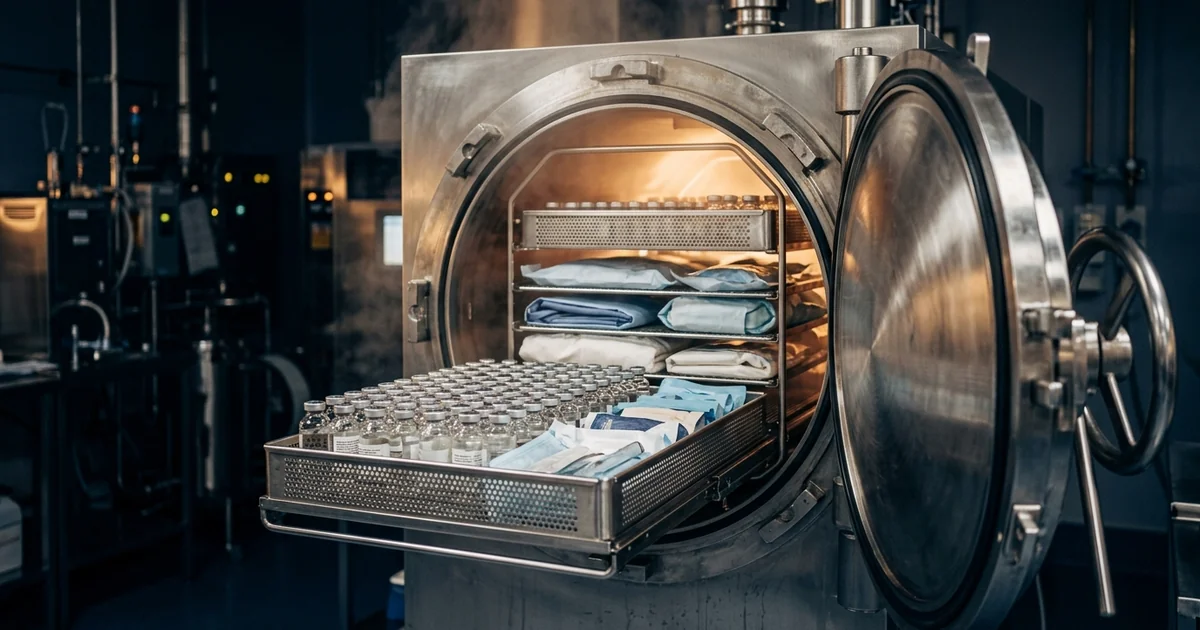
A sterile injectable can reach late development with a stable formulation, then stall when the regulator asks why it is not terminally sterilized. The choice of terminal sterilization vs aseptic processing decides the facility, the validation package, the batch release route and part of the dossier. Getting it wrong late costs reformulation, new stability data or an aseptic line that the product never needed. This guide explains the core difference, sterility assurance level and F0, and why the EMA and Annex 1 prefer terminal sterilization. It then covers moist heat cycles, sterile filtration, aseptic filling, post-aseptic heat treatment and the accepted exceptions. It rests on the EMA sterilisation guideline, EU GMP Annex 1 and the FDA aseptic processing guidance, with formulation support from Global Formulation.
Terminal Sterilization vs Aseptic Processing: The Core Difference
Both routes aim for a sterile product, but they place the sterilizing step at different points. The FDA's aseptic processing guidance describes terminal sterilization as filling and sealing under high-quality conditions, then sterilizing the product in its final container by heat or irradiation. In an aseptic process, the drug product, container and closure are sterilized separately and then brought together. Because nothing sterilizes the product after it is sealed, every step of that assembly has to stay sterile.
| Aspect | Terminal Sterilization | Aseptic Processing |
|---|---|---|
| Where sterility is achieved | In the sealed final container | In each component separately, then maintained during assembly |
| Main methods | Moist heat, dry heat, ionising radiation | Sterile filtration of the solution, separate sterilization of containers and closures |
| Sterility assurance level | Calculable and validatable, 10⁻⁶ or better | Not calculable in the same way; relies on process control |
| Filling environment (Annex 1) | At least grade C | Grade A critical zone, usually in a RABS or isolator |
| Process simulation | Not part of the terminal route | Aseptic process simulations (media fills) at set intervals |
| Typical products | Heat-stable solutions in heat-resistant containers | Proteins, most biologics and other heat-labile products |
The EMA guideline makes the distinction explicit: aseptic processing is not considered a sterilization process at all, but a way of handling already-sterile components without adding contaminants. Our guide to parenteral formulation development shows where this choice sits among the other parenteral decisions. The reason one route is preferred comes down to a number, the sterility assurance level.
Sterility Assurance Level, D-Value and F0
Sterility is a probability, not a test result. The EMA sterilisation guideline explains that microbial inactivation follows an exponential law, so there is always a finite chance that an organism survives. It defines sterility as a sterility assurance level, or SAL, of 10⁻⁶ or less. That means not more than one non-sterile item in one million sterilized items.
- D-value — the time or dose needed to reduce a population of viable organisms to 10 percent of its original number. D121 is the D-value of the relevant spores at 121 °C.
- F0 — the lethality of a saturated steam process, expressed as equivalent minutes at 121 °C for organisms with a theoretical z-value of 10.
- Overkill cycle — a process with F0BIO above 12 minutes, for example a 12-log reduction of biological indicator organisms with a D-value of at least 1 minute.
- Biological indicator — a test system of resistant spores used to verify that the cycle delivers the required lethality.
- SAL calculation — the EMA prefers it to be calculated from the maximum bioburden per container and the D-value of the biological indicator used in validation.
A simple illustration, our own arithmetic from these definitions, shows why overkill cycles leave a wide margin. A container holding 100 organisms with a D-value of 1 minute, exposed to 12 equivalent minutes, ends with a survival probability of 10² × 10⁻¹² = 10⁻¹⁰. The guideline adds a caution: an indicator of low D-value makes the calculated SAL look better without adding real safety.
EU GMP Annex 1 makes the same point from the other side: monitoring or testing alone does not give assurance of sterility. The next section shows how that principle becomes a rule.
Why Terminal Sterilization Comes First
European regulators state the preference outright: the EMA guideline says sterile finished products should be terminally sterilized in their final container whenever possible, as Ph. Eur. chapter 5.1.1 also states. EU GMP Annex 1, in operation since 25 August 2023, repeats in clause 8.34 that terminal sterilization gives greater assurance of sterility than sterile filtration and aseptic processing. In the United States, 21 CFR 211.113(b) requires validation of all aseptic and sterilization processes, and the FDA guidance notes that aseptic processing involves more variables.
- Substantial effort — the EMA expects substantial efforts to enable terminal sterilization before aseptic processing is chosen.
- Evidence of failure — aseptic processing becomes acceptable when the active or another component degrades significantly, or an impurity limit is exceeded, under even the least stressful terminal conditions.
- Impurity thresholds — degradation above ICH Q3A or Q3B qualification thresholds, or ICH M7 limits, is not on its own a reason to rule out terminal sterilization.
- Shelf life — a shorter shelf life or new storage condition caused by terminal sterilization is not in itself a reason to exclude it. The exception is a change that causes significant problems for the user.
- Biologics — for proteins and other heat-labile biological substances, a scientific rationale is generally enough to justify aseptic processing.
The guideline asks for the risk from degradation to be balanced against the risk of aseptic manufacture, taking account of posology and the nature of the degradants. Our guide to biologics formulation covers the protein stability limits that keep most biologics on the aseptic side. For everything else, the first option to test is moist heat.
Moist Heat Sterilization in Pharma: From Reference Cycle to Overkill
Steam is the first choice because it is lethal, well understood and easy to control. The EMA guideline requires every steam sterilization process to deliver a minimum lethality of F0 8 minutes with a minimum hold temperature of 110 °C. Its Table 1 lists the options in order of decreasing lethality, and the first feasible one should be selected. Each step down asks for more validation data in the dossier.
| Cycle (EMA Table 1) | Hold Temperature | Bioburden Control Before Sterilization | Dossier Data |
|---|---|---|---|
| Ph. Eur. 5.1.1 reference cycle | At least 121 °C for at least 15 minutes | 100 CFU/100 ml, non-routine | Confirmation that validation was done |
| Overkill, F0 above 12 minutes | At least 121 °C | 100 CFU/100 ml, non-routine | Cycle description, F0 validation, indicator with D121 of 1.5 minutes or more |
| F0 above 8 minutes | Above 115 °C | 100 CFU/100 ml, routine; characterised where low-resistance indicators are used | As above, plus extra data for low-resistance indicators |
| F0 above 8 minutes | Above 110 °C | 100 CFU/100 ml, routine, bioburden characterised | As above, with justification for low-temperature lethality |
| Post-aseptic processing terminal heat treatment, F0 below 8 minutes | Above 110 °C, lower if justified | 0 CFU/100 ml after aseptic filtration and processing | Heat resistance of the bioburden characterised |

Validation for any cycle outside the reference condition includes load mapping and at least three runs showing an SAL of 10⁻⁶ or better. It also defines the relationship between physical and biological results. Cycles held below 115 °C are exceptional and need scientific justification, because lethality is not always log-linear at low temperature. Annex 1 clause 8.55 adds that superheated water cascade or immersion cycles suit containers that other cycles would damage, such as blow-fill-seal units and plastic bags.
Other terminal methods follow steam in the EMA decision trees. The reference conditions are at least 160 °C for 2 hours for dry heat and 25 kGy for ionising radiation, with ISO 11137 guiding other doses. Heat ranks above radiation because it carries lower risk, such as radiolysis impurities, and is easier to control, while gas is acceptable only when no other method is possible. When none of these terminal options works, sterile filtration takes over.
Sterile Filtration: The First Half of Aseptic Processing
In aseptic processing, liquid dosage forms are sterilized by filtration, as the FDA guidance describes. The EMA treats the two steps together, because filtration is almost always followed by at least one aseptic step. Unlike heat, a filter removes organisms rather than killing them, so its performance depends on challenge testing, integrity testing and tight control of the incoming bioburden. Those controls appear directly in the quality dossier.
- Pore size — nominal 0.22 µm or less is accepted without further justification, in line with the Ph. Eur.
- Bioburden before filtration — in most situations a limit of not more than 10 CFU/100 ml, tested on a 100 ml bulk sample immediately before filtration.
- Retention validation — a challenge of at least 10⁷ CFU/cm² with a justified indicator organism in the actual solution.
- Integrity testing — before use after sterilization of the filter (PUPSIT under Annex 1 clause 8.87) and online immediately after use.
- Compatibility — sorption of solution components, worst-case compatibility and extractables, with leachables where extractables point to toxic components.
- Time limits — filtration times over 24 hours need justification, and a filtered bulk not filled within 24 hours should normally be refiltered.
Annex 1 accepts that PUPSIT is not always possible, for example with very small volumes, but then expects a documented risk assessment and compensating controls. A filtered solution is only half the job. It still has to reach a sealed container without picking up a single organism.
The Aseptic Filling Line: Barriers, Grades and Media Fills
The filling line is where open sterile product, open containers and people come closest together. Annex 1 defines grade A as the critical zone for operations such as filling, the stopper bowl and open primary packaging. It notes that such conditions are normally provided by unidirectional airflow within a RABS or isolator. Annex 1 also says their use should be considered in the contamination control strategy, and any alternative approach must be justified.
- Contamination control strategy — Annex 1 clause 2.3 requires a facility-wide CCS that defines every critical control point and assesses its effectiveness.
- Isolators and RABS — barriers that separate operators from grade A; with isolators, a background lower than grade B can be considered.
- Terminal route by contrast — Annex 1 sets at least grade D for preparing and at least grade C for filling products that will be terminally sterilized.
- Hold and filling times — the EMA asks for bulk holding and filling times to be stated, minimised and supported by media simulation results.

Media fills, or aseptic process simulations, are the main proof that the line works. Annex 1 and the FDA's 2004 guidance agree on the structure but differ on acceptance.
| Requirement | EU GMP Annex 1 (2022) | FDA Aseptic Guidance (2004) |
|---|---|---|
| Initial validation | At least three consecutive satisfactory runs covering all shifts | At least three consecutive separate successful runs |
| Routine frequency | Normally twice a year for each aseptic process, filling line and shift | Semi-annual for each processing line, with shift activities included |
| Operators | Each operator in at least one successful run each year | All authorised personnel in a media fill at least once a year |
| Acceptance | Target of zero growth; any contaminated unit fails the run | Criteria scaled by run size, with investigation or revalidation triggers |
Our guides to environmental monitoring and cleanroom facility design cover the monitoring and room classification that support these runs. Some products sit between the two routes, and a middle option exists for them.
Post-Aseptic Processing Terminal Heat Treatment
Some formulations cannot survive a full sterilization cycle but tolerate a milder heat exposure in the sealed container. The EMA defines post-aseptic processing terminal heat treatment as a terminal moist heat process applied after aseptic processing. It must be shown to give an SAL of 10⁻⁶ or better, even though it does not meet steam sterilization requirements such as F0 of 8 minutes. Annex 1 clause 8.34 asks manufacturers to consider it whenever terminal sterilization is not possible.
- Lethality — F0 below 8 minutes, at a hold temperature above 110 °C unless lower is justified.
- Upstream control — the bulk is sterile-filtered and aseptically processed first, with a bioburden limit of 0 CFU/100 ml before the heat step.
- Bioburden characterisation — the heat resistance of the bioburden before filtration has to be characterised.
- No shortcuts — the treatment must not compensate for poor aseptic practice, and the aseptic steps keep all their normal requirements.
Where even that is impossible, or where heat is possible but not the best choice for patients, the EMA lists specific justifications.
When Aseptic Processing Is Accepted Anyway
The EMA accepts aseptic processing in some cases even when the formulation itself is able to withstand terminal sterilization. Each case rests on a benefit to patients or users that outweighs the lower sterility assurance. The approach has to be documented, explained and scientifically justified through the decision tree and a risk assessment. These are exceptions with conditions, not general permissions.
- Eye drops — containers that dispense single drops to the eye.
- Preservative-free multi-dose — containers enabling non-parenteral multi-dose products without preservative.
- Ease of administration — containers that make the product easier to use.
- Safer handling — for example plastic vials instead of glass vials for cytotoxic medicines.
- Short-lived radiopharmaceuticals — enabling as long a shelf life as possible where it is under one week.
A heat-labile container cannot by itself justify aseptic processing, and the applicant must discuss efforts to develop a container that can be terminally sterilized. The assessment also weighs whether the container is fit for purpose, the degradation and toxicity profile, and the volume per dose. Our guides to ophthalmic formulation and prefilled syringes cover two product types where container design shapes the route. The formulation itself is the other lever.
Designing a Formulation That Survives Terminal Sterilization
The EMA expects the development section to show what was tried before aseptic processing was chosen. That makes sterilizability a formulation target from the first prototypes, not a question for the end of development. The guideline names the levers: optimal pH, choice of excipients, the container, and optimisation of the sterilization method and manufacturing conditions. Each lever shifts how much degradation a terminal cycle causes.
- pH and buffer — chosen where the active degrades least under heat, not only where it is most stable at room temperature.
- Excipients — selected for heat stability, both qualitatively and quantitatively, as the guideline puts it.
- Container and closure — glass or heat-resistant polymers, and superheated water cycles for containers that steam cycles would damage.
- Cycle optimisation — lower-temperature cycles with F0 of 8 minutes or more, based on the degradation mechanism and the actual bioburden.
- Secondary packaging — the EMA asks for a risk assessment where an overpouch can trap moisture or changes the sterilization step.
- Endotoxin and bioburden — low microbial levels in the active, excipients and containers, because bioburden limits are set before every sterilization step.
Container choice links directly to our guide on pharmaceutical primary packaging. Freeze-dried products are aseptically filled before the lyophilisation chamber closes, as our lyophilization guide explains. The steps above combine into a single decision sequence.
A Decision Sequence for Choosing the Route
The EMA decision trees work from the most to the least assured option, and the first feasible one should normally be chosen. There are separate trees for aqueous products, for dry powders, non-aqueous liquids and semi-solids, and for containers. The sequence below follows the selection rules covered above. It applies most directly to chemical actives, since the EMA notes that biological products can need a different approach.
- Try the reference cycle — moist heat at 121 °C for 15 minutes in the final container.
- Try reduced steam cycles — F0 of 8 minutes or more at lower temperatures, with bioburden control and validation.
- Consider other terminal methods — ionising radiation, and dry heat for products it suits.
- Optimise before giving up — pH, excipients, container and cycle, with the work recorded for the dossier.
- Assess impurities fairly — degradation above ICH thresholds is not alone a reason to abandon terminal sterilization.
- Add post-aseptic heat treatment — where a full cycle fails but some heat is tolerated.
- Choose sterile filtration and aseptic processing — with filter validation, barrier technology, a contamination control strategy and media fills.
- Document the justification — benefit-risk evaluation and development efforts, in line with the EMA guideline.
Every step in that sequence generates data that a regulator will read. Organising it from the start is easier than reconstructing it at filing.
Working With a Pharmaceutical Formulation Consultant
The sterilization route is decided by formulation data, container choice and regulatory expectations together. A pharmaceutical formulation consultant brings those strands into one development plan. The aim is a route that survives scrutiny, backed by the evidence the EMA expects. Pharmaceutical product development services then carry that plan into validation and manufacture.
- Sterilizability screening — heat stress studies on prototypes to find the gentlest feasible terminal cycle.
- Formulation optimisation — pH, buffer, excipient and container work aimed at enabling terminal sterilization.
- Route justification — a documented benefit-risk case when aseptic processing is chosen.
- Validation planning — cycle, filter and media fill strategies aligned with Annex 1 and FDA expectations.
- Technology transfer — handover to a contract formulation CDMO support partner with defined bioburden and hold-time limits.
The full range of services sits under pharmaceuticals and health care. Before choosing a route, collect heat-stress data on the formulation, the container options and the target markets. Those three inputs decide where the product lands in the decision tree.
Frequently Asked Questions
What is the difference between terminal sterilization and aseptic processing?
In terminal sterilization the product is filled and sealed under clean conditions and then sterilized in its final container, usually by heat or irradiation. In aseptic processing the product, container and closure are sterilized separately and then brought together in a grade A environment.
The FDA's 2004 guidance notes that aseptic processing involves more variables than terminal sterilization, because there is no sterilizing step for the product in its final container.
Why do regulators prefer terminal sterilization?
The EMA guideline explains that terminal sterilization is lethal to micro-organisms and its sterility assurance level can be calculated, validated and controlled. That is not possible for sterile filtration followed by aseptic processing, because accidental contamination cannot be reliably eliminated by monitoring.
EU GMP Annex 1 also states that terminal sterilization gives greater assurance of sterility. Both texts say it should be used whenever possible.
What is the sterility assurance level?
The sterility assurance level, or SAL, is the probability of a micro-organism surviving in a product item after the sterilization process. An SAL of 10⁻⁶ means not more than one non-sterile item in one million sterilized items.
The EMA guideline defines sterility as an SAL equal to or less than 10⁻⁶. It prefers the SAL to be calculated from the maximum bioburden per container and the D-value of the biological indicator.
What does F0 mean in moist heat sterilization?
F0 is the lethality of a saturated steam process expressed as equivalent minutes at 121 °C, for micro-organisms with a theoretical z-value of 10. It lets cycles run at different temperatures be compared on one scale.
The EMA guideline requires F0 of at least 8 minutes and a hold temperature of at least 110 °C for any steam sterilization process. An overkill cycle delivers F0BIO above 12 minutes.
When is aseptic processing accepted for a product that can be terminally sterilized?
The EMA guideline accepts it for user benefits such as single-drop eye-drop containers, preservative-free multi-dose containers, easier administration or safer handling of toxic products. Radiopharmaceuticals with a shelf life under one week are another accepted case.
A heat-labile container on its own is not enough, and the applicant must show efforts to develop a container that can be terminally sterilized.
What is post-aseptic processing terminal heat treatment?
It is a moist heat process applied to an aseptically filled product in its final container, with an F0 below 8 minutes. It is used for formulations that cannot withstand a full terminal sterilization cycle but tolerate some heat.
The EMA guideline says it must not compensate for poor aseptic practice, and the aseptic part of the process must still meet the same requirements. EU GMP Annex 1 asks manufacturers to consider it where terminal sterilization is not possible.
How often must aseptic process simulations be run?
EU GMP Annex 1 calls for at least three consecutive satisfactory simulations at initial validation, covering all shifts. After that, simulations are normally repeated twice a year for each aseptic process, filling line and shift, and each operator takes part at least once a year.
Annex 1 sets a target of zero growth, and any contaminated unit fails the simulation. The FDA's 2004 guidance recommends three initial runs and semi-annual runs per line, with acceptance criteria that depend on the number of units filled.
How can a pharmaceutical formulation consultant help choose a sterilization route?
A consultant tests whether the formulation and container can survive terminal sterilization and documents the development effort the EMA guideline expects. Where they cannot, the team plans sterile filtration, aseptic processing and any post-aseptic heat treatment.
Pharmaceutical product development services then cover cycle and filter validation planning and transfer to a contract formulation CDMO support partner.
Choosing a Sterilization Route or Preparing a Sterile Product for Transfer?
Global Formulation supports sterile product developers with sterilization route selection, formulation work for terminal sterilization, validation planning and transfer to a contract manufacturing partner.
Talk to Our Formulation Team