Plant Growth Regulator Types, Chemistry and Formulation
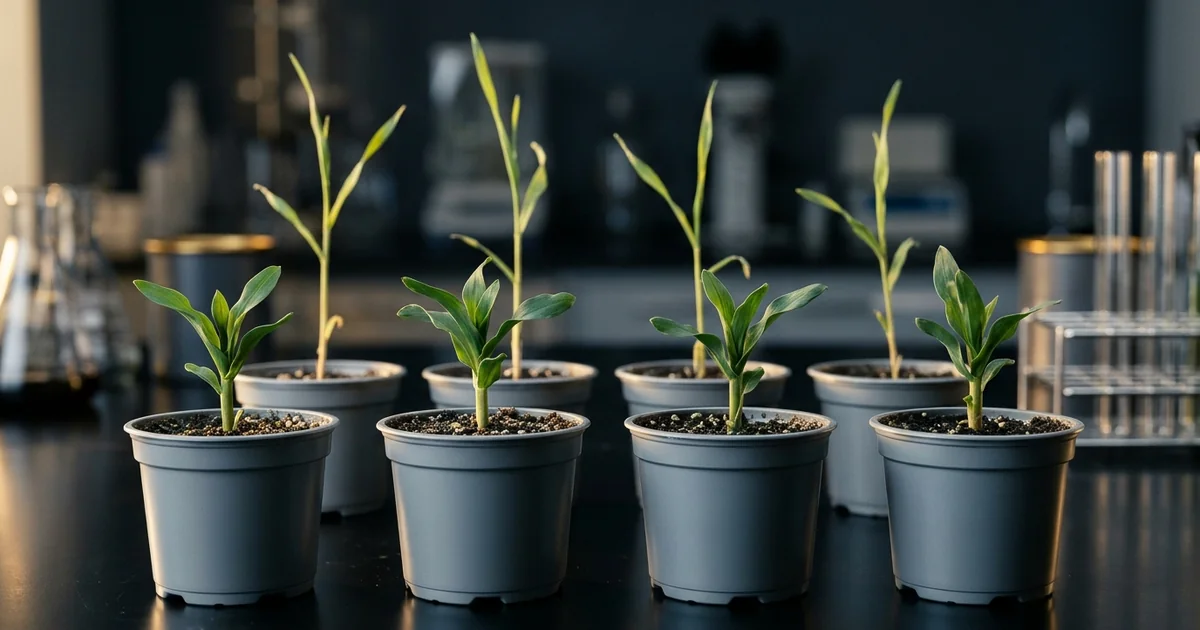
A gibberellin solution loses activity in alkaline water, an ethephon product decomposes as its pH rises and a rooting liquid changes strength as its alcohol evaporates. Each looks like an agronomy problem and is a formulation problem. A plant growth regulator can act at low concentrations, so any change in strength between factory and tank changes the dose the plant receives. This guide explains the hormone classes, the chemistry that makes each active difficult to formulate and the formulation types in use, then covers quality control, application and regulation. It draws on FIFRA, FAO specifications, an Indian registration extract and peer-reviewed work, with formulation experience from Global Formulation behind it.
Plant Growth Regulator: Definition, Hormone Classes and Actives
A plant growth regulator is a substance intended to change how a plant grows or matures through physiological action. US pesticide law defines a plant regulator as a substance or mixture intended to accelerate or retard the rate of growth or maturation, or to alter the behaviour of plants. The definition excludes substances intended as plant nutrients, trace elements, plant inoculants and soil amendments. Plant hormones are the natural counterparts, and the classical set has five groups.
| Group | Natural Hormone | Commercial Actives Named in the Sources | Roles Named in the Sources |
|---|---|---|---|
| Auxins | Indole-3-acetic acid (IAA) | NAA, IBA; 2,4-D is an auxin also used as a herbicide | Adventitious root formation, fruit set, fruit drop and thinning |
| Gibberellins | GA1, GA3, GA4, GA7 | GA3; GA4 plus GA7 | Cell elongation, overcoming dormancy, fruit set and shape |
| Cytokinins | Cytokinins | CPPU (forchlorfenuron), kinetin | Cell division, delayed leaf senescence |
| Ethylene | Ethylene (a gas) | Ethephon, which releases ethylene | Fruit ripening, abscission |
| Growth retardants | Abscisic acid is a natural inhibitor | Chlormequat, mepiquat, paclobutrazol, prohexadione-calcium, trinexapac-ethyl, daminozide | Shorter stems and less elongation |
The groups come from the California knowledge outline for pest control advisers, with roles for cytokinins from a 2026 review of regulators in rice. A 2024 review adds that regulators can be natural or synthetic compounds that interfere with plant development without acting as a nutrient or being phytotoxic.
Each active has its own chemical weakness, and the first one concerns the auxins.
Auxins: IBA, NAA and the Solubility Problem
Auxins such as indole-3-butyric acid (IBA) and naphthaleneacetic acid (NAA) are used to start roots on vegetative cuttings. A Kansas State University extension publication says they raise rooting percentage and the number of roots per cutting. The formulation problem is solubility: in its acid form IBA is insoluble in water. It must be dissolved in an organic solvent such as alcohol or converted into a water-soluble form.
| Form | What It Is | Formulation Consequence |
|---|---|---|
| Water-soluble salts | IBA formulated to dissolve in water | Commercial products include a pH buffer |
| Liquid concentrates | Alcohol-based, diluted before use; registered US products contain IBA and NAA | Strength of a dip solution changes as alcohol evaporates or water is added |
| Talc powders | IBA chemically affixed to talc particles | Registered only in certain strengths; absorption from a powder can be slower than from a solution |
| Gels | Viscous auxin solutions with a thickening agent, typically cellulose-derived | The thickening agent sets the viscosity |
| Potassium salt (K-IBA) | The water-soluble potassium salt of IBA | Technical grade is not registered for grower use in the US |
The Kansas State publication gives handling points that matter to a formulator as well as a grower.
- Mixing water — use sterile water, because well and pond water can carry fungi and bacteria that feed on hormone solutions. Municipal tap water can contain chlorine or a pH buffer that changes how the solution performs.
- Light and storage — hormones are photosensitive, so solutions are stored in a dark bottle and refrigerated after preparation.
- Rate — too much auxin can promote callusing and hinder rooting. Burn from alcohol-based solutions is typically due to an excessive rate of IBA plus NAA or to poor cuttings, not to the alcohol.
The Indian register of major pesticide uses also lists NAA as a soluble liquid made from the sodium salt, which shows the same logic in a registered product. The acid form of the active sets the formulation: a poorly soluble acid becomes a salt, a solution or a solid carrier. Gibberellic acid adds a second problem, which is chemical stability.
Gibberellins: Fermentation Origin and Aqueous Instability
Gibberellic acid (GA3) is a tetracyclic diterpenoid carboxylic acid made by the fungus Fusarium fujikuroi. A 2024 review reports that the highest GA3 yields came from solid-state and submerged fermentation, and that scale-up is limited by the complexity of process regulation. The California outline notes that more than 100 gibberellin structures exist but only a few are used commercially. It lists GA3 and a GA4 plus GA7 mixture among the gibberellins to know.
The molecule is also chemically fragile in water. A 1993 study in Biotechnology Techniques found by HPLC that in weakly alkaline solution GA3 converts to a dicarboxylic acid through iso-GA3. The dicarboxylic acid had about 20 percent of the activity of GA3, and above 0.3 M sodium hydroxide it appeared to decompose. The authors concluded that aqueous sodium hydroxide cannot serve as a solvent in GA3 activity assays.
- Form in the register — the Indian register of major pesticide uses lists gibberellic acid as a soluble powder and as a granule, not as a liquid concentrate.
- Hazard notes — the California outline says some gibberellin formulations are flammable and can cause eye injury, so solvent choice is a safety decision.
- Excess — the 2024 review lists adverse responses to excess GA3, including etiolation, chlorosis, sterility and premature death.
Cytokinins raise a different question, which is how the active is used in the laboratory as well as the field.
Cytokinins, Tissue Culture and Other Hormone-Type Actives
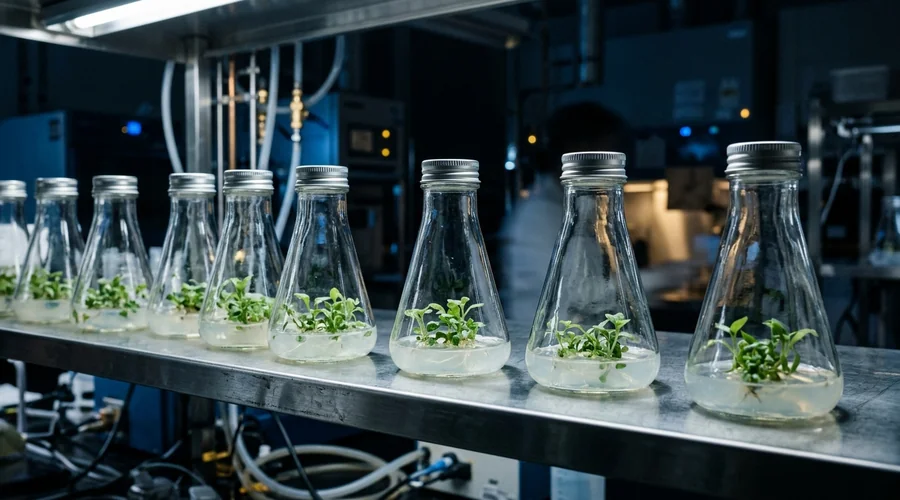
Cytokinins promote cell division and delay leaf senescence, according to the 2026 rice review. The California outline names CPPU and kinetin as cytokinins to know, and the Indian register lists forchlorfenuron as an emulsifiable concentrate. Cytokinins are also used in laboratory propagation. In tissue culture the auxin and cytokinin supplied in the medium steer how an explant develops.
A 2026 petunia study shows the contrast. The classic Arabidopsis two-step system uses an auxin-rich callus-inducing medium, while petunia leaf explants regenerated shoots in one step on cytokinin-supplemented medium. Shoot formation proceeded through a pathway independent of the root meristem. The regulators in a medium are therefore not interchangeable.
The Indian register groups further actives under the same heading, which shows the formulation types in use for products that are not classical hormones.
- Triacontanol — listed as an emulsifiable concentrate and as an emulsion in water.
- Sodium para-nitrophenolate — listed as a soluble liquid.
- Hydrogen cyanamide — listed as a soluble liquid and as an aqueous solution.
- Chlorpropham — listed as a fogging concentrate, applied as supplied with a fogging applicator.
Ethylene is the one hormone that is a gas, and its releaser has a strong pH dependence.
Ethephon: pH-Triggered Ethylene Release
Ethephon is a systemic plant growth regulator that the plant absorbs and that releases ethylene, according to the FAO/WHO JMPR evaluation. Its formulation chemistry is a pH story. The compound is very soluble at low pH and decomposes faster as pH rises. The table gives the evaluation's figures.
| pH | Water Solubility (21 to 24 °C) | Hydrolysis DT50 at 25 °C |
|---|---|---|
| Below 0.2 | Above 1,000 g/L | — |
| 4 | 800 g/L | — |
| 5 | — | 73.5 days |
| 7 | — | 2.4 days |
| 9 | — | 1.0 day |
Above pH 5 the evaluation reports decomposition, so it gives no solubility value there. In plants it reports that ethephon is metabolised to ethylene, phosphate and a small amount of 2-hydroxyethylphosphonic acid (HEPA). AHDB adds that it penetrates plant tissue, is translocated and breaks down there to generate ethylene. The FAO ethephon specification turns the chemistry into product requirements.
- pH range — 1.5 to 2.0 for the technical material, the technical concentrate and the soluble concentrate.
- Impurities — limits on two manufacturing impurities, the mono-2-chloroethyl ester of 2-chloroethylphosphonic acid and 1,2-dichloroethane.
- Stability — dilution stability in standard water. Storage tests allow no more than 0.3 mL separation after 7 days at 0 °C and require at least 95 percent of the active after 14 days at 54 °C.
- Packaging — containers for solutions are lined where necessary to prevent corrosion, and the California outline lists corrosiveness and flammability among hazards of some ethephon formulations.
An acidic, corrosive, pH-sensitive liquid asks a lot of a formulator, and the retardants ask something different.
Growth Retardants: Blocking Gibberellin Biosynthesis
Growth retardants lower the level of active gibberellin, so stems stay shorter. AHDB states that chlormequat, daminozide, paclobutrazol, prohexadione-calcium and trinexapac-ethyl all inhibit gibberellin biosynthesis, generally at different stages. A 2026 review of wheat lodging control maps the sites. The table adds the formulation types listed for each active in the Indian register.
| Active | Site in the Gibberellin Pathway | Formulation Types in the Indian Register |
|---|---|---|
| Chlormequat chloride | Early: copalyl diphosphate synthase and ent-kaurene synthase | Soluble liquid |
| Mepiquat chloride | Early | Aqueous solution; also a suspension concentrate with cyclanilide |
| Paclobutrazol | Intermediate: ent-kaurene oxidation (triazole) | Suspension concentrate |
| Prohexadione-calcium | Late | Water-dispersible granule |
| Trinexapac-ethyl | Late: GA 20-oxidase and GA 3-oxidase | Not in the register extract read |
| Daminozide | Late | Not in the register extract read |
The FAO chlormequat chloride specification shows how a salt-based soluble liquid is controlled. It sets a pH range of 2.5 to 8 and requires a clear or opalescent solution after dilution in standard water following the heat test. It also limits persistent foam to 30 mL after one minute and requires the same cold and heat storage tests as ethephon.
Specifications of this kind lead to the wider question of which formulation type suits which active.
Formulation Types and Quality Control for Plant Growth Regulators
Plant growth regulators appear in many formulation types, and the type follows the chemistry of the active. The Indian CIB&RC register of major uses for plant growth regulators, current to 31 March 2024, shows the spread. The table lists the active and formulation types only, without strengths or uses. Generic formulation guides on this site explain each type in depth.
| Active | Formulation Types Listed | Related Guide |
|---|---|---|
| NAA (sodium salt), chlormequat chloride, sodium para-nitrophenolate, hydrogen cyanamide | Soluble liquid (SL) | SL and SG formulation |
| Ethephon | Soluble liquid; paste | — |
| Gibberellic acid | Soluble powder (SP); granule (GR) | — |
| Mepiquat chloride, hydrogen cyanamide | Aqueous solution (AS) | — |
| Paclobutrazol; mepiquat chloride with cyclanilide | Suspension concentrate (SC) | SC formulation and wet milling |
| Forchlorfenuron, triacontanol | Emulsifiable concentrate (EC) | EC formulation |
| Triacontanol, nitrobenzene | Emulsion in water (EW) | — |
| Prohexadione-calcium | Water-dispersible granule (WG) | WP and WG formulation |
| Chlorpropham | Fogging concentrate (HN) | — |
The FAO specifications for ethephon and chlormequat chloride give a quality-control pattern that applies well beyond those two actives.
- Identity and content — an identity test, and an active content that stays within a declared tolerance.
- Relevant impurities — named manufacturing impurities with maximum limits, such as 1,2-dichloroethane.
- Physical properties — a pH range, dilution or solution stability in standard water and, for chlormequat, a persistent foam limit.
- Storage stability — low separation after 7 days at 0 °C and at least 95 percent of the active retained after 14 days at 54 °C.
- Packaging — containers that suit the contents, lined where corrosion is a risk.
- Fix the active, its salt or ester form and the formulation type that suits its solubility.
- Set the formulation pH to protect the active, as with ethephon at low pH.
- Choose the solvent and consider flammability, as the California outline notes for some gibberellin formulations.
- Run the cold and heat storage tests and the dilution stability test in standard water.
- Check packaging compatibility, including corrosion.
- Check tank-mix behaviour with the adjuvants and products the user will add.
Our guides to tank-mix compatibility and agricultural adjuvants cover the last step, which is where application begins.
Application, Response and Why Rate Matters
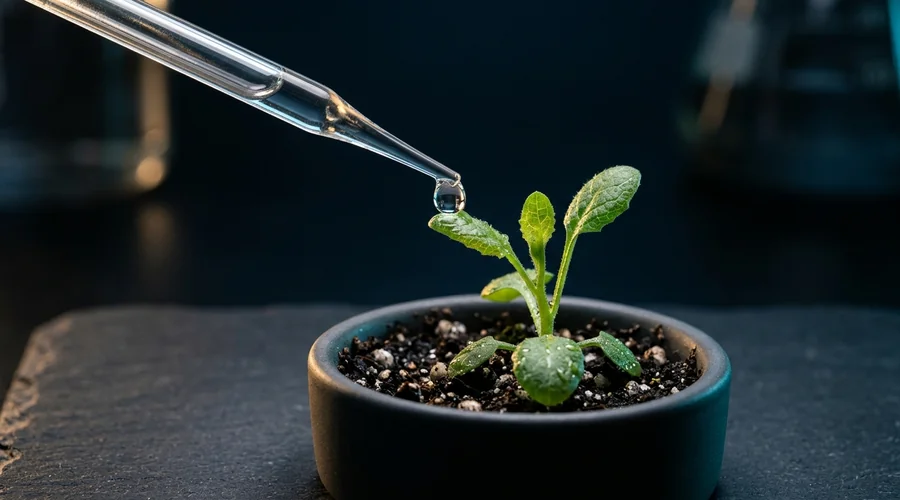
The same regulator can stimulate or retard growth, and the outcome depends on rate, timing and conditions. The California outline asks advisers to compare how one regulator can stimulate and retard growth in different situations. It lists humidity, pH, plant growth stage, plant condition, rainfall, sunlight and temperature as factors that change the appropriate dose. This section pulls out what a formulator needs from that list.
- Solution pH — the outline treats solution pH as a point that applicators must understand, which echoes ethephon and gibberellic acid chemistry.
- Surfactant need — the outline asks how to decide whether a surfactant is needed, so the product label and formulation should state it.
- Tank-mix incompatibility — regulators can be incompatible with other chemicals in a tank mix.
- Hormone interaction — regulators interact with other hormones and growth-regulating compounds in the plant.
- Hazards — specific hazards attach to some formulations, including corrosive and flammable liquids and eye injury.
Which claims a label can carry is a regulatory question, which comes next.
Regulation: How a Plant Growth Regulator Is Classified
Classification depends on the intended action and on the jurisdiction. In the United States, FIFRA defines the active ingredient of a plant regulator as one that will accelerate or retard growth or maturation through physiological action. It also covers an ingredient that otherwise alters the behaviour of ornamental or crop plants. The same law excludes nutrients, trace elements, inoculants and soil amendments, so a product's claims decide which side of the line it sits on.
- India — the CIB&RC lists plant growth regulators registered under the Insecticides Act, 1968, with a disclaimer that the document is compiled for guidance and not for legal purposes. Use the current register, not an older copy, to confirm an active, a formulation type and a crop.
- FAO specifications — they carry a disclaimer that they are not an endorsement of a use or a warranty of fitness for a purpose. The ethephon specification adds that suitability is decided at national or provincial level.
- Unregistered uses — registration is specific to the product, the crop and the country. A use claim without a registration behind it is not a decision a manufacturer can make.
Because the rules differ by country, a development plan needs the regulatory route fixed early. That is where a consultant adds most.
Working With an Agrochemical Formulation Consultant
Plant growth regulators sit between plant physiology, solution chemistry and regulation, so an agrochemical formulation consultant works across all three. The brief usually starts with the active, the target formulation type and the market. Agrochemical product development services then carry the work from bench stability trials to plant batches. A contract formulation agrochemical manufacturer can handle scale-up and supply.
- Active and form selection — acid, salt or ester, matched to a formulation type.
- Stability design — pH, solvent and buffer choices around the weak point of each active.
- Specification and testing — content tolerance, impurity limits, dilution stability and storage tests modelled on FAO specifications.
- Tank-mix and adjuvant checks — compatibility with the products users add.
- Packaging — corrosion and flammability review of container and closure.
- Scale-up — pilot batches and technology transfer, as in our guide to starting an agrochemical formulation business.
The full range of services sits under agro chemicals, and our overview of agrochemical technology and formulations shows how the product families connect. Before approaching a consultant, collect the active and its form, the target formulation type, the markets and registration routes, and any stability or field-performance problems seen so far.
Frequently Asked Questions
What is a plant growth regulator?
US pesticide law defines a plant regulator as a substance or mixture intended, through physiological action, to accelerate or retard growth or maturation. It also covers substances intended to otherwise alter the behaviour of plants. Substances intended as plant nutrients, trace elements, inoculants and soil amendments are excluded.
A plant growth regulator can be natural or synthetic. The main groups are auxins, gibberellins, cytokinins, ethylene releasers and growth retardants.
How is a plant growth regulator different from a plant hormone?
A plant hormone is a naturally occurring compound, and the classical set has five groups: auxins, cytokinins, ethylene, gibberellins and abscisic acid. A plant growth regulator is a natural or synthetic compound that interferes with plant development or metabolism without acting as a nutrient.
Many commercial regulators are therefore synthetic. Chlormequat, paclobutrazol and ethephon are examples, and they act on or through hormone systems.
Why does ethephon need an acidic formulation?
Ethephon decomposes as pH rises, and the decomposition releases ethylene. The FAO/WHO JMPR evaluation reports a hydrolysis DT50 at 25 °C of 73.5 days at pH 5, 2.4 days at pH 7 and 1.0 day at pH 9.
The FAO specification therefore sets a pH range of 1.5 to 2.0 for the technical material, the technical concentrate and the soluble concentrate. It adds storage tests at 0 °C and 54 °C, and says containers for solutions are lined where necessary to prevent corrosion.
Why are gibberellic acid solutions unstable?
Gibberellic acid is a carboxylic acid that degrades in water. A 1993 study found by HPLC that in weakly alkaline solution it converts to a dicarboxylic acid through iso-GA3. That product has about 20 percent of the activity of GA3.
The same study found the product decomposed above 0.3 M sodium hydroxide, so aqueous sodium hydroxide cannot serve as a solvent for GA3 work. Check the pH of mixing water and store solutions as the supplier directs.
Which formulation types are used for plant growth regulators?
The Indian CIB&RC register of major uses lists plant growth regulators as soluble liquids, soluble powders, granules, aqueous solutions, suspension concentrates, emulsifiable concentrates, emulsions in water, water-dispersible granules and pastes. Examples are soluble liquids for ethephon and chlormequat chloride, a suspension concentrate for paclobutrazol and a water-dispersible granule for prohexadione-calcium.
The choice follows the chemistry of the active. A water-soluble salt suits a soluble liquid, while an active that does not dissolve in water suits a suspension or an emulsion-type concentrate.
How do growth retardants work?
Chlormequat, daminozide, paclobutrazol, prohexadione-calcium and trinexapac-ethyl act by inhibiting gibberellin biosynthesis, at different steps. Less active gibberellin means shorter stems.
A 2026 review places chlormequat and mepiquat at early steps, triazoles such as paclobutrazol at the ent-kaurene oxidation step, and trinexapac-ethyl, prohexadione-calcium and daminozide at later steps.
Which quality tests apply to plant growth regulator liquids?
The FAO specifications for ethephon and chlormequat chloride soluble concentrates give a model. They require identity and active ingredient content within a tolerance, limits on named manufacturing impurities, a pH range and dilution or solution stability in standard water.
They also require storage stability: little separation after 7 days at 0 °C and at least 95 percent of the active retained after 14 days at 54 °C. The chlormequat specification adds a persistent foam limit.
How can an agrochemical formulation consultant help with plant growth regulators?
A consultant matches the active and its salt form to a formulation type, then designs pH, solvent and packaging choices around its stability. The same work sets the specification and the storage and dilution tests.
Agrochemical product development services extend this to tank-mix checks and registration support. A contract formulation agrochemical manufacturer then handles scale-up and supply.
Developing or Stabilising a Plant Growth Regulator Product?
Global Formulation supports agrochemical makers with plant growth regulator formulation design, pH and storage stability studies, quality specifications, tank-mix checks and scale-up to a contract manufacturing partner.
Talk to Our Formulation Team