Breakpoint Chlorination: Free vs Combined Chlorine Guide
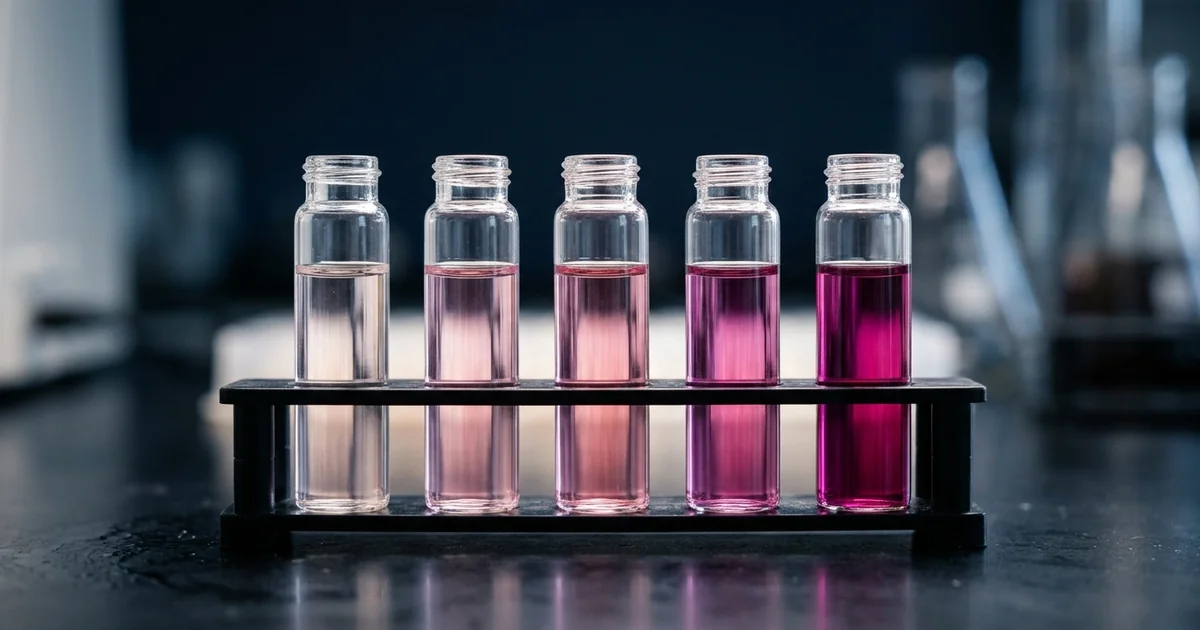
An operator raises the chlorine dose and the residual falls instead of rising. The dosing pump is fine: the water contains ammonia, and the chlorine is being consumed by reactions that finish only at the breakpoint. Breakpoint chlorination decides whether added chlorine ends up as free chlorine, the fastest disinfectant, or as chloramines, which are weaker but longer lasting. This guide explains chlorine species and pH, chloramine formation and the breakpoint curve, then covers testing, byproducts, residual control and hypochlorite stability. It draws on the US EPA and Irish EPA manuals, WHO fact sheets, 40 CFR 141 and a Hach test method, with formulation experience from Global Formulation behind it.
Breakpoint Chlorination: Free, Combined and Total Chlorine
Chlorine in water is not one substance, and the species decide how well the water is disinfected. Free chlorine is hypochlorous acid plus hypochlorite ion, and combined chlorine is chlorine bound to nitrogen. Breakpoint chlorination adds enough chlorine to oxidise the ammonia, so the dose moves from combined forms to free chlorine. The terms below recur through this guide.
| Term | Meaning | Note |
|---|---|---|
| Free chlorine | Hypochlorous acid (HOCl) plus hypochlorite ion (OCl⁻) | Elemental chlorine appears only below about pH 4, so in practice free chlorine is the sum of the two (Irish EPA manual) |
| Combined chlorine | Chlorine bound to nitrogen as monochloramine, dichloramine and trichloramine | The EPA manual treats residual chloramines as combined chlorine |
| Total chlorine | Free plus combined chlorine | What a total chlorine test reports |
| Chlorine demand | The reduction in chlorine concentration caused by reaction with contaminants | Part is almost instantaneous, such as ammonia, and part is gradual, such as natural organic matter |
| Breakpoint | The dose at which the residual reaches a minimum before free chlorine appears | Ammonia is oxidised to nitrogen gas by this point |
Free chlorine itself comes in two forms, and pH decides the balance between them. That balance is the next section.
Hypochlorous Acid, Hypochlorite and the Effect of pH
Chlorine gas hydrolyses rapidly in water to hypochlorous acid, a weak acid that then dissociates to hypochlorite ion. The US EPA guidance manual on alternative disinfectants gives the pKa of hypochlorous acid as about 7.5, so both species are present across the normal treatment range. Hypochlorous acid is the stronger oxidant and disinfectant. The pH therefore sets how effective a given amount of free chlorine is.
| pH | Share as HOCl (approx.) | Share as OCl⁻ (approx.) |
|---|---|---|
| 6.5 | 91% | 9% |
| 7.0 | 76% | 24% |
| 7.5 | 50% | 50% |
| 8.0 | 24% | 76% |
| 8.5 | 9% | 91% |
| 9.0 | 3% | 97% |
These shares are our own arithmetic from a pKa of 7.5 at one temperature. The Irish EPA manual shows that the real balance shifts with temperature, using curves at 5, 15 and 35 °C. It also notes that at a given pH the HOCl share falls as temperature rises, but the much higher oxidation activity at higher temperature compensates, so disinfection improves.
The chlorine source also moves the pH, which moves the balance again.
- Chlorine gas — hydrolysis releases hydrogen ion, so adding the gas lowers the pH of the water.
- Sodium hypochlorite — hydrolysis releases hydroxide, and the commercial solution contains excess sodium hydroxide from manufacture, so the pH rises.
- Calcium hypochlorite — hydrolysis also releases hydroxide, so the pH rises here too.
With the free chlorine species set by pH, the next question is what happens when ammonia is present.
Chloramine Formation in Water: Mono-, Di- and Trichloramine
Hypochlorous acid reacts with ammonia in a series of competing steps that form monochloramine, dichloramine and nitrogen trichloride. The EPA manual says the balance depends mainly on pH and on the chlorine to ammonia nitrogen ratio, with temperature and contact time also playing a part. Monochloramine is the preferred species in drinking water because dichloramine and nitrogen trichloride cause taste and odour problems. The table sets out where each species dominates.
| Species | Formula | Where It Dominates | Notes |
|---|---|---|---|
| Monochloramine | NH₂Cl | Applied Cl₂:N ratio below about 5:1 by weight, pH 7 to 8.5 | WHO guideline value 3 mg/L; it slowly hydrolyses back to free chlorine (EPA) |
| Dichloramine | NHCl₂ | Low pH, and in aged monochloramine solutions | Taste and odour; WHO has no health-based guideline value |
| Nitrogen trichloride | NCl₃ | Chlorine dosed beyond the breakpoint, above about 7.6:1 | Taste and odour; WHO has no health-based guideline value |
The formation rate depends strongly on pH. The EPA manual tabulates the time for 99 percent conversion of chlorine to monochloramine at 25 °C and a chlorine to ammonia ratio of 3 to 1.
| pH | Time to 99% Conversion (seconds) |
|---|---|
| 2 | 421 |
| 4 | 147 |
| 7 | 0.2 |
| 8.3 | 0.069 |
| 12 | 33.2 |
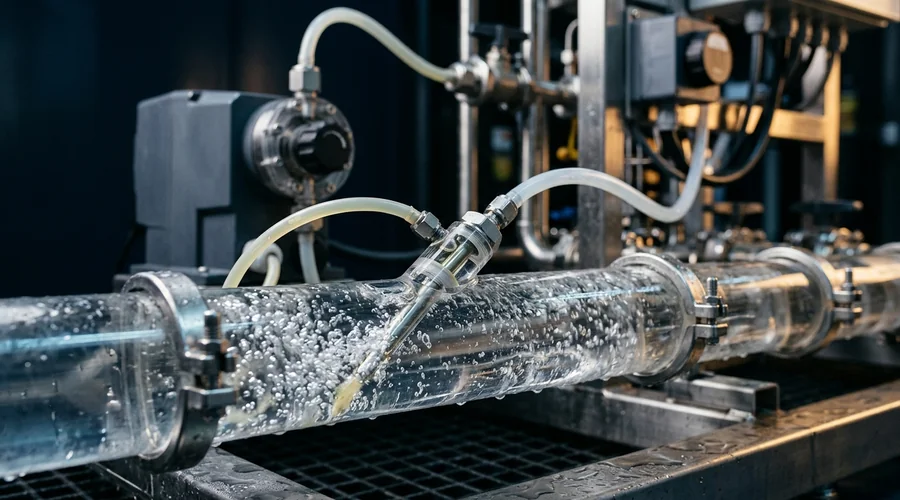
Mixing therefore matters as much as chemistry. The EPA manual notes that chlorine and ammonia cannot be mixed instantaneously, so free chlorine reacts before chloramine formation is complete, and monochloramine slowly hydrolyses to free chlorine. Without any change in pH or ratio, monochloramine degrades over about a day toward a mixture of 43 percent monochloramine and 57 percent dichloramine. For chloramination, the manual describes current practice as a chlorine to ammonia nitrogen ratio of 3 to 1 up to 5 to 1. Excess ammonia feeds nitrification and biofilm growth, which is why the ratio is not lower.
What happens above that ratio is the breakpoint, covered next.
The Breakpoint Curve: Four Zones of the Chlorine Dose
A breakpoint curve plots the chlorine residual against the chlorine dose in water that contains ammonia. The curve rises, falls to a minimum and rises again, and each part reflects a different set of reactions. In the EPA manual's theoretical curve, the horizontal axis is the ratio of chlorine to ammonia nitrogen. The table walks through the zones in order of increasing dose.
| Zone | Applied Cl₂:N (by weight) | What Happens | Residual |
|---|---|---|---|
| 1. Demand | First chlorine added | Chlorine-reducing compounds consume chlorine, so free chlorine disappears rapidly | Little or none |
| 2. Chloramine formation | Below about 5:1 | Monochloramine predominates as ammonia is chlorinated | Rises, as combined chlorine |
| 3. Breakpoint reaction | About 5:1 to 7.6:1 | Chloramines are destroyed; products include nitrogen gas, nitrate and nitrogen chloride | Falls to a minimum |
| 4. Beyond breakpoint | Above about 7.6:1 | Free chlorine and nitrogen trichloride are present | Rises with dose, as free chlorine |
The Irish EPA manual gives the overall breakpoint reaction as 2 NH₃ + 3 HOCl → N₂ + 3 HCl + 3 H₂O. In theory a molar ratio of chlorine to ammonia of 1.5 to 1 oxidises all the ammonia to nitrogen. That is a mass ratio of 7.6 to 1 as chlorine to ammonia nitrogen. In practice the breakpoint typically occurs at a molar ratio of about 2 to 1, or about 10 to 1 by mass, because other reactions also consume chlorine.
The EPA manual also tabulates the theoretical chlorine needed for each ammonia reaction, per unit mass of ammonia.
| Reaction | Theoretical mg Cl₂ per mg NH₃ |
|---|---|
| Monochloramine (NH₂Cl) | 4.2 |
| Dichloramine (NHCl₂) | 8.4 |
| Nitrogen trichloride (NCl₃) | 12.5 |
| Nitrogen gas (breakpoint) | 6.3 |
| Nitrate | 16.7 |
The Irish manual notes that breakpoint chlorination, also called superchlorination, has traditionally been used to eliminate ammonia. Tests that separate free from combined chlorine are what make the curve usable, so measurement is next.
Measuring Free, Combined and Total Chlorine
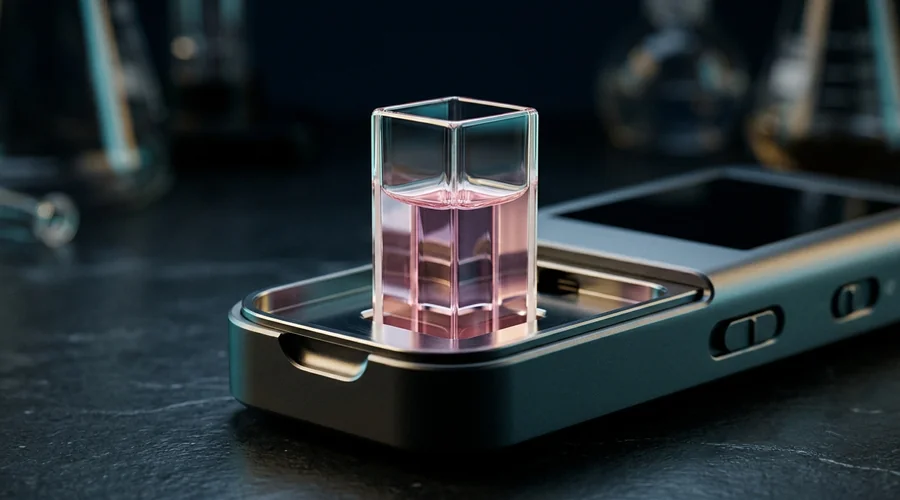
A breakpoint curve is only useful if the tests can tell the species apart. DPD colorimetry is the routine choice: it reports free chlorine from the colour that forms on addition of the reagent, and total chlorine after iodide is added. Combined chlorine is then the difference between the two. The EPA manual lists three methods acceptable for residual chloramines under the Disinfection Byproducts Rule.
| Method | What It Separates | Notes From the Sources |
|---|---|---|
| DPD colorimetric (Standard Method 4500-Cl G) | Free and combined chlorine; procedures exist to estimate monochloramine and dichloramine | Operationally simpler than amperometric titration; Hach Method 8021 is equivalent for drinking water |
| DPD ferrous titration (4500-Cl F) | Free and combined chlorine | Listed with the other two as acceptable for chloramines |
| Amperometric titration (4500-Cl D, ASTM D1253) | Free chlorine, monochloramine and dichloramine | A standard of comparison; little affected by common oxidants, temperature, turbidity or colour; needs more operator skill |
The Hach DPD free chlorine procedure shows how much depends on handling. Its rules show where readings go wrong.
- Sampling — analyse immediately, because samples cannot be preserved. Use clean glass bottles treated to remove chlorine demand, since plastic can have a large demand, and fill them with no headspace.
- Separate cells — never use the same sample cell for free and total chlorine. Trace iodide carried over from the total reagent makes monochloramine interfere with the free reading.
- Monochloramine drift — monochloramine causes a gradual upward drift, so the reading is taken within a minute. Read within that minute, and 3 mg/L monochloramine gives less than a 0.1 mg/L rise.
- Over-range or yellow flash — if the result is over range or the sample turns yellow briefly, dilute with chlorine demand-free water and repeat. Multiply the result by the dilution factor.
- Oxidant interferences — bromine, chlorine dioxide and ozone read as positive interference at all levels, and oxidised manganese or chromium needs pre-treatment. Peroxides and organic chloramines can also interfere.
- Sample chemistry — high acidity or alkalinity prevents full colour development, so the pH must be adjusted into the 6 to 7 range first.
Once the species can be measured, the byproduct trade-off between free and combined chlorine can be judged.
Disinfection Byproducts: The Free-Versus-Combined Trade-Off
Chlorine that disinfects also reacts with organic matter, and the products are regulated. The Irish EPA manual says trihalomethane formation depends on pH, temperature, free chlorine concentration, contact time and the amount and nature of oxidisable organic material. Chloramination cuts trihalomethanes but does not remove byproduct risk. The table lists the main limits and where each applies.
| Item | Value | Source |
|---|---|---|
| Chlorine, maximum residual disinfectant level | 4.0 mg/L as Cl₂ | 40 CFR 141.65 |
| Chloramines, maximum residual disinfectant level | 4.0 mg/L as Cl₂ | 40 CFR 141.65 |
| Total trihalomethanes, maximum contaminant level | 0.080 mg/L | 40 CFR 141.64 |
| Five haloacetic acids, maximum contaminant level | 0.060 mg/L | 40 CFR 141.64 |
| Residual entering distribution | Not below 0.2 mg/L for more than 4 hours | 40 CFR 141.72 |
| Distribution residual, measured as total or combined chlorine | Not undetectable in more than 5% of monthly samples for two consecutive months | 40 CFR 141.72 |
| WHO guideline values | Chlorine 5 mg/L; monochloramine 3 mg/L | WHO chlorine and chloramine fact sheets |
The free chlorine route and the chloramine route trade different byproducts against each other.
- Free chlorine — the Irish EPA manual notes that trihalomethane formation increases with pH while haloacetic acid formation decreases with pH. Its control options include removing precursors first, limiting free chlorine and contact time, dechlorinating soon after breakpoint chlorination and keeping pH low for trihalomethanes.
- Chloramines — WHO states that chloramines instead of chlorine reduce trihalomethane formation, but haloketones, chloropicrin, cyanogen chloride and haloacetic acids have been reported. The EPA manual adds that cyanogen chloride is greater with monochloramine, and that byproducts rise as the ratio approaches the breakpoint.
- Nitrosamines — a 2025 Environmental Science & Technology study reports that breakpoint chlorination in swimming pools generates hydroxyl radicals and nitrosating agents, and the nitrosating agents promote nitrosamine formation.
- Inorganic byproducts — chlorate and chlorite arise from decay of stored hypochlorite, and bromate from bromide in commercial hypochlorite or in electrolysis salt. WHO sets provisional guideline values of 0.7 mg/L for chlorite and chlorate. Chlorine gas adds no inorganic byproducts of consequence.
Limits such as these are why residual control, and not just dosing, is the design task. The next section covers it.
Chlorine Residual Control, Demand and Nitrification
A residual that holds at the dose point can vanish downstream, so control means watching demand as well as dose. The Irish EPA disinfection manual defines chlorine demand as the reduction in chlorine concentration through reaction with contaminants. Instantaneous demand is the difference between the mass dose and the residual measured immediately downstream. A marked change in demand points to measurement error, loss of treatment efficiency or pollution of the raw water.
- Gas dosing — the mass feed rate can be estimated from the control valve position or measured with a flowmeter.
- Commercial hypochlorite — the mass feed rate follows from the volumetric flow and an analysis of the chlorine content.
- On-site hypochlorite — this is the difficult case, because the chlorine content varies with generation conditions and decays quickly unless storage is optimised.
- Upstream treatment — removing organic carbon reduces chlorine demand and gives more reliable control of the residual.
Chloraminated systems add a biological failure mode. According to the EPA manual, excess ammonia feeds nitrifying bacteria, and partial nitrification can cause loss of total chlorine and ammonia residuals and a rise in heterotrophic plate counts. Nitrite formed in the process exerts a chlorine demand of 5 mg/L per 1 mg/L of nitrite and accelerates monochloramine decay. The factors implicated include a low chlorine to ammonia ratio, long detention times and warm water.
- Control measures — decrease detention time, increase pH, decrease temperature, decrease organic carbon, increase the chloramine residual, increase the chlorine to ammonia ratio and decrease excess ammonia.
- Regulatory view — 40 CFR 141.72 measures the distribution residual as total or combined chlorine, so a combined residual counts when free chlorine is absent.
- Dechlorination — the Irish manual lists sodium thiosulphate, sulphite and bisulphite as reducing agents that react with free or combined chlorine in seconds. Aeration does not remove chloramines, while activated carbon removes both.
Our guide to reverse osmosis pretreatment and dechlorination covers the membrane case. Control also depends on the chlorine product itself, which decays in storage.
Chlorine Sources: Gas, Hypochlorite and Stabilised Chlorine
The chlorine source sets the pH shift, the byproducts and the storage problems. Chlorine gas is concentrated and adds no inorganic byproducts of consequence. Sodium hypochlorite is easier and safer to use, according to the Irish EPA manual, but it decays in storage. The table summarises the main sources.
| Source | Strength | Chemistry and Handling |
|---|---|---|
| Chlorine gas | Pure gas | Hydrolyses to HOCl and lowers pH; classed as an oxidising, highly toxic compressed gas |
| Sodium hypochlorite | Up to about 15% w/w as Cl₂ (Irish EPA); 12.5% typical (US EPA) | Made from chlorine and caustic soda; pH 11 to 13; corrosive to metals; raises water pH; decays in storage |
| Calcium hypochlorite | About 65% available chlorine | Granular solid; raises water pH on dissolving |
| On-site generation | Varies with operating conditions | Made from salt and electric power; decays quickly unless storage is optimised; bromate arises from bromide in the salt |
Sodium hypochlorite is chemically unstable and gradually converts to sodium chlorate, releasing oxygen. The Irish manual reports second order decay kinetics, so decay depends on the square of the concentration and stronger solutions decay faster. It gives illustrative supplier data for decay at 20 °C in the dark.
| Initial Available Chlorine | After 20 Days | After 100 Days |
|---|---|---|
| 15% | 13% | 10% |
| 13% | 12% | 8% |
| 10% | 9% | 8% |
| 6.5% | 6.2% | 6% |
- Metals — iron, copper, cobalt and nickel accelerate decomposition, and the manual advises against metal anywhere in a hypochlorite system.
- Light and heat — sunlight and higher temperature speed deterioration.
- Stabiliser — the commercial product has a small excess of caustic soda added to improve stability.
- Chlorate — long storage converts the decayed chlorine almost entirely to chlorate, and WHO notes chlorate rises when new hypochlorite is added to old.
- Stock rotation — deliveries are dated and used in rotation, and a lower strength product can suit long storage.
- Standards — the Irish manual cites EN 937 for chlorine, EN 901 for sodium hypochlorite and EN 14805 for salt used in on-site generation.
Stabilised chlorine adds another layer. The 2025 study reports that cyanuric acid reacts reversibly with free chlorine to form chlorinated cyanurates, which lock free chlorine and change breakpoint chemistry. The chlorinated cyanurates chlorinate monochloramine and dichloramine at about half the rate of hypochlorous acid. Under simulated pool conditions cyanuric acid suppressed nitrogen trichloride but promoted nitrosamine formation. It also notes that reported dissociation constants for chlorinated cyanurates vary widely, which complicates estimating free chlorine. Our guide to starting a swimming pool chemical business covers the product side. Knowing the chemistry, the next step is a way to work through a failing residual.
Troubleshooting a Chlorine Residual: Symptoms, Causes and a Check Sequence
Most residual problems trace back to ammonia, demand, pH, product decay or a test error. Each shows up in a different combination of free and total readings. The table maps common symptoms to the evidence above. A numbered sequence then gives the order in which to check them.
| Symptom | Likely Cause | First Check |
|---|---|---|
| Residual falls as dose rises | Destruction zone of the breakpoint curve in water containing ammonia | Free and total chlorine, and ammonia, before any dose change |
| Total chlorine present, free near zero | Chlorine held as chloramines | Free versus total readings; ammonia source and chlorine to nitrogen ratio |
| Residual vanishes in storage or distribution | Nitrification, long detention, warm water | Nitrite, detention time and temperature |
| Dose creeps up for the same residual | Hypochlorite decay or rising chlorine demand | Product strength and age; instantaneous demand |
| Over-range reading or yellow flash on the test | Chlorine above the test range | Dilute with chlorine demand-free water and repeat |
| Chloramine-type taste and odour | Dichloramine or trichloramine from poorly controlled formation | Chlorine to nitrogen ratio and pH |
| pH drifts after dosing | Gas lowers pH; hypochlorites raise it | Chlorine source and water buffering |
- Confirm the test: fresh sample in clean glass, free read first within a minute, separate cells and a check for other oxidants.
- Compare free and total chlorine to find the combined fraction.
- Check for ammonia and compare the dose against the ratios on the breakpoint curve.
- Compare the dose with the residual measured just downstream to find the instantaneous demand.
- Check the chlorine product: strength, age, storage temperature and metal contact.
- Check pH at the dose point and downstream, with water temperature.
- Change the dose only then, and measure free and total chlorine again.
Each step needs data from the real system, which is where outside support shortens the work.
Working With a Water Treatment Formulation Consultant
Chlorine chemistry sits between product formulation, test methods and operating practice, so a water treatment formulation consultant works across all three. The brief usually starts with the application, the water chemistry and the chlorine source in use. Water treatment chemical product development services then carry the work from bench trials to plant supply. A contract manufacturing partner for industrial water chemicals can handle blending, packaging and storage studies.
- Source selection — gas, sodium hypochlorite, calcium hypochlorite or a stabilised product, matched to pH, storage and byproduct limits.
- Stability studies — hypochlorite strength over time, with the effect of temperature, light and metals.
- Test method selection — a method that separates free from combined chlorine and copes with other oxidants.
- Residual control design — demand monitoring, dose points and mixing.
- Byproduct review — trihalomethanes, haloacetic acids, chlorate and bromate against the applicable limits.
- Scale-up — pilot batches and technology transfer for chlorine-based products.
The full range of services sits under water treatment. Our guides to cooling tower water treatment and Legionella control show chlorine inside wider programmes. For cleaning products, see our guides to chlorine and oxygen bleach chemistry and sanitizer, disinfectant and cleaner differences. Before approaching a consultant, collect the application, the water analysis including ammonia and organic carbon, the current chlorine product and its age, and the test method in use.
Frequently Asked Questions
What is breakpoint chlorination?
Breakpoint chlorination is the addition of enough chlorine to water that contains ammonia to oxidise the ammonia, after which free chlorine appears. The overall reaction converts ammonia to nitrogen gas and hydrochloric acid.
Before the breakpoint, added chlorine is held as chloramines, which are weaker disinfectants. After it, further chlorine stays as free chlorine, the form that disinfects fastest.
What is the difference between free and combined chlorine?
Free chlorine is hypochlorous acid plus hypochlorite ion. Combined chlorine is chlorine bound to nitrogen, mainly as monochloramine, dichloramine and trichloramine, and total chlorine is the sum of the two.
WHO describes monochloramine as a less effective disinfectant than chlorine that is used as a secondary disinfectant to maintain a residual in distribution systems. Free chlorine is the stronger disinfectant.
Why does the chlorine residual fall when I increase the dose?
In water containing ammonia, the residual can fall as the dose rises. Dichloramine and other combined forms are being destroyed as chlorine is added, and the residual reaches a minimum at the breakpoint.
The EPA guidance manual shows the effect on a theoretical breakpoint curve. Measure free and total chlorine before changing the dose, because the two readings show which zone of the curve the water is in.
How much chlorine does breakpoint chlorination need?
In theory, a molar ratio of chlorine to ammonia of 1.5 to 1 oxidises all the ammonia to nitrogen. That is a mass ratio of about 7.6 to 1 as chlorine to ammonia nitrogen.
The Irish EPA manual notes that the breakpoint typically occurs at a molar ratio of about 2 to 1 in practice. That is about 10 to 1 by mass, because other reactions also consume chlorine. Water with organic matter or other chlorine demand needs more again.
How is combined chlorine measured?
The usual method is DPD. A free chlorine reading is taken first, then potassium iodide is added so that combined chlorine also reacts, which gives total chlorine. Combined chlorine is the total result minus the free result.
Amperometric titration can also separate free chlorine, monochloramine and dichloramine, and the EPA manual calls it a standard of comparison. The Hach DPD procedure warns that monochloramine causes a gradual upward drift in the free reading. Read within about a minute and keep separate cells for free and total tests.
Do chloramines form fewer disinfection byproducts than free chlorine?
Yes for trihalomethanes. WHO states that using chloramines instead of chlorine reduces trihalomethane formation, but it also lists other byproducts reported with chloramines, including haloketones, chloropicrin, cyanogen chloride and haloacetic acids.
The EPA manual adds that cyanogen chloride formation is greater with monochloramine than with free chlorine, and that byproduct formation rises as the chlorine to ammonia ratio approaches the breakpoint.
Why does sodium hypochlorite lose strength in storage?
Sodium hypochlorite is chemically unstable and gradually converts to sodium chlorate, releasing oxygen. The Irish EPA manual reports second order decay, so stronger solutions decay faster, and the rate rises with temperature, sunlight and traces of iron, copper, cobalt or nickel.
WHO notes that chlorate increases in hypochlorite stored at high ambient temperature or when new hypochlorite is added to old. Date deliveries, rotate stock and consider a lower strength product where storage is long.
How can a water treatment formulation consultant help with chlorination?
A consultant matches the chlorine source to the application, whether gas, sodium hypochlorite, calcium hypochlorite or a stabilised product. The same work designs hypochlorite stability and storage studies and selects the test method that separates free from combined chlorine.
Water treatment chemical product development services extend this to residual control design and troubleshooting. A contract manufacturing partner for industrial water chemicals then handles scale-up and supply.
Building or Troubleshooting a Chlorination Programme?
Global Formulation supports water treatment chemical makers with chlorine product formulation, hypochlorite stability and storage studies, test method selection, residual control design and scale-up to a contract manufacturing partner.
Talk to Our Formulation Team